
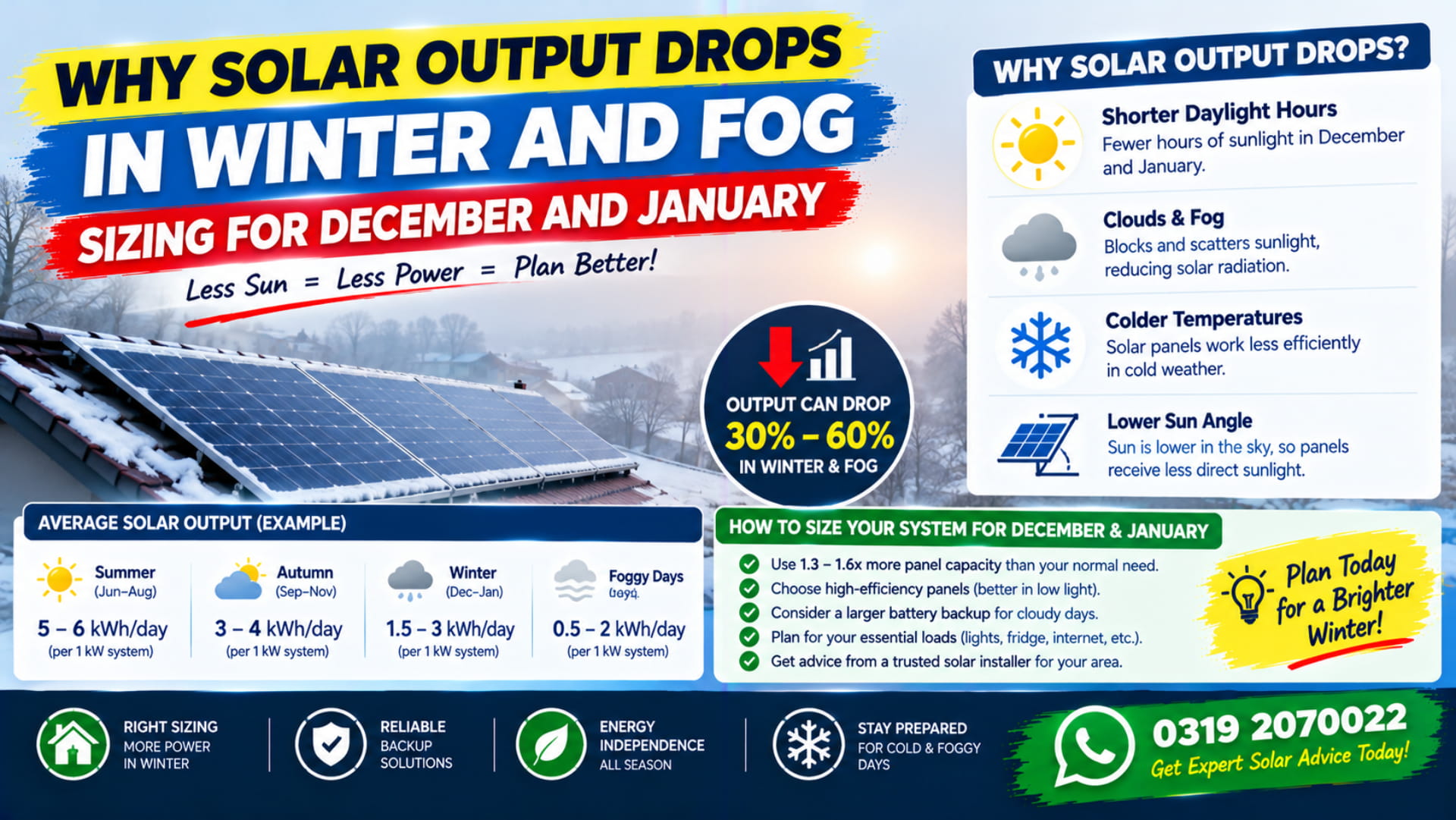
A solar system that comfortably ran the house all summer can suddenly feel undersized in December. Nothing about the inverter or the panels changed. The sun did.
Winter cuts solar generation from three directions at once: a lower sun angle that spreads the same sunlight over a wider effective area, shorter daylight hours, and in Punjab and parts of Sindh, dense fog that can block useful sunlight for days at a stretch. In January 2026, that fog did more than dim the sky. It was named as a direct factor in a nationwide power shortfall, with demand rising roughly 2,000MW on heating load, a shortfall reaching around 4,000MW, forced load-shedding across most of Punjab and Sindh, and officials specifically noting that fog disrupted solar generation, pushing net-metered households back onto grid power exactly when the grid was most strained (Digital Pakistan, 13 January 2026).
That is the gap this guide is for. If your system was sized on a bright April rooftop demo or a summer sales pitch, winter is where the undersizing shows up. Here is how to size the panels, the inverter and the battery bank so December and January still deliver. For a system sized around your actual winter load, WhatsApp 03192070022.
The Three Reasons Winter Output Falls
Lower sun angle. Pakistan sits at a latitude where the winter sun tracks low across the southern sky. Panels mounted flat, or at a shallow angle meant to maximise summer output, receive sunlight at a steeper incidence in winter, which reduces the effective energy striking each panel even on a clear day.
Shorter days. Fewer daylight hours means fewer hours of generation, independent of weather. A system that generates for ten or eleven hours in June may only have seven or eight usable hours in December.
Fog. This is the factor most buyers underestimate, and the one the January 2026 shortfall made visible nationally. Dense fog across central and northern Punjab, and parts of Sindh, can reduce irradiance for days, not hours. A system that depends on a clear sky to hit its rated output can underperform badly during a prolonged fog spell, at the same time that heating load pushes demand up and grid supply gets tighter.
None of these is a fault in your equipment. They are the reason winter sizing is a different calculation from summer sizing, not a smaller version of it.
How Much Does Output Actually Fall?
There is no single number that applies to every roof, because tilt angle, orientation, local fog frequency and panel cleanliness all move the figure. As a planning range, many systems in central and northern Punjab see winter generation fall to somewhere between 40% and 65% of their summer output on an average day, with the lower end of that range showing up during multi-day fog events and the higher end on clear winter days with good tilt.
Southern Punjab, interior Sindh and Balochistan generally see a smaller winter drop than Lahore, Gujranwala or Faisalabad, because fog is less frequent and less dense there. If you are deciding how much headroom to build in, treat your own city’s fog pattern as more important than a national average.
Fix One: Panel Tilt, Not Just Panel Count
The cheapest winter improvement is often adjusting the angle the panels sit at, not adding more panels.
A fixed installation optimised purely for summer is typically mounted closer to flat, which suits the high summer sun but works against the low winter sun. A steeper tilt, closer to your latitude angle plus roughly ten to fifteen degrees, captures winter sun more directly, at a small cost to peak summer output. For a household relying on solar through winter outages, that trade is usually worth making.
If your mounting structure allows a seasonal adjustment, two settings, a shallower one for summer and a steeper one for winter, capture more of both. If it is fixed, choosing the angle at installation time with winter in mind matters more than it is usually given credit for.
Fix Two: Oversize the Panel Array, Not Just the Inverter
This is the single most effective structural fix, and it is also one most buyers skip to save money upfront.
Most hybrid inverters accept a DC panel array well above their rated AC output, commonly in the range of 130% to 200% of the inverter’s capacity. A 5kW hybrid inverter paired with only 5kW of panels will struggle in winter, because the array rarely reaches its rating even in good sun, and falls further behind it on a foggy or hazy day. The same inverter paired with 7kW to 8kW of panels has enough surplus capacity that a cloudy or foggy day still produces a meaningful amount, because the array was never relying on perfect conditions to meet the inverter’s ceiling.
For the correct inverter capacity to build this oversizing around, our what size inverter do I need guide walks through the load calculation, and 3.6kW vs 5kW vs 6kW compares the common capacity tiers directly.
Fix Three: Size the Battery Bank for Winter Demand, Not Summer Demand
Winter changes the load side of the equation as much as the generation side.
Heaters, electric blankets and sometimes an electric geyser add load exactly when solar generation is weakest and grid outages, as the January 2026 event showed, can get longer rather than shorter. A battery bank sized around a mild autumn evening can run out of charge well before a long winter outage ends, especially on a day the panels barely topped up the bank at all.
The practical fix is to size backup duration around your worst realistic winter night, not your average one: fans and lighting plus whatever heating load you intend to run, multiplied by the longest outage you have actually experienced in recent winters, with a safety margin on top. Our how many batteries for a 6kW inverter guide works through that arithmetic for both lead-acid and lithium. Because battery rates move too often to print reliably, WhatsApp us now for the latest price of the battery at 03192070022 for a configuration matched to your winter backup target.
Watch the Heater Load Specifically
Room heaters and electric blankets are resistive loads, which means their running wattage is their full wattage with no startup surge to plan around, but it is often a larger number than buyers expect. A single 2,000W room heater can draw more continuous power than a 1.5 ton air conditioner, and running two or three through a cold evening alongside lighting and a geyser can push a modest system past its continuous rating.
This is also one of the more common causes of a winter overload trip that has nothing to do with low generation. If your inverter trips specifically when heaters are switched on, that is a load problem, not a solar problem, and our guide to inverter overload error and fault codes explains how to tell the two apart before you assume the system itself is failing.
What a Realistic Winter-Ready System Looks Like
Panels oversized relative to the inverter, in the 130% to 200% range discussed above, so a foggy day still produces something rather than nothing.
A tilt angle chosen with winter in mind, not purely for a summer demonstration figure.
A battery bank sized around your longest realistic winter outage with heating load included, not an average evening with none.
An inverter capacity that already accounts for heater and geyser load, reviewed against your actual appliance list rather than assumed from last year’s bill.
A hybrid architecture, so the system can draw from grid, battery and panels together through a weak-generation stretch rather than being an on-grid system that simply has nothing to offer once the sun is gone. Our hybrid inverter price in Pakistan guide covers what that costs at each capacity.
Monitoring Through the Winter Months
A system that performed well in summer deserves a second look once the weather changes, not a set-and-forget assumption that it will keep behaving the same way. Most hybrid inverters with an app or monitoring portal let you check daily generation against the same day last winter, which is a far more useful comparison than checking against last month’s summer figures.
Two things are worth watching specifically through December and January. First, whether the battery bank is reaching a full charge at all during a multi-day fog spell, because a bank that never tops up is quietly losing capacity night after night until an outage finds it empty. Second, whether the inverter is drawing more from the grid than usual to cover load the panels used to handle alone, which is often the first sign that the array’s winter shortfall is larger than the system was built to absorb. Catching either pattern in early December gives you time to add panels or adjust the battery bank before the coldest, foggiest weeks arrive, rather than discovering the gap during the outage itself.
Mistakes That Show Up Every December
Sizing entirely from a summer bill or a summer demo. Both describe the best conditions the system will ever see, not the conditions it most needs to cope with.
Treating fog as an occasional inconvenience rather than a multi-day planning case. A single clear day recovers quickly. A week of fog does not, if the battery bank was never sized to bridge it.
Adding heaters to the load without rechecking inverter capacity. A system that handled summer comfortably can be pushed past its continuous rating by winter heating loads it was never sized around.
Leaving panels at a summer-optimised flat tilt and wondering why winter output is poor. The fix frequently costs nothing beyond labour.
Assuming net metering exports will offset a weak winter month the way they did in summer. Lower generation means less to export, on top of lower self-consumption, and the netting works against you in both directions at once.
Lower sun angle, shorter daylight hours and, in parts of Punjab and Sindh, dense fog all reduce generation. None of these indicate a fault in the equipment.
Significantly, and for longer than people expect. Dense multi-day fog events in Punjab have been reported as a contributing factor in nationwide power shortfalls, not just a local nuisance.
Yes, within what your inverter’s DC input rating allows. Most hybrids accept well above their rated capacity in panels, and that headroom is what keeps winter generation usable.
It can meaningfully change winter output. A steeper angle suited to the low winter sun captures more energy per panel than a shallow summer-optimised angle.
Possibly not, if it was sized around a mild evening without heating load. Recalculate backup duration using your actual winter appliance list and your longest recent outage.
Size Your System for Winter, Not Just Summer
Tell us your city, your current panel and inverter capacity, and which heating appliances you run, and we will tell you honestly whether your system is winter-ready or needs adjusting before the fog season sets in.
WhatsApp 03192070022 for today’s rates on additional panels, a winter-sized battery bank or a full system review.
This guide reflects general seasonal patterns in Pakistan as of October 2026. Local fog frequency, grid conditions and outage duration vary by city and year, so plan around your own recent experience as well as the general pattern described here.