
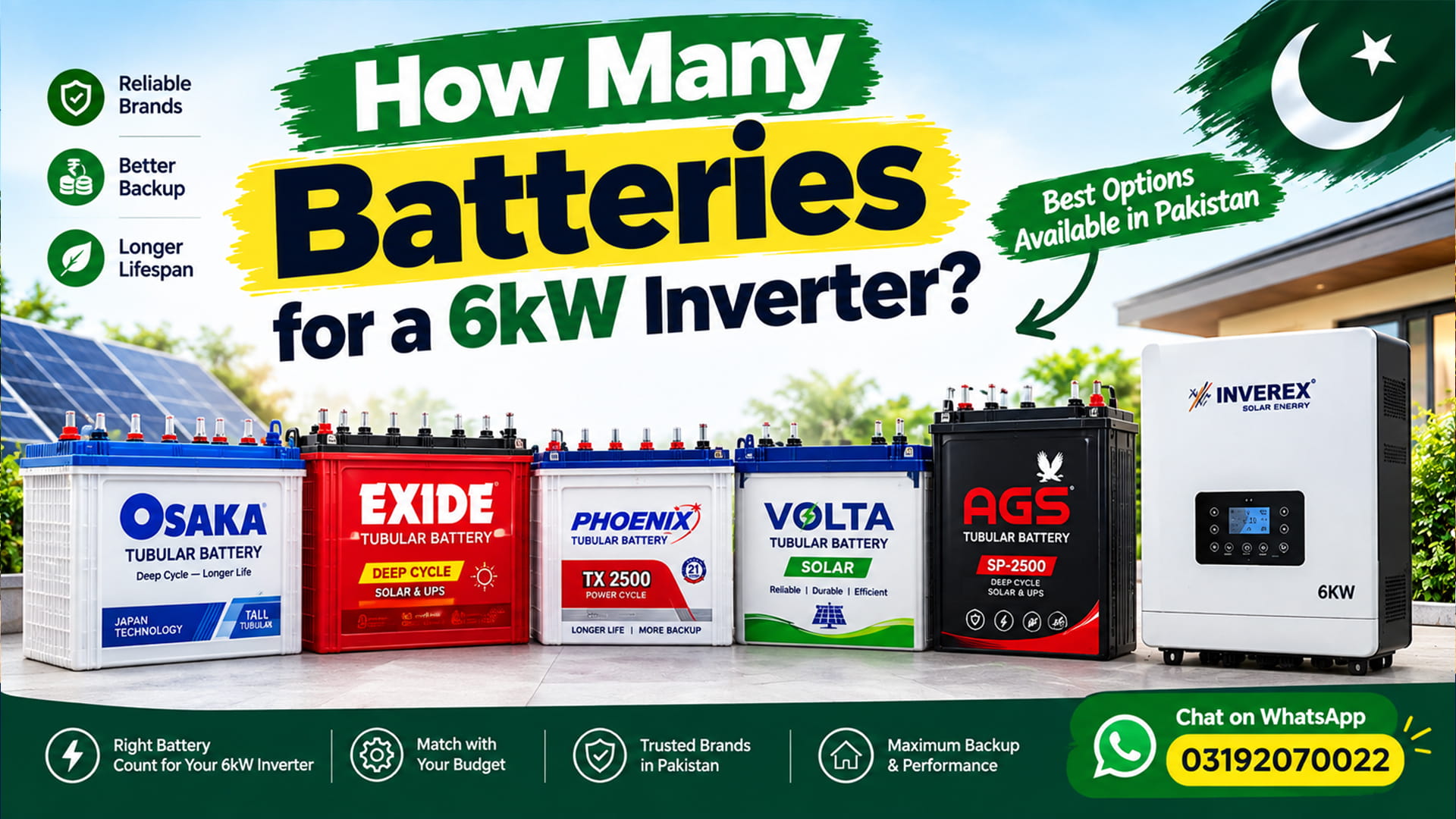
There is no single number, and anyone who gives you one without asking a question first is guessing. The honest answer depends on two things you have to decide before the maths even starts: what voltage your inverter runs at, and how many hours of backup you actually want.
Get those two answers and the battery count falls out of a straightforward calculation. Skip them and you end up either underspending on a bank that lasts ninety minutes, or overspending on capacity you will rarely use.
This guide walks through both the wiring question, how many batteries you need to reach the right voltage, and the capacity question, how many of those groups you need to reach the backup time you want.
For current battery rates once you have your number, WhatsApp 03192070022.
Step 1: Find Your Inverter’s Battery Voltage
Almost every 6kW hybrid inverter sold in Pakistan runs on a 48V battery bus. This is not a coincidence. At 6kW, running the system at a lower voltage like 24V would require impractically high current, thick expensive cable and significant resistive losses. Crown’s Yorker, Xavier and Nexus 6kW units, Sako’s Sunon and Sunpolo range, Inverex, Knox and MaxPower’s 6kW hybrids are all built around 48V.
Check your specific inverter’s label or datasheet before buying anything, since a small number of older or unusual models use 24V, and mixing up the two ruins the calculation that follows.
Everything below assumes the standard 48V system, which covers the overwhelming majority of 6kW installations in the country.
Step 2: How Many Batteries to Build 48V
This is the wiring question, and it is separate from the capacity question. Most deep-cycle batteries sold for inverter use in Pakistan are 12V. To reach 48V, you wire four of them in series, positive to negative, so their voltages add: 12V + 12V + 12V + 12V = 48V.
Four 12V batteries in series is your minimum battery bank for a 48V system, regardless of how much backup time you want. This single string gives you 48V at whatever amp-hour rating the individual batteries carry.
If you want more capacity, you do not add batteries to lengthen the series string. You build a second identical string of four and connect the two strings in parallel, positive to positive and negative to negative. Voltage stays at 48V; amp-hour capacity doubles.
| Bank Configuration | Batteries | Voltage | Capacity Multiplier |
|---|---|---|---|
| One string | 4 | 48V | 1× |
| Two strings in parallel | 8 | 48V | 2× |
| Three strings in parallel | 12 | 48V | 3× |
| Four strings in parallel | 16 | 48V | 4× |
Batteries within a string must be identical in age, brand and capacity. Mixing an old battery into a fresh string drags the whole string down to the weakest unit’s performance and shortens everyone’s life. This is the single most common mistake in DIY battery bank building.
Step 3: Decide How Much Backup You Actually Need
This is where most sizing conversations should start, and where most of them skip straight past.
Work out two numbers: how much load you want to keep running, and for how long. Multiply them and you get the energy requirement in watt-hours, which converts to the amp-hour capacity your bank needs to hold.
Essential-load backup
If your 6kW inverter has dual output, you can split circuits into heavy and essential and drop the air conditioners during an outage. A typical essential load, fans, lights, fridge, router, sits around 700W to 1,000W.
For six hours of essential backup: 800W × 6 hours = 4,800Wh, or 4.8kWh of usable energy.
Full-house backup, AC included
Running one 1.5-ton AC continuously alongside essential load pushes the draw to roughly 2,000W to 2,500W.
For four hours of full backup: 2,200W × 4 hours = 8,800Wh, or 8.8kWh of usable energy.
The difference between these two scenarios is roughly double, and it is entirely a choice about what you want the battery to do. This is why the dual-output feature on modern hybrids matters more than people realise: choosing to back up only essential circuits can halve or better the battery bank you need to buy. Our 6kW solar inverter price in Pakistan guide covers which 6kW models offer this split.
Step 4: Convert Usable Energy Into Battery Count
This is where lead-acid and lithium diverge sharply, and it is the single biggest factor in how many batteries you actually need to buy.
Lead-acid and tubular batteries
Lead-acid batteries should not be discharged past 50% of their rated capacity on a regular basis. Do it anyway and the battery’s usable life drops from years to months. So a 100Ah lead-acid battery gives you roughly 50Ah of usable capacity in practice, not 100Ah.
Nameplate energy of a 12V 200Ah battery is 2.4kWh. Usable energy at 50% depth of discharge is roughly 1.2kWh.
Worked example, lead-acid, essential backup. You need 4.8kWh usable for six hours of essential circuits. At 1.2kWh usable per 12V 200Ah battery, that requires four batteries worth of usable capacity. Since you already need four batteries just to build the 48V string, one string of 200Ah batteries happens to land close to this requirement.
Worked example, lead-acid, full-house backup. You need 8.8kWh usable for four hours including the AC. At 1.2kWh usable per battery, that is roughly seven to eight batteries worth of capacity, meaning two parallel strings of four 200Ah batteries, eight batteries total, comfortably covers it with a small margin.
Lithium (LiFePO4)
Lithium batteries tolerate much deeper discharge safely, typically 80% to 90% of rated capacity, sometimes higher depending on the battery management system. This is the core reason lithium banks are physically smaller and lighter for the same usable energy.
A 48V 100Ah lithium battery holds 4.8kWh nameplate, and at 85% usable depth of discharge that delivers roughly 4.1kWh of genuinely usable energy, more than three times what a similarly rated lead-acid bank delivers per unit of nameplate capacity.
Worked example, lithium, essential backup. You need 4.8kWh usable. A single 48V 100Ah lithium unit, delivering around 4.1kWh usable, gets you close, and most installers would recommend one such unit or step up slightly to 120Ah for comfortable margin.
Worked example, lithium, full-house backup. You need 8.8kWh usable. Two 48V 100Ah lithium units in parallel, delivering roughly 8.2kWh combined usable energy, cover this comfortably, or a single larger 200Ah unit where available.
Lithium units are typically sold as complete, self-contained 48V modules rather than as individual cells you wire yourself, so the “how many” question for lithium is usually about how many complete units to parallel, not how many individual cells to string together. Most modules parallel easily, often up to four to eight units on a single inverter depending on the model’s specification.
Quick Reference Table
| Backup Goal | Lead-Acid (12V 200Ah) | Lithium (48V 100Ah module) |
|---|---|---|
| Essential load, 4–6 hours | 4 batteries (1 string) | 1 unit |
| Essential load, 8–10 hours | 8 batteries (2 strings) | 2 units |
| Full house incl. AC, 3–4 hours | 8 batteries (2 strings) | 2 units |
| Full house incl. AC, 6–8 hours | 12–16 batteries (3–4 strings) | 3–4 units |
| Overnight full coverage, 10+ hours | 16+ batteries (4+ strings) | 4+ units |
These figures are working estimates for typical Pakistani household loads and standard battery ratings. Your exact numbers shift with your specific appliance list, your battery’s actual Ah rating, and how conservatively you want to size the bank. Treat this table as a starting point for a conversation, not a final answer.
Why Lithium Needs Fewer Batteries for the Same Job
Three things compound to make lithium banks physically smaller than equivalent lead-acid banks.
Deeper usable discharge, 80% to 90% against lead-acid’s 50%, roughly doubles the usable energy per unit of nameplate capacity on its own.
Lithium cells also hold their voltage flatter across the discharge curve, meaning the inverter draws rated performance for nearly the full usable capacity instead of tapering off as lead-acid does toward the end of its discharge.
And lithium tolerates far more charge and discharge cycles before capacity degrades meaningfully, often 3,000 to 6,000 cycles against 300 to 500 for a decent tubular lead-acid battery, which means the effective lifetime cost per usable kilowatt-hour favours lithium even though the upfront unit cost is higher.
None of this means lead-acid is the wrong choice. For many households the lower upfront cost and wide local availability of lead-acid batteries make more sense, particularly for shorter backup windows where the battery count difference is smaller. The gap widens as your backup target grows.
Pricing on both battery types moves substantially with the market, and lithium in particular shifts week to week. WhatsApp us now for the latest price of the battery at 03192070022.
Wiring Considerations for a Multi-String Bank
Match every battery in a string. Same brand, same capacity, same age. A single weaker battery drags the whole string down and shortens its neighbours’ lives.
Balance the parallel connections. When you parallel two or more strings, connect them so that cable length and resistance are equal to each string, or one string will do more work than the others and wear out first. A busbar arrangement handles this properly; connecting strings directly to opposite corners of a single battery bank does not.
Fuse every string individually. A fault in one string should not be able to draw current from every other string through it. This is a basic safety requirement, not an optional extra.
Confirm your inverter’s maximum charge current supports the bank you are building. A large lead-acid bank needs proportionally more charging current to recharge in a reasonable window, and an inverter with a modest charge controller can leave a big bank chronically undercharged, which shortens battery life regardless of how well it is wired.
Ventilate lead-acid batteries properly. Flooded and some tubular types release hydrogen gas during charging. The room needs airflow. Lithium units do not have this requirement, which is one reason they suit tighter installation spaces.
For guidance on sizing the inverter itself before you get to the battery bank, our complete inverter sizing guide covers load calculation in full, and our Crown Nexus 6KW price in Pakistan guide covers a 6kW model built specifically with proper lithium BMS communication if that is the direction you are heading.
Common Mistakes
Sizing the battery bank before sizing the backup goal. Decide what you want to keep running and for how long first. Everything else follows from that.
Assuming lead-acid and lithium need the same battery count. They do not, often by a factor of two or more, because of the discharge depth difference.
Mixing old and new batteries in the same string. This shortens the life of the entire string, not just the weak battery.
Undersizing the charge controller relative to the bank. A big battery bank that never fully recharges between outages degrades faster than a smaller, properly charged one.
Forgetting that dual output can halve your requirement. If your inverter supports load splitting, backing up only essential circuits is a legitimate way to reduce the battery bank significantly rather than a compromise. Our hybrid inverter price in Pakistan guide covers which models offer this feature across every capacity.
A minimum of four, wired in series to reach the 48V most 6kW inverters run on. The actual count depends on your desired backup hours, commonly eight for a few hours of full-house backup including an AC, or four for several hours of essential-only backup.
Not if your inverter runs at 48V, since you need four 12V batteries in series just to reach that voltage. Two batteries in series only gives you 24V, which is incompatible with a 48V system.
Typically one to four complete 48V lithium modules depending on backup target, since lithium units deliver far more usable energy per unit than lead-acid and are sold as complete parallel-capable modules rather than individual cells.
Lithium needs fewer units for the same usable backup, lasts far more charge cycles, and does not require the ventilation lead-acid does. Lead-acid costs less upfront and is more widely available. Both are valid depending on budget and how much backup you want.
Depends entirely on what you are running against how much usable capacity you have installed. Essential circuits only stretch a modest bank for many hours; running an AC continuously drains the same bank in a fraction of the time.
Yes, within each series string. Different ages or capacities in the same string shorten the whole string’s usable life.
This requires a substantially larger bank than essential-only backup, often 12 to 16 lead-acid batteries or 3 to 4 lithium units for a full night. Consider whether running the AC on grid or solar during the day and reserving battery for essential circuits overnight is the more practical approach.
Battery rates change too frequently to publish accurately, and pricing varies significantly between lead-acid and lithium and between brands. WhatsApp us now for the latest price of the battery at 03192070022.
Get Your Battery Bank Sized Properly
Tell us your 6kW inverter’s battery voltage, whether it supports dual output, and how many hours of backup you want along with what you want running during that time. That is enough for us to tell you exactly how many batteries you need and in what configuration, lead-acid or lithium.
WhatsApp 03192070022 for current battery rates and a sizing recommendation, or browse our current stock on the products page.
Sizing figures reflect typical battery ratings and Pakistani household loads as of September 2026. Confirm exact specifications against your specific inverter and battery model before purchasing.