
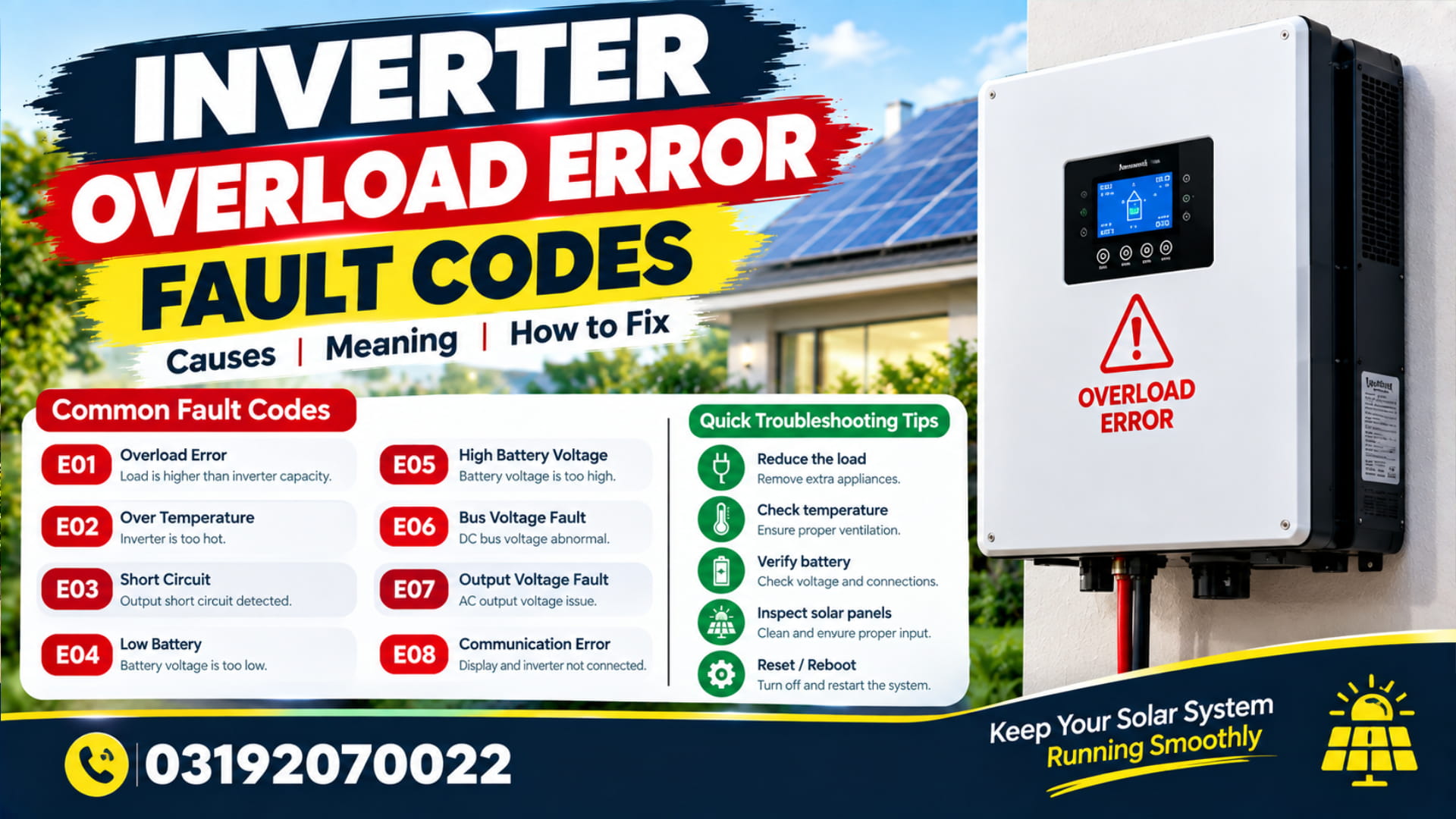
An overload trip is the inverter doing exactly what it is designed to do. Something asked it for more current than it is rated to deliver safely, and it shut the output down rather than let its internal components overheat or fail. That is a protection working correctly, not the inverter breaking.
The frustrating part is that the message on the display rarely tells you which of several very different causes triggered it. Genuine overload, a motor’s starting surge, a short circuit, or a fault buried somewhere in the wiring can all show the same “overload” icon or code. Sorting out which one you are dealing with is the point of this guide.
Some of the checks below involve mains AC and battery-connected wiring. Read the safety note before you start.
Safety First
Switch the inverter’s output off, or isolate the affected circuit at the breaker, before inspecting any wiring or connected equipment. An overload trip means significant current was flowing a moment ago, and components can stay warm for some time after the protection kicks in.
If the trip was accompanied by a burning smell, visible smoke, scorch marks, or a tripped main breaker that will not reset even with everything disconnected, stop troubleshooting and call a technician. That combination points to a wiring fault or a failed component rather than something you can safely diagnose by testing loads one at a time.
If your inverter has repeatedly tripped on overload within a short period, give it a few minutes before attempting a reset. Restarting immediately into an unresolved fault repeatedly stresses the same components that just protected themselves.
What “Overload” Actually Means
Every inverter has two power figures that matter here, and confusing them is where most overload confusion starts.
Continuous rating. What the inverter can supply indefinitely. This is the number on the box, 5kW, 6kW, and so on.
Surge rating. What the inverter can supply briefly, usually one to five seconds, to handle the startup current of motors and compressors. This is typically 1.5 to 3 times the continuous rating, and it varies significantly between models.
An overload trip happens when demand exceeds whichever of these two limits applies at that moment, for longer than the inverter is designed to tolerate. A genuine overload is steady load that simply exceeds the continuous rating. A surge-related trip is a brief spike, usually from something starting, that exceeds the surge rating or lasts longer than the surge window allows.
These need different fixes entirely, which is why the next section separates them.
Cause 1: Genuine Overload, Too Much Steady Load
This is the straightforward case. Add up everything running at once and it exceeds the inverter’s continuous rating.
Common contributors: two air conditioners plus a water pump plus a washing machine all running together, a workshop machine added to a system that was never sized for it, or a household that has simply grown since the inverter was installed, a second AC unit added, a tenant moved in, a home business started drawing extra load.
How to check. Note what was running at the moment of the trip. Add up the approximate wattage of each item. If the total genuinely exceeds the inverter’s rated continuous output, this is your answer, and the fix is reducing simultaneous load or upgrading capacity, not further troubleshooting.
Our complete inverter sizing guide walks through the load calculation properly if you suspect your system was undersized from the start rather than newly overloaded.
Cause 2: Motor Starting Surge
This is the single most common cause of an overload trip on an otherwise correctly sized system, and it is also the most misunderstood.
Anything with a motor, a water pump, a non-inverter air conditioner’s compressor, a washing machine, an older refrigerator, draws far more current for a second or two at startup than it does while running. A 1HP water pump running at 750W can spike to 2,500W on startup. A non-inverter AC compressor can spike to three times its running load.
If that surge lands on top of load that is already close to the inverter’s continuous rating, the combined instantaneous demand can exceed the surge rating and trip the protection, even though nothing was individually excessive.
How to check. Does the trip happen at a predictable moment, specifically when a pump, motor or compressor kicks in, rather than randomly? If the timing lines up with something starting, this is very likely a surge issue rather than a genuine overload.
Our inverter for 1.5-ton AC guide covers this specific interaction in detail, since air conditioner type, inverter compressor versus non-inverter compressor, is one of the most common sources of exactly this problem.
The fix. Stagger appliance startup rather than switching several things on together. If the issue is a specific non-inverter appliance, check whether it can be scheduled to avoid running alongside the AC. If it happens routinely and cannot be avoided, the inverter may be undersized for your actual surge profile even though its continuous rating looks adequate on paper, and a model with a higher surge-to-continuous ratio may be the real fix.
Cause 3: Short Circuit or Wiring Fault
A genuine short circuit downstream of the inverter can trip the overload protection because the fault draws far more current than any normal load would, and some inverters do not distinguish clearly between “too much normal load” and “a dead short” in the message they display.
Warning signs this is the cause rather than genuine overload. The trip happens immediately on power-up before any significant load is even switched on. The trip happens with only a small, known load connected that should not be anywhere near the rated capacity. A specific circuit or socket trips the inverter every time it is used, regardless of what is plugged into it.
How to check. Disconnect all loads from the affected output entirely and attempt to power the inverter with nothing connected. If it still trips or shows a fault with zero load, the problem is very likely internal to the inverter rather than the wiring, and this points toward Cause 5 below. If it powers up cleanly with nothing connected, reconnect circuits one at a time, waiting between each, until the fault reappears. That isolates which circuit or appliance is the actual source.
This kind of fault-finding involves handling live AC wiring safely. If you are not confident doing this yourself, this is a reasonable point to call a technician rather than continue.
Cause 4: A Specific Faulty Appliance
Sometimes the inverter is fine, the wiring is fine, and one specific appliance has developed an internal fault, a failing motor winding, a degraded capacitor, or an insulation breakdown, that causes it to draw abnormal current.
How to check. If isolating circuits in the process above points to a single device rather than a whole circuit, unplug that device specifically and test the rest of the circuit normally. An appliance that trips the inverter even when nothing else significant is running is a strong signal that the appliance itself, not the inverter, needs attention or replacement.
Cause 5: Split Output Imbalance
If your inverter has dual output, splitting circuits into heavy and essential loads, it is possible for one output to be overloaded while the inverter’s total capacity has plenty of headroom left on the other side. The display may show an overload fault that looks like a whole-system problem when it is actually confined to one output.
How to check. If your inverter shows separate readings or fault indicators per output, check which one triggered. If everything that trips the fault is connected to a single output circuit, redistributing some load to the other output, if your wiring allows it, may resolve the issue without any capacity upgrade at all.
Cause 6: A Deeper Internal Fault
If the inverter trips on overload with genuinely minimal or no load connected, and this happens consistently rather than as a one-off, the cause has likely moved from “something outside the inverter is demanding too much” to “something inside the inverter is malfunctioning.”
Common internal causes include a failed cooling fan causing the unit to overheat and misreport as an overload condition rather than a thermal one, a degraded power transistor or IGBT module that can no longer handle its rated current cleanly, or a firmware fault following a previous severe overload event that has left the protection logic in an incorrect state.
This is where DIY troubleshooting should stop. None of these are safely diagnosable without opening the enclosure and testing components directly, and doing so also voids most warranties. If you have ruled out load, surge, wiring and a specific appliance, and the fault persists, this is a technician or a warranty claim, not a continued self-diagnosis.
Reading the Display
Exact fault codes and their wording vary meaningfully between manufacturers, and giving you a made-up universal code table would do more harm than good. What is broadly consistent across most hybrid inverters sold in Pakistan is the category of message, something along the lines of an “overload,” “Ovld,” or “OL” indicator, sometimes numbered as a specific fault code in the unit’s manual.
Note the exact wording or code shown, and check it against your specific model’s manual before assuming a cause. The manual’s fault code table, not a generic online guide, is the authoritative source for what that particular code means on your particular inverter, since the same abbreviation can mean subtly different things between brands.
If you cannot locate your manual, the model number on the inverter’s serial plate combined with a search for the manufacturer’s published fault code list is usually faster than guessing.
Preventing Repeat Trips
Stagger heavy appliance startup. Do not switch the AC, the pump and the washing machine on within the same few seconds. A five to ten second gap between starting large appliances gives the inverter room to absorb each surge separately rather than stacking them.
Know your surge-heavy appliances. Non-inverter air conditioners, older refrigerators, and motor-driven pumps are the usual suspects. If your household has several of these, size the inverter to their combined surge profile, not just their combined running load. Our hybrid inverter price in Pakistan guide covers models with stronger surge ratings if this is a recurring issue for you.
Use dual output deliberately if your inverter supports it. Splitting heavy, surge-prone appliances across two outputs, where your wiring allows it, reduces the chance of stacked surges tripping the whole system.
Keep the inverter clean and ventilated. A unit running hotter than it should due to dust or poor airflow has less thermal margin before a marginal load looks like an overload to its protection circuitry.
Do not ignore repeated trips as a nuisance. A system that overloads occasionally under genuinely excessive load is working as designed. A system that overloads repeatedly under normal, previously fine conditions is telling you something has changed, in the load, the wiring, or the inverter itself, and is worth investigating before it becomes a bigger failure.
When to Call a Technician
Call rather than continue troubleshooting if: the trip happens with no load or minimal load connected, you smell burning or see scorch marks anywhere near the inverter or wiring, the fault will not clear even after a proper cool-down period and reset, you have isolated the cause to internal wiring or a specific circuit and are not confident working with live AC safely, or the same fault keeps recurring despite reducing load and staggering appliance startup.
None of this reflects poorly on your troubleshooting. Overload faults sit exactly at the point where continued guessing risks damaging expensive equipment further, which is the right moment to bring in someone qualified.
If the underlying issue turns out to be genuine undersizing rather than a fault, current stock and specifications for a properly sized replacement are on our products page, and this often pairs with a battery review if the system was recently upgraded, covered in our inverter not charging battery troubleshooting guide if charging issues are showing up alongside the overload faults.
Most often a motor starting surge, not a genuine overload. Check whether the trip coincides with a pump, compressor or motor starting rather than steady running load.
No, the trip itself is the protection working correctly. It becomes a concern only if it happens with minimal load, will not clear, or is accompanied by burning smell or visible damage.
For an occasional, explainable trip, yes. Repeated resets without addressing the cause risk further stressing components that are already working harder than intended.
This points to the AC’s starting surge exceeding available headroom at that moment, especially likely if it is a non-inverter model. Staggering the AC’s startup away from other heavy loads, or checking whether the inverter’s surge rating suits the appliance, are the next steps.
Not necessarily. It can mean the system is correctly sized for continuous load but the combination of several things starting together exceeds momentary surge capacity, which is a different problem with a different fix.
Battery rates change too frequently to publish accurately. WhatsApp us now for the latest price of the battery at 03192070022, and we can also quote a replacement inverter if that turns out to be needed.
Still Tripping?
Tell us the exact wording or code on your display, what was running when it happened, and whether the trip clears with a reset or keeps recurring. That is usually enough for us to narrow down the likely cause before arranging a technician visit if one is needed.
WhatsApp 03192070022 for troubleshooting help.
This guide covers general overload behaviour common to most hybrid inverters sold in Pakistan. Always check your specific model’s manual for exact fault code meanings, and do not attempt any repair involving live AC wiring or internal components without appropriate training.