
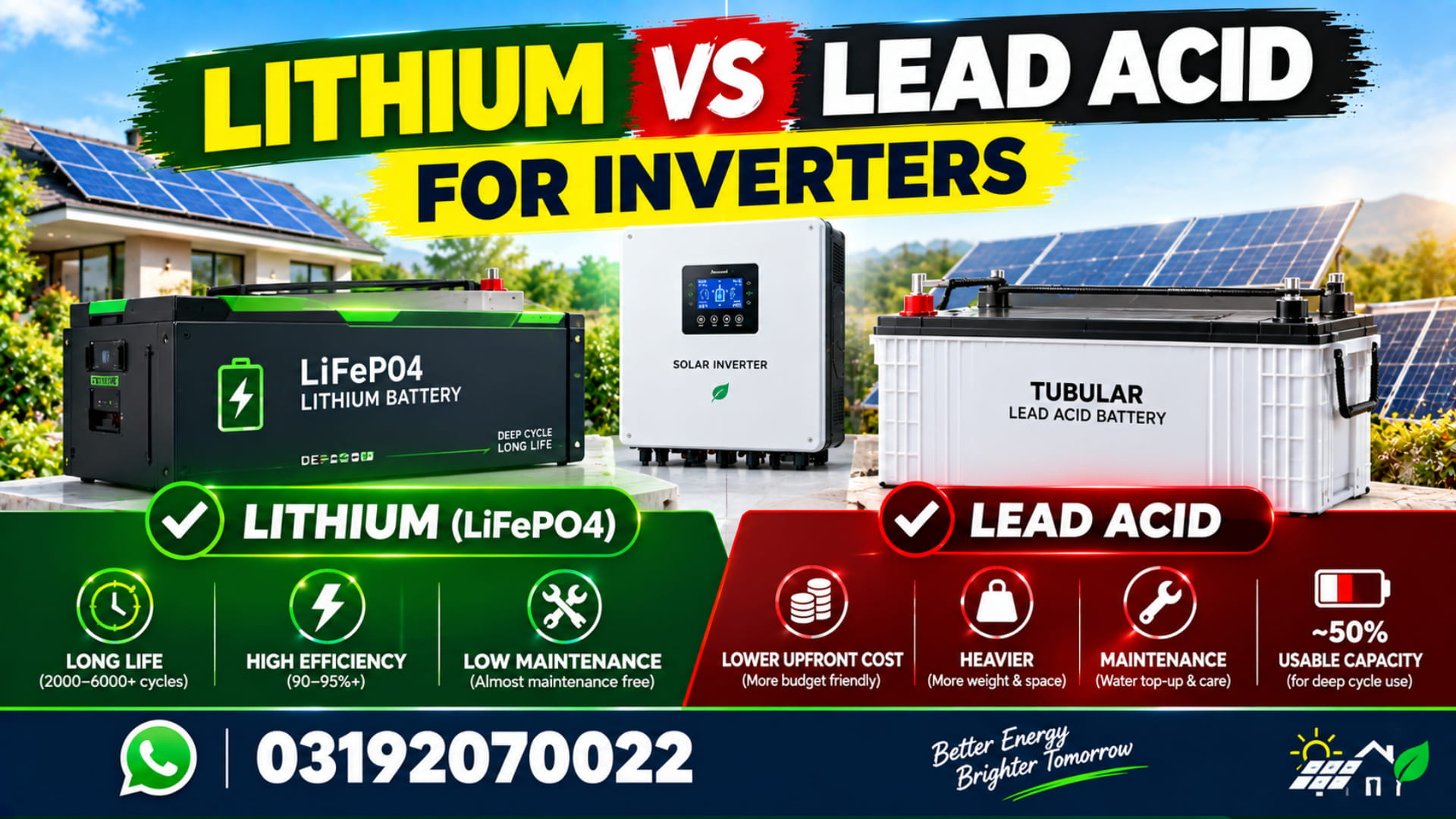
This is not a question with one right answer, whatever a lithium salesperson or a tubular battery dealer will tell you with equal confidence. Both chemistries are genuinely good at what they do. The right choice depends on how you actually use the system, how much space and weight you have to work with, and how you weigh a higher upfront cost against a longer, lower-maintenance life.
This comparison sticks to the technical differences that actually matter for inverter use in Pakistan, without pretending one chemistry wins every category. For current rates on either battery type, WhatsApp 03192070022.
The Quick Comparison
| Factor | Lead-Acid / Tubular | Lithium (LiFePO4) |
|---|---|---|
| Usable depth of discharge | 50% recommended | 80% – 90% typical |
| Cycle life | 300 – 500 cycles | 3,000 – 6,000 cycles |
| Weight for same usable capacity | Heavy | Roughly one-third to one-quarter |
| Physical footprint | Large | Compact |
| Maintenance | Water topping on flooded types, terminal cleaning | Effectively none |
| Charging speed | Slower, tapered | Faster, flatter curve |
| Round-trip efficiency | Roughly 80% – 85% | Roughly 95% |
| Ventilation requirement | Needed for flooded and some tubular types | Not required |
| Upfront cost per nameplate capacity | Lower | Higher |
| Typical lifespan | 3 – 5 years | 8 – 12 years or more |
Neither column is universally “better.” A short backup requirement with light daily use makes lead-acid’s lower upfront cost genuinely sensible. A system cycling daily, running for years, or squeezed into a small installation space tips the calculation firmly toward lithium. The rest of this guide explains why, one factor at a time.
Depth of Discharge: The Number That Changes Everything
This is the single biggest practical difference between the two chemistries, and it affects every other comparison on this page.
Lead-acid batteries should not be regularly discharged below 50% of their rated capacity. Do it anyway and the battery’s usable life drops sharply, sometimes to a fraction of its rated years. So a battery labelled 200Ah delivers roughly 100Ah of capacity you can actually use on a regular basis without shortening its life.
Lithium, specifically LiFePO4, the chemistry used in nearly all solar and inverter battery packs sold in Pakistan, tolerates discharge to 80% or even 90% of rated capacity without the same life penalty. A battery with the same 200Ah nameplate rating delivers roughly 160Ah to 180Ah of genuinely usable capacity.
That means a lithium bank rated at roughly half the nameplate capacity of a lead-acid bank can deliver similar real-world backup time. Our how many batteries for a 6kW inverter guide walks through this arithmetic in detail with worked examples, since it is the calculation that actually determines how many batteries either chemistry requires for a given backup target.
Cycle Life: How Long Before Capacity Fades
A cycle is one full discharge and recharge. Every rechargeable battery loses a small amount of capacity with each cycle, and how many cycles it tolerates before capacity drops to an unusable level is the real measure of lifespan, more meaningful than a simple age-in-years figure.
Decent tubular lead-acid batteries typically manage 300 to 500 cycles at their recommended depth of discharge before capacity has degraded significantly. Cheaper flooded batteries can fall well short of that.
LiFePO4 lithium batteries typically manage 3,000 to 6,000 cycles, sometimes more depending on the specific cell quality and how conservatively the battery management system manages charge and discharge.
In a household that experiences daily or near-daily outages, and therefore cycles its battery bank regularly, this difference compounds fast. A lead-acid bank cycling once a day can reach the end of its useful life within two to three years. A lithium bank under the same usage pattern can comfortably outlast a decade.
For a household that only cycles occasionally, a handful of outages a month rather than daily, the cycle life gap matters far less in practice, since neither chemistry is likely to reach its cycle limit before other factors, corrosion, connector wear, general age, become the limiting issue anyway.
Weight and Space
This rarely makes anyone’s shortlist of deciding factors until they are physically trying to fit a battery bank into a small utility room or carry batteries up a narrow staircase, at which point it becomes the deciding factor immediately.
A lead-acid bank sized for a meaningful backup target is genuinely heavy, often requiring a dedicated floor-mounted position with real structural consideration if installed anywhere above ground level. Lithium packs delivering equivalent usable capacity typically weigh a fraction as much and take up meaningfully less floor space, which matters in urban homes and apartments where a dedicated battery room is not a luxury everyone has.
Maintenance
Flooded lead-acid batteries need periodic water topping to replace electrolyte lost through normal gassing during charging, and neglecting this shortens battery life significantly. Sealed lead-acid types, AGM and GEL, avoid this specific requirement but still benefit from periodic terminal inspection and cleaning, and all lead-acid types are sensitive to being left at a low state of charge for extended periods.
Lithium battery packs are effectively maintenance-free in normal operation. No water topping, no risk of sulfation from being left partially discharged, and the battery management system handles cell balancing internally without any owner intervention required.
For anyone who travels, rents out a property, or simply does not want an item on their household maintenance checklist, this difference is worth weighing seriously against the upfront cost gap.
Charging Speed and Efficiency
Lead-acid batteries need a tapered charging profile, bulk, absorption, then float, and accepting charge slows noticeably as the battery approaches full. This means a lead-acid bank can take considerably longer to return to full charge after a deep discharge than its charging current alone would suggest.
Lithium accepts charge at a much flatter rate across most of its capacity range and generally reaches full charge faster for a given charging current. Round-trip efficiency, how much of the energy you put in comes back out as usable power, also favours lithium meaningfully, typically around 95% against roughly 80% to 85% for lead-acid. In a solar system, that efficiency gap means more of your panel generation actually ends up available to use rather than lost as heat during charging and discharging.
Heat Tolerance: A Point Worth Correcting
There is a common assumption that lead-acid handles Pakistani summer heat better than lithium. In practice it is closer to the opposite, and this is worth stating plainly since it runs against what many buyers expect.
High ambient temperature accelerates internal corrosion in lead-acid batteries and speeds up water loss in flooded types, both of which shorten usable life. A lead-acid battery that might last five years in a moderate climate can see that shortened noticeably by consistent exposure to Pakistani summer heat, particularly if installed somewhere with poor ventilation.
LiFePO4 lithium is a comparatively heat-stable chemistry relative to other lithium types, and it holds up reasonably well in hot conditions. That said, extreme heat still affects it, most battery management systems will throttle or pause charging at very high internal temperatures as a protective measure, which is the system working as intended rather than a fault. Installing either chemistry somewhere shaded and ventilated, rather than a sealed room that traps heat, extends the working life of both.
Safety
Worth addressing directly, since lithium’s safety reputation is coloured heavily by a different chemistry entirely.
The lithium batteries associated with laptop and phone fires in the public imagination are typically a different chemistry, lithium cobalt oxide or NMC, chosen for those applications because of high energy density in a small package. LiFePO4, the chemistry used in essentially all solar and inverter battery packs, is significantly more thermally stable and considerably more resistant to the kind of thermal runaway that makes headlines. A quality LiFePO4 pack with a properly functioning battery management system is a safe, well-understood technology for stationary home energy storage.
Lead-acid carries its own, different safety considerations. Flooded types release hydrogen gas during charging, which needs adequate ventilation to avoid any risk of accumulation. The electrolyte is corrosive and requires careful handling during any maintenance. Neither chemistry is inherently dangerous when installed and maintained correctly; both require respecting their specific requirements.
Compatibility With Your Existing Inverter
Not every inverter communicates properly with a lithium battery management system. Older units, and some budget models, estimate battery charge from voltage alone, which works reasonably for lead-acid but poorly for lithium, since lithium voltage stays nearly flat across most of its usable range and does not reveal true state of charge the way lead-acid voltage does.
If you are considering a lithium upgrade on an existing inverter, confirm it has genuine BMS communication support, usually over RS485 or a similar protocol, rather than assuming “lithium compatible” on a spec sheet means proper communication rather than basic voltage-based charging. Our Crown Nexus 6KW price in Pakistan guide and our Sako Sunon Pro 5.5KW price guide both cover models built with proper lithium BMS support if a new inverter is part of the plan alongside a battery upgrade.
Total Cost Over Time
Lithium costs more upfront per unit of nameplate capacity than lead-acid, sometimes considerably more. But nameplate capacity is not the number that matters, usable capacity over the battery’s full working life is.
Once you account for lithium’s deeper usable discharge, longer cycle life, and higher round-trip efficiency, the cost per unit of energy actually delivered over the battery’s lifetime often narrows significantly compared to the gap in sticker price, and in systems that cycle daily over many years, lithium frequently works out cheaper in total despite costing more to buy. In systems that cycle rarely, lead-acid’s lower upfront cost is harder to argue against, since the battery is less likely to reach the point where lithium’s longevity advantage pays off.
Because pricing on both battery types shifts substantially with the market, particularly lithium, any specific figures would be stale within weeks. WhatsApp us now for the latest price of the battery at 03192070022 to compare current rates for your specific capacity target.
Which One Fits Your Situation
Choose lead-acid if: your backup needs are occasional rather than daily, your upfront budget is the primary constraint, you have adequate ventilated space for a larger bank, and you are comfortable with basic periodic maintenance.
Choose lithium if: you cycle the battery regularly, whether from frequent outages or from using it as a genuine daily energy source rather than pure backup, you have limited installation space, you want to avoid ongoing maintenance entirely, or you are planning for a system that needs to perform reliably for a decade or more without replacement.
Our hybrid inverter price in Pakistan guide covers which inverter models across every capacity properly support lithium if that is the direction you are heading, and current stock for both inverters and compatible batteries is on our products page.
Not universally. Lithium wins on cycle life, usable capacity, weight and maintenance. Lead-acid wins on upfront cost and remains a sensible choice for occasional, light backup use.
Lithium typically lasts 8 to 12 years or more with regular use. Quality lead-acid typically lasts 3 to 5 years, shorter if regularly discharged past 50% or exposed to consistent high heat.
Yes, provided it is LiFePO4 chemistry with a properly functioning battery management system, which describes essentially all solar and inverter battery packs sold for this purpose. This chemistry is significantly more thermally stable than the lithium types associated with consumer electronics fires.
Only if your inverter supports genuine lithium BMS communication rather than basic voltage-based charging. Confirm this specifically before purchasing, since a mismatch can lead to poor charging behaviour or reduced battery life.
No, generally the opposite. High heat accelerates corrosion and water loss in lead-acid batteries, often shortening their working life more than it affects a properly managed LiFePO4 lithium pack.
Get the Right Battery for Your System
Tell us your inverter model, how often you experience outages, and how much backup time you want. That is enough for us to recommend lead-acid or lithium honestly, based on your actual usage rather than whichever has the better margin.
WhatsApp 03192070022 for current rates on both battery types.
Comparisons reflect typical LiFePO4 lithium and tubular lead-acid battery performance as of September 2026. Actual lifespan and performance vary by brand, installation conditions and usage pattern.