
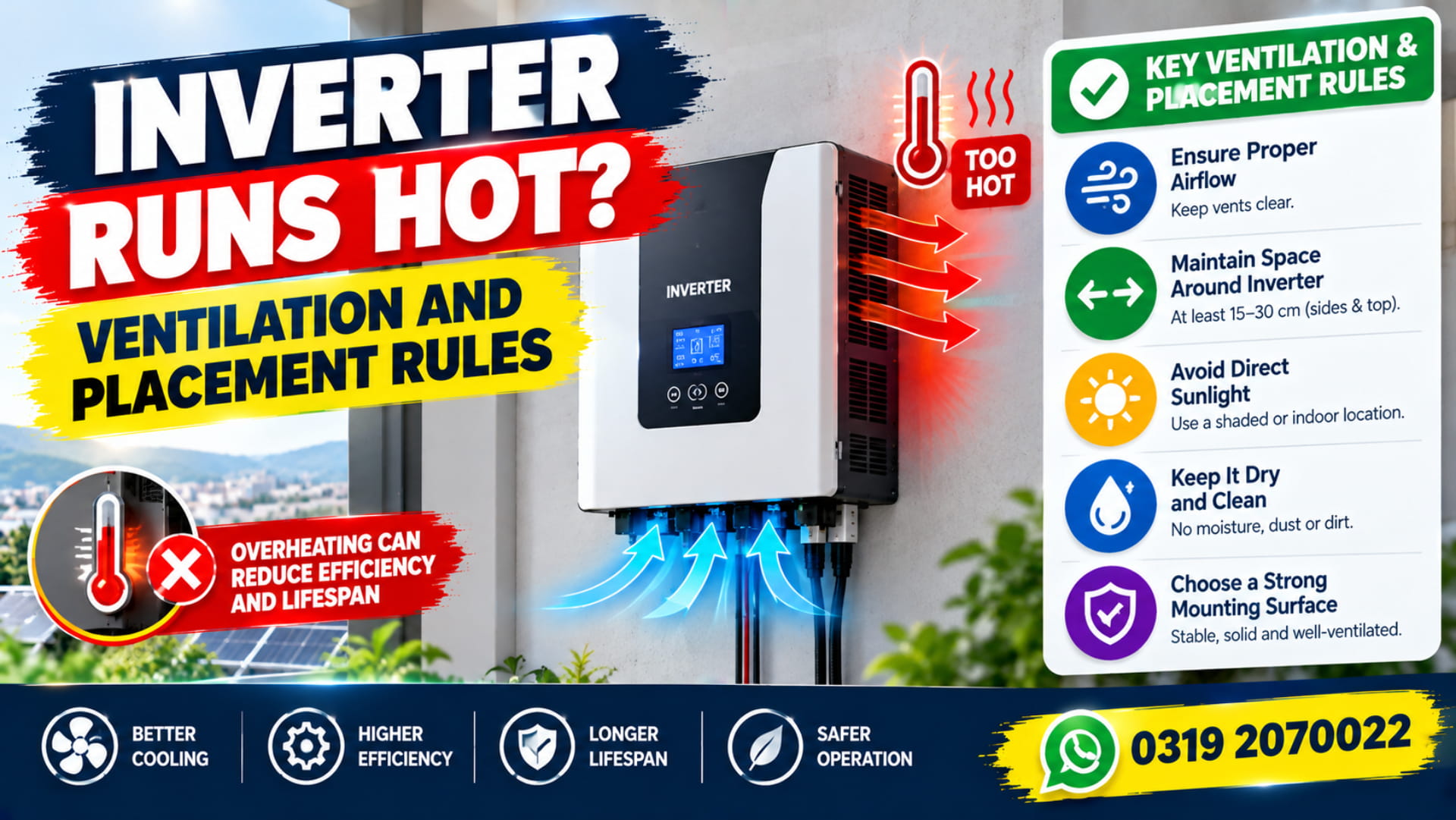
Heat is the quietest way an inverter dies in Pakistan. Nothing dramatic happens on the day of installation. The unit works, the fans spin, the display looks normal. Then a summer passes, and another, and one afternoon in June the unit trips at the hottest hour and never comes back properly.
Most of those failures are not manufacturing faults. They are installation decisions made in March, when nobody was thinking about a 47°C afternoon in Multan or a sealed store room with the door shut. Where you mount the inverter and how much air it can move matter as much as which brand you bought.
This guide explains why heat shortens inverter life, what correct placement looks like, and the mounting mistakes we see most often. For help choosing a unit suited to your mounting position, WhatsApp 03192070022.
Why Heat Matters More Than Buyers Expect
An inverter converts DC to AC, and no conversion is perfectly efficient. The few percent that is lost leaves as heat, inside a sealed or semi-sealed box, often mounted on a wall in a country where ambient temperatures sit above 40°C for weeks at a time.
Three things follow from that.
Component life shortens as temperature rises. Electrolytic capacitors are the usual weak point in any power electronics, and their rated life falls substantially as operating temperature climbs. A unit running consistently hot ages faster than the same unit running cool, even when neither ever trips.
Output falls when the unit gets too hot. Most inverters reduce their output rather than fail outright when internal temperature climbs past a threshold, a behaviour usually called derating. This is a protective feature, and it means a hot inverter quietly delivers less than you paid for, often at exactly the hour you need the most, when the air conditioners are running and the sun is at its strongest.
Thermal shutdown is the last resort. Push further and the unit stops to protect itself. If your inverter trips on hot afternoons and recovers in the evening, heat is the first thing to investigate, not the last. Our guide to inverter overload error and fault codes covers how to tell a genuine overload from a thermal trip, because they are frequently confused.
Ambient Temperature Is Not the Same as Enclosure Temperature
This is the single most useful idea in this article.
A datasheet may list an operating range up to 55°C or 60°C. Buyers read that and assume a 45°C afternoon is comfortably inside spec. But the number that matters is the temperature of the air immediately around the inverter, not the temperature on the weather forecast.
A unit mounted on a west-facing wall in direct afternoon sun, inside a small room with the door closed and no cross-ventilation, can sit in air considerably hotter than the outdoor shade temperature. Add the heat the inverter itself is producing, with nowhere for it to go, and the air around the heat sink climbs further. The room becomes an oven that the inverter is helping to heat.
The practical conclusion: you are not trying to keep the outdoor temperature down. You are trying to make sure the hot air the inverter produces leaves the space, and cooler air replaces it.
Clearance: How Much Space the Unit Actually Needs
Every manufacturer specifies minimum clearances around the unit, and those figures differ between models. Check the manual for your specific inverter rather than relying on a general rule, because a sealed outdoor unit and an open-frame indoor unit have different requirements.
That said, the pattern is consistent in principle:
- Above the unit: the largest clearance, because hot air rises and needs a path away from the casing.
- Below the unit: clearance for cool air to be drawn in.
- At the sides: enough space that the casing is not sandwiched between walls or other equipment.
- In front: access for service, and for any front-facing vents to breathe.
What matters is not the exact centimetres but the principle behind them. Air must be able to enter below, pass across the heat sink and leave above. Any installation that blocks either the entry or the exit defeats the clearance, even if the measured gap looks correct on paper.
A common failure we see: the correct clearance above the unit, but a shelf or cabinet top thirty centimetres higher, trapping the rising hot air in a pocket. The gap existed. The airflow did not.
Where to Mount It: The Good Positions
A shaded exterior wall, with a properly rated unit. North or east-facing where possible, so the wall is not absorbing afternoon sun. This is often the best option in Pakistani homes, provided the inverter’s protection rating actually permits outdoor mounting.
A ventilated utility room with cross-flow. Two openings at different heights work far better than one, because air needs somewhere to leave as well as somewhere to enter. A room with a window and a door vent outperforms a room with a single window.
A covered veranda or open car porch. Shade from direct sun, generous natural airflow and protection from rain where the unit is not fully weather-rated.
On a solid masonry wall, not a thin partition. Masonry absorbs and spreads heat better than a hollow board, and provides a stable mount for the weight.
In all cases, mount at a height that keeps the unit clear of splashing water and accessible for service.
Where Not to Mount It
A sealed store room. The most common mistake in Pakistani installations. A small, windowless room with the door kept shut has no mechanism to remove heat. The inverter heats the room, the room heats the inverter, and the cycle accelerates through the afternoon.
Inside a cupboard or cabinet. Even a large one. Enclosures without engineered ventilation trap heat regardless of their volume.
Directly above or below a battery bank. Lead-acid batteries can release gas during charging, and batteries themselves generate heat. Keep both in ventilated space, and avoid stacking one heat source immediately on top of another.
In direct afternoon sunlight. Any unit, including a fully sealed outdoor-rated one, runs cooler in shade. Sealed does not mean indifferent to sun; it means protected from dust and water.
Behind or beside other heat-producing equipment. A geyser, a boiler, a kitchen wall that gets hot, a bank of charge controllers. Each one raises the air temperature the inverter has to work in.
In a dusty, unfiltered space with no cleaning access. Dust on a heat sink acts as insulation, which is covered below.
Anywhere you cannot reach to inspect. If checking the vents means moving furniture or climbing, it will not get done.
Sealed Outdoor Units Are Not Exempt
A fully sealed unit solves the dust and rain problem, which is a genuine advantage in Sukkur, Bahawalpur, interior Sindh and coastal Karachi. It does not remove the need for sensible placement.
Sealed units shed heat through the casing and external heat sink rather than by drawing air through the electronics. That means the outside surface still needs moving air across it, and still benefits enormously from shade. Mounting a sealed unit in a tight recess, or in full afternoon sun on a dark wall, undermines much of the advantage you paid for.
If you are weighing whether a higher protection rating is worth the premium for your situation, our explainer on the IP66 rating on an inverter covers what the digits actually mean and when sealing earns its cost. For a specific example of a sealed outdoor hybrid at this protection level, see the Crown Nexus 6kW price in Pakistan breakdown.
Dust: The Hidden Thermal Problem
Heat and dust are not two separate issues in this country. They are the same issue.
A fine layer of dust on a heat sink behaves like insulation, reducing how effectively the fins shed heat into the surrounding air. Dust in an intake grille restricts airflow. Dust on fan blades unbalances them and shortens their life. None of this trips an alarm. It simply means the unit runs a few degrees hotter every season than it did the season before, until one summer the margin runs out.
The maintenance is unglamorous and effective: inspect the vents and heat sink periodically, more often if you live somewhere dusty, and clean them according to the manufacturer’s guidance. Always isolate the unit safely first, or have a qualified technician do it. Never spray water into a vent.
Signs Your Inverter Is Running Too Hot
- The cooling fan runs constantly at high speed rather than cycling.
- The casing is uncomfortably hot to touch during normal operation.
- Output drops, or the unit trips, specifically during the hottest hours and recovers later.
- The room the inverter sits in is noticeably warmer than adjacent rooms.
- Fan noise has become louder or rougher over time, suggesting dust or wear.
- Error indications appear in hot weather and clear in cooler weather.
If the unit is also sounding an alarm, our guide on an inverter beeping continuously walks through the common causes, several of which are temperature related.
Undersizing Makes Heat Worse
A unit running near its rated limit for hours produces more heat than the same unit running at half load. That is simple physics, and it means sizing and cooling are connected decisions.
An inverter chosen with no headroom will run hot every summer evening when the air conditioners are on, in a country where summer evenings are exactly when you need it. Adding modest headroom at purchase reduces the thermal stress for the entire life of the system. Our what size inverter do I need guide walks through calculating that headroom properly rather than guessing.
The same logic applies to battery choice, since battery performance and life are also temperature sensitive and a hot cupboard is a poor place for storage. Battery pricing moves too often to publish accurately, so WhatsApp us now for the latest price of the battery at 03192070022.
A Placement Checklist Before Installation Day
- Read the clearance figures in your unit’s own manual, and mark them on the wall before drilling.
- Confirm the protection rating permits the position you have chosen, especially for anything outdoors or semi-exposed.
- Check sun exposure at the hottest part of the day, not at the time you happen to be looking.
- Make sure air can both enter below and leave above, with no trapped pocket.
- Keep the unit away from batteries, geysers and other heat sources.
- Leave room to reach the vents for cleaning without dismantling anything.
- Confirm proper earthing and surge protection are included in the installation.
- Ask the installer to explain, out loud, how hot air will leave that space. If there is no clear answer, the position is wrong.
Retrofitting a Bad Position
If the inverter is already mounted somewhere poor, you have options short of moving it.
Improve the room, not the unit. Adding a high-level vent and a low-level vent to a sealed room transforms it. Hot air leaves at the top, cooler air enters at the bottom.
Add shade rather than enclosure. A simple sun shade above an outdoor unit helps. A box around it does not.
Keep the door open. Trivially simple and frequently the whole fix for a store-room installation.
Reduce the load during the hottest hours. Load prioritisation settings can keep the unit further from its limit at the worst time of day.
Clean on a schedule. Put it in your calendar before summer, not after a fault.
Moving the unit is sometimes the right answer. Compared with replacing an inverter in three years, relocation is cheap.
Conversion losses leave as heat, and high ambient temperatures plus poor airflow prevent that heat escaping. Direct sun and enclosed spaces make it worse.
It varies by model, so follow your manual. The principle is generous space above for hot air to leave and below for cool air to enter.
Only if it is genuinely ventilated, with openings at two heights. A sealed, windowless room is one of the worst positions.
Only if its protection rating permits it, and even then shade and airflow still matter. Check the rating before choosing an outdoor position.
Many units reduce output when internal temperature rises, so a hot inverter can quietly deliver less than its rating at the hottest hours.
Get a Unit Suited to Your Mounting Position
Tell us where the inverter will be installed, indoors or outdoors, shaded or exposed, and how much airflow that space has, and we will recommend a model with the right protection rating and sensible thermal headroom rather than whichever unit is cheapest.
WhatsApp 03192070022 for today’s rates.
This guide offers general placement advice as of October 2026. Clearance, temperature and maintenance requirements differ by model, so always follow the manufacturer’s manual and use a qualified installer for electrical work.