
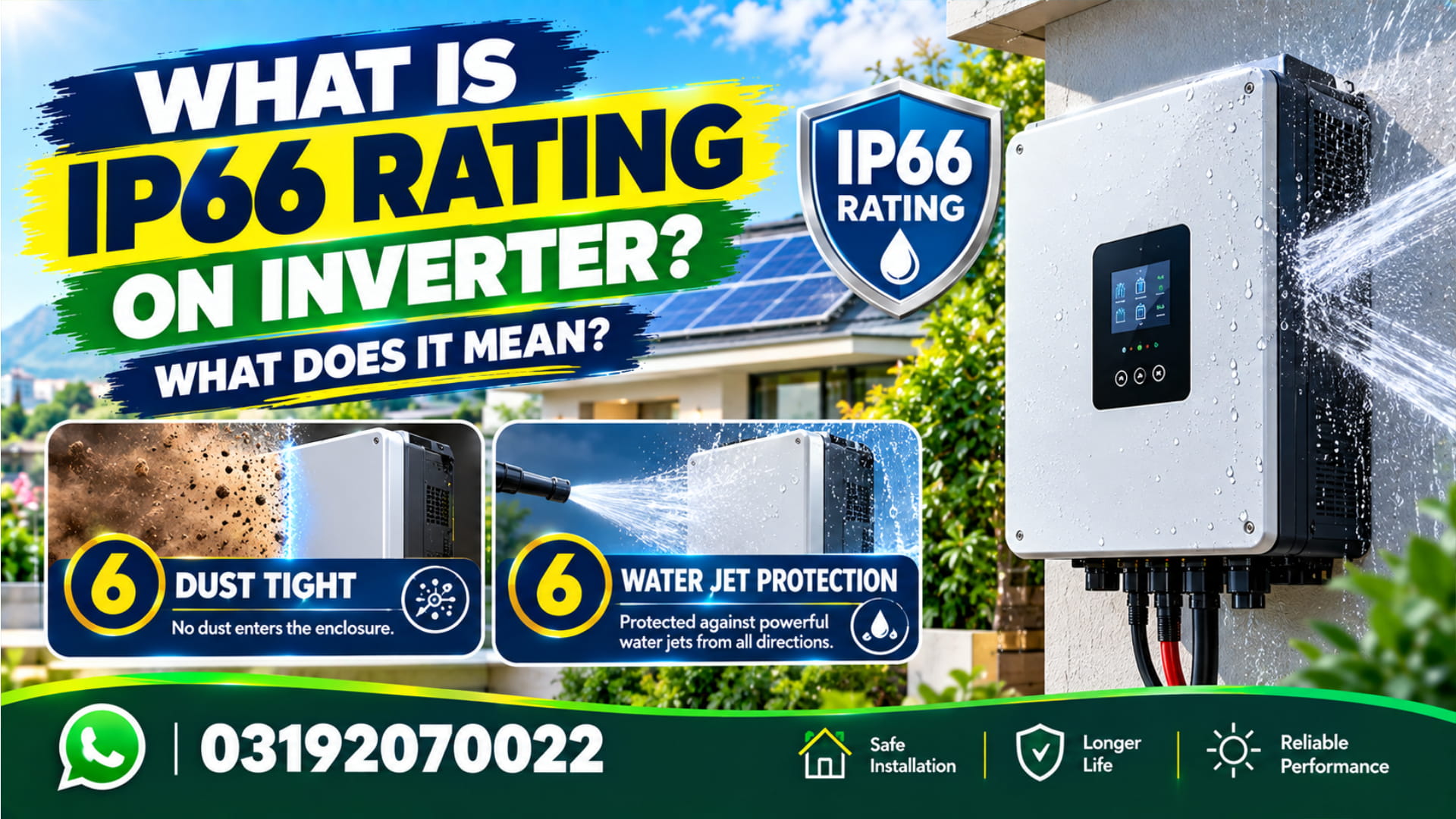
You will see “IP66” on almost every outdoor-rated hybrid inverter listing in Pakistan, usually right next to the price, as if the number alone tells you everything worth knowing. It does tell you something specific and genuinely useful. It does not tell you what most people assume it does.
IP66 is not a marketing term. It is a defined engineering standard with a precise meaning, two digits that each stand for a specific, tested level of protection. Once you know what those two digits actually cover, you can tell the difference between a rating that matters for your installation and one that is marketing dressed up as a spec.
IP Stands for Ingress Protection
The letters IP come from “Ingress Protection,” sometimes called “International Protection.” It is defined by an international standard, IEC 60529, and it describes how well an enclosure keeps solid objects and liquids from getting inside.
Every IP rating is written as IP followed by two digits. The first digit covers protection against solid objects, including dust. The second covers protection against liquids, essentially water. Each digit is tested and certified separately, on a fixed scale, which is what makes the rating meaningful rather than a vague claim.
Breaking Down the Two Digits
First digit: solid object and dust protection
| Digit | Protects Against |
|---|---|
| 0 | No protection |
| 1 | Solid objects larger than 50mm |
| 2 | Solid objects larger than 12.5mm |
| 3 | Solid objects larger than 2.5mm |
| 4 | Solid objects larger than 1mm |
| 5 | Dust protected, limited ingress that does not affect operation |
| 6 | Dust tight, no ingress of dust at all |
Second digit: liquid protection
| Digit | Protects Against |
|---|---|
| 0 | No protection |
| 1 | Vertically dripping water |
| 2 | Dripping water when tilted up to 15° |
| 3 | Spraying water up to 60° from vertical |
| 4 | Splashing water from any direction |
| 5 | Water jets from any direction, standard nozzle and pressure |
| 6 | Powerful water jets from any direction, larger nozzle and higher pressure |
| 7 | Temporary immersion up to 1 metre for 30 minutes |
| 8 | Continuous immersion beyond 1 metre |
IP66, put together, means dust tight and protected against powerful water jets from any direction. Not “outdoor” as a vague description. Not “waterproof” in the way that word gets used casually. Those two specific, tested things, and nothing more, nothing less.
What IP66 Does Not Mean
This is where most confusion happens, and it is worth being precise about it before anything else.
IP66 does not mean submersible. That is IP67, temporary immersion up to a metre for half an hour, or IP68, continuous immersion. An IP66 inverter mounted somewhere that floods will fail just as badly as an unrated one. The rating covers water arriving as jets, driven rain, and spray, not standing water rising around the enclosure.
IP66 does not mean airtight or heat-resistant. Dust tight is about particles, not about airflow for cooling. An IP66 inverter still needs the clearance and ventilation specified in its manual to dissipate heat properly. Sealing it into a cupboard with no airflow defeats the thermal design regardless of what the dust rating says.
IP66 does not automatically mean better in every respect. It specifically means better sealed against dust and water. It says nothing about efficiency, warranty, firmware, or any other quality that might matter to your purchase. A well-built IP21 unit installed correctly indoors can outlast a poorly made IP66 unit in every respect except the two things the rating actually measures. Our complete guide to inverter sizing covers capacity alongside these installation questions, since getting both right matters more than either alone.
IP65 vs IP66: The Difference That Actually Matters
Both ratings share the first digit, 6, meaning both are equally dust tight. The difference sits entirely in the second digit.
IP65 is tested against water jets from a 6.3mm nozzle at a defined pressure. IP66 is tested against a considerably more powerful jet, from a 12.5mm nozzle, at higher pressure and volume. In practical terms, IP66 is built to withstand a more aggressive, sustained soaking, closer to what wind-driven monsoon rain against an exposed wall can deliver, rather than moderate splashing.
For Pakistan specifically, this difference is not academic. Coastal Karachi, monsoon-affected Punjab, and areas that see driving rain rather than gentle showers benefit meaningfully from the IP66 threshold over IP65. Inland, drier regions where dust is the dominant concern and heavy driven rain is rare see less practical difference between the two, since both handle dust identically.
How the Common Ratings Compare on Real Inverters
| Rating | Dust | Water | Typical Use |
|---|---|---|---|
| IP20 / IP21 | Basic, larger objects only | Vertical dripping only | Strictly indoors, dry, ventilated room |
| IP54 | Dust protected, limited ingress | Splashing from any direction | Semi-sheltered, covered veranda |
| IP65 | Dust tight | Standard water jets | Outdoor, moderate rain exposure |
| IP66 | Dust tight | Powerful water jets | Outdoor, driven rain, dust storms, coastal humidity |
Our Crown inverter price in Pakistan guide covers real models across this full range, from the IP21 Yorker line through the IP66 Nexus line, with pricing at each level.
Why This Actually Matters in Pakistan
Dust, not age, is the leading cause of premature inverter failure in this country. A fine layer settles into the heat sink over months, thermal performance degrades a little more each season, and eventually the unit either derates badly on hot afternoons or fails outright. An IP21 unit sitting in a semi-open space in Multan, Bahawalpur or interior Sindh has no meaningful defence against this. An IP66 unit does, by design and by test standard, not by marketing claim.
The same logic applies to monsoon exposure and coastal salt-laden air in Karachi and Gwadar, both of which accelerate corrosion on exposed electronics far faster than a dry inland climate would.
None of this means every inverter needs IP66. It means the rating is solving a real, specific, climate-driven problem for installations that actually face it.
When You Genuinely Need IP66
Mounting on an exterior wall with no roof overhang. A location that regularly sees dust storms, common across southern Punjab, interior Sindh and Balochistan. Coastal humidity, particularly Karachi and areas near the sea. No available indoor space, forcing outdoor mounting as the only realistic option. A semi-covered position that still takes wind-driven rain during monsoon season.
When You Do Not Need It
A genuinely clean, dry, ventilated indoor room, a proper utility space rather than a converted storage cupboard, is where an IP21 unit does the same electrical job for meaningfully less money. Paying for IP66 sealing on an inverter that will never see dust or rain is paying for a feature you will not use, and that money is generally better spent on panel capacity or battery storage instead.
Our guide to choosing the best inverter for a home in Pakistan walks through this decision alongside capacity and load, since IP rating and sizing usually need to be decided together rather than separately.
The Price Difference
Across most brands and capacities, moving from an IP21 unit to the equivalent IP66 model typically adds 40% to 70% to the inverter’s price. Our 6kW solar inverter price in Pakistan guide shows this clearly at a single capacity: IP21 units in the 6kW class start around Rs. 116,000, while sealed IP66 equivalents run from roughly Rs. 215,000.
That premium is buying the sealing itself, plus typically the more robust dual MPPT tracking and higher build quality that tend to accompany IP66 models in practice, since manufacturers rarely put a premium enclosure around a budget internal design.
Batteries Carry IP Ratings Too
Worth a brief mention, since outdoor battery enclosures are increasingly common alongside outdoor inverters. If your battery bank, particularly a lithium pack, will also be mounted outside or in an exposed space, check its IP rating separately from the inverter’s. The two are not automatically matched, and an IP66 inverter paired with an unrated indoor-only battery box defeats the purpose of sealing the inverter at all. Battery pricing varies significantly by type, capacity and enclosure rating, so WhatsApp us now for the latest price of the battery at 03192070022 if an outdoor-rated battery enclosure is part of your plan.
How to Verify a Genuine IP66 Claim
IP ratings are supposed to be independently tested and certified, not self-declared. A few checks are worth doing before trusting a listing.
Look for the rating stated clearly on the manufacturer’s official datasheet, not just on a retailer’s product page, since datasheets are harder to misrepresent than marketing copy. Check whether the manufacturer references the IEC 60529 standard specifically, which indicates the claim is tied to the actual testing framework rather than an informal description. Be wary of a rating claimed without any supporting documentation at all, particularly on unfamiliar or unusually cheap brands, since IP-rated enclosures cost more to manufacture and a suspiciously low price on a claimed IP66 unit is worth questioning.
Our current stock, with manufacturer specifications for every listed IP rating, is on our products page.
Installation Notes That Apply Even to IP66 Units
Sealed does not mean maintenance-free or clearance-free. Follow the manufacturer’s specified clearance around the heat sink, typically around 30cm above and below, even on a fully sealed enclosure, since IP66 protects against ingress, not against the need for airflow to dissipate heat.
Mounting on a shaded wall rather than one that takes direct afternoon sun still matters, since ambient heat against the enclosure affects internal temperature regardless of how well sealed the unit is against dust and water.
Periodic inspection is still worth doing. IP66 significantly reduces the risk of dust and water ingress; it does not eliminate the value of an occasional visual check, particularly after severe weather.
Not in the sense of being submersible. IP66 protects against powerful water jets and driven rain from any direction, but not standing water or flooding. Submersible ratings are IP67 and IP68.
Both are equally dust tight. IP66 is tested against a more powerful, higher-volume water jet than IP65, making it better suited to sustained heavy rain and monsoon exposure.
A roof overhang alone is not sufficient. IP21 only protects against vertically dripping water and basic solid objects, and dust, wind-driven rain and humidity will still reach the unit. Semi-sheltered outdoor positions generally need at least IP54, and full outdoor exposure needs IP65 or IP66.
Typically 40% to 70% more than an equivalent IP21 unit at the same capacity, though this also usually comes with better internal build quality, not just a sealed case.
No. A genuinely clean, dry, ventilated indoor room is well served by an IP21 unit, and paying for IP66 sealing you will never need is money better spent elsewhere in the system.
Look for the rating stated on the manufacturer’s official datasheet with reference to the IEC 60529 standard, rather than trusting a retailer’s description alone.
No. Ventilation clearance is still required for heat dissipation regardless of the IP rating, since sealing against dust and water ingress is unrelated to the airflow needed for cooling.
No, IP67 and IP68 exist and offer submersion protection, but they are uncommon on solar and hybrid inverters, since the practical need for submersion resistance rarely applies to how these units are actually installed.
Need Help Choosing the Right Rating?
Tell us where the inverter will actually be mounted, indoors, under a roof, or fully exposed, and whether your area sees dust storms, driven rain, or coastal humidity. That is enough for us to recommend the right IP rating rather than defaulting to the most expensive option.
WhatsApp 03192070022 for a recommendation and today’s rates.
IP rating definitions reflect the IEC 60529 international standard. Always confirm the specific rating and supporting certification for any individual inverter model before purchase.