
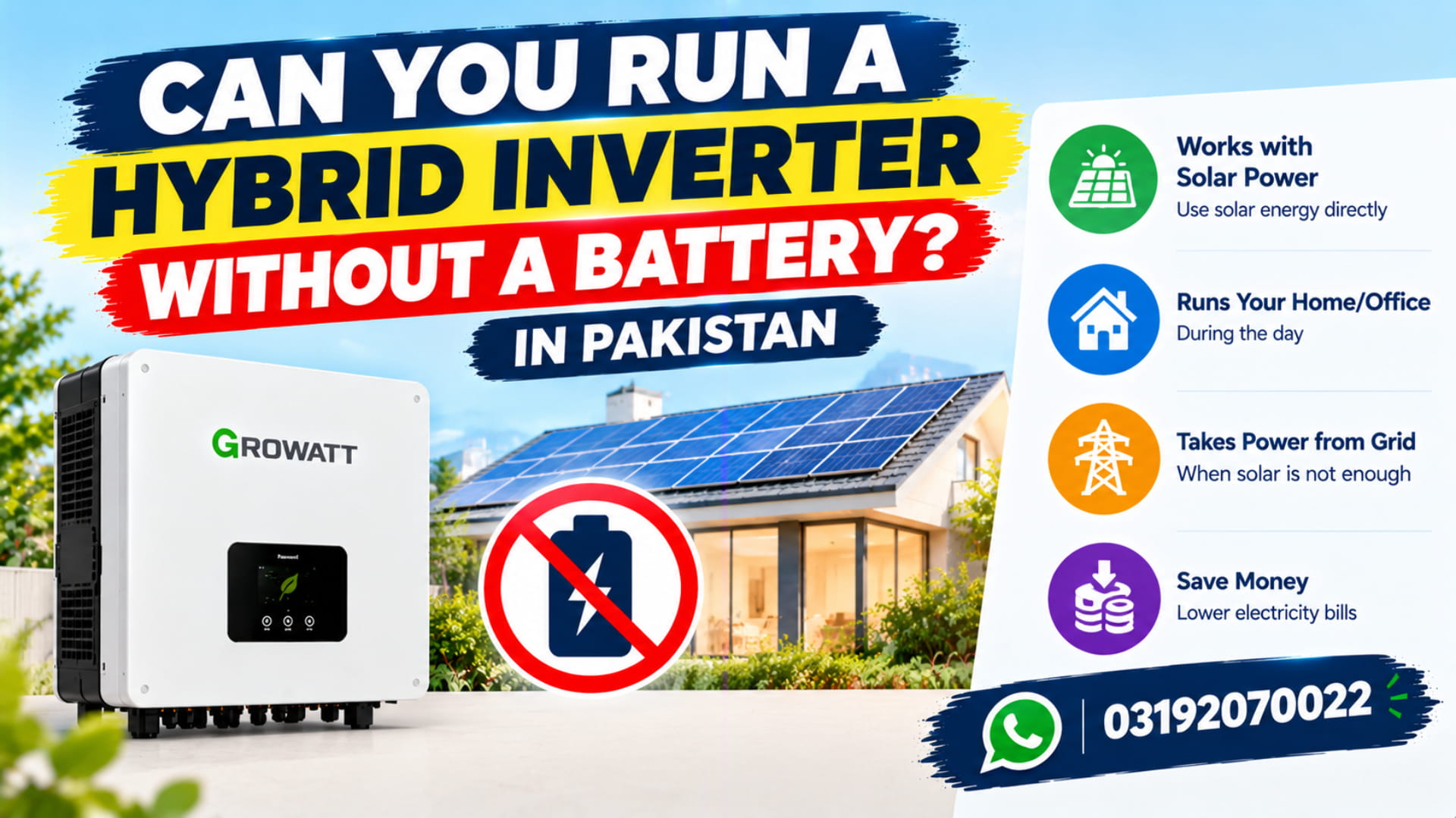
Yes. A hybrid inverter will run perfectly well with no battery connected at all, generating from your panels, feeding your house load during the day, and exporting or idling the surplus. Dealers sell this configuration regularly, usually to buyers who want the hybrid inverter’s future-proofing without committing to the full system cost on day one.
The real question is not whether it works. It does. The real question is what you are actually buying when you do this, what you are giving up compared with having the battery installed from the start, and whether that trade makes sense for your budget and your outage pattern. This guide answers all three plainly, because “yes it works” without that context leads to buyers either overpaying for a capability they will never use, or underbuying and discovering the gap during the first long outage.
For a system priced both ways, with and without the battery, so you can compare the real numbers for your own load, WhatsApp 03192070022.
What a Hybrid Inverter Without a Battery Actually Does
Without a battery connected, a hybrid inverter behaves almost identically to a plain on-grid inverter during the day. Panels generate, the inverter feeds your running load directly, and surplus beyond your load is exported to the grid under whatever net billing or net metering terms apply to your connection. The “hybrid” part of the inverter, its ability to manage battery charge and discharge, sits unused.
The moment the grid fails, the difference disappears entirely. Without a battery, both a hybrid inverter and a plain on-grid inverter are required to disconnect for safety, and your house goes dark exactly the same way. The hybrid inverter’s extra capability only becomes real the day a battery is physically connected to it.
What You Gain Buying Hybrid Now, Battery Later
You avoid a second inverter purchase. This is the entire point of buying hybrid upfront. A plain on-grid inverter has no battery input or charge-management circuitry at all, so adding backup later means replacing the inverter, not just adding a battery. A hybrid inverter bought today, even running without a battery for a year or two, saves you that replacement cost entirely.
You can stage the cost of a system you cannot fully afford today. Panels and the inverter are one cost. The battery is often a separate, substantial cost on top. Buying the panels and hybrid inverter now, and adding the battery once budget allows, gets you most of the bill-reduction benefit immediately while spreading the total spend over time.
You keep today’s panel and inverter sizing decisions correct. If you wait entirely and buy everything as a plain on-grid system now, upgrading later means a full inverter swap and possibly a mismatched panel array sized for the wrong architecture. Buying hybrid now avoids that mismatch regardless of when the battery actually arrives.
What You Give Up Without the Battery
No backup during an outage, at all. This is the one limitation that matters most and the one buyers most often underestimate. A hybrid inverter with no battery is not a backup system. It is a grid-tied solar system that happens to be hybrid-capable. If an outage happens, you lose power exactly as you would with any on-grid system.
No improvement to self-consumption under net billing. Under the current net billing rules, exported surplus is worth considerably less than electricity drawn from the grid, so the financial case for a battery comes specifically from storing midday surplus and using it in the evening instead of exporting it cheaply. Our hybrid inverter price in Pakistan guide breaks down what the battery-ready hardware costs versus a plain on-grid unit, but the saving itself does not exist yet without the battery actually installed, no matter how capable the idle inverter is.
You are paying a premium today for a benefit you have not received yet. A hybrid inverter costs more than a plain on-grid unit of the same capacity. If the battery is genuinely years away, you are carrying that extra cost for a long time before it does anything for you.
When Staging the Purchase Makes Real Sense
You have a firm, reasonably near-term plan to add the battery. Staging works best when the gap is months, not years. If you genuinely expect to add storage within a year or two, the premium you pay now is a sensible bet against a full inverter replacement later.
Your main goal right now is bill reduction, not backup. If outages are infrequent where you live, or tolerable for now, and your priority is cutting your electricity bill through daytime solar offset, a hybrid inverter without a battery delivers that identically to a plain on-grid system, while keeping your options open.
You are deliberately building the system in phases to manage cash flow. Buying the panels and inverter this year and the battery next year is a completely reasonable way to afford a full system you could not fund all at once, as long as you go into it with eyes open about having no backup in the interim. Our best inverter for home in Pakistan guide names specific hybrid-capable models that suit this staged approach without locking you into a poor upgrade path later.
When It Does Not Make Sense
Outages are frequent or long where you live, and backup is your actual priority. If the reason you wanted solar in the first place was to keep the lights on during load shedding, a hybrid inverter without a battery does not deliver that, and you are better off either committing to the battery now or, if budget truly will not allow it, considering a smaller combined system within reach that includes storage from day one. WhatsApp 03192070022 and tell us your outage pattern, and we will tell you honestly which side of this line your situation falls on.
You have no real plan or timeline to ever add the battery. If “later” is vague and indefinite, you may simply be paying the hybrid premium forever for a capability you never use. In that specific case, a correctly sized plain on-grid system is the more honest purchase.
You are being sold hybrid by default without being told the battery is optional and separate. Some buyers end up with a hybrid inverter and no battery simply because that is what the dealer quoted, without a clear conversation about what it does and does not do. Make sure you understand which configuration you are actually buying and why, and use our how many batteries for a 6kW inverter guide to work out what a genuine backup-ready configuration would have cost you for comparison.
What to Check Before Buying Hybrid-Now, Battery-Later
Confirm the inverter’s battery input genuinely supports the chemistry you plan to add. Not every hybrid inverter communicates properly with every battery type, and lithium in particular needs proper BMS communication to charge and discharge efficiently. Confirm this specifically for the battery chemistry you expect to buy, rather than assuming “hybrid” means “works with anything.” Our lithium vs lead-acid for inverters guide covers what differs between the two and what the inverter needs to support either one properly.
Confirm the inverter’s maximum battery capacity covers what you will eventually want. If you expect to add a larger bank down the line, check now that the model you are buying can actually support it, rather than discovering a ceiling after you have already paid for the inverter.
Ask whether the dealer will keep a record of your model and settings for the eventual battery installation. Some settings, charge current limits, battery type selection, discharge priority, are easier to configure correctly at the time the battery is actually connected if the installer knows exactly what inverter and firmware you are running.
Size the panel array with the eventual battery in mind, not just today’s load. A panel array sized tightly to your current daytime load leaves little surplus for a battery to actually charge from once it arrives. If a battery is genuinely in your future plan, a modestly larger array now avoids under-feeding the battery later.
A Realistic Way to Decide
Ask yourself three questions honestly. How often do outages actually happen where you live, and for how long? Is backup during those outages a real priority, or a nice-to-have? And do you have an actual timeline, even a rough one, for adding the battery, or is “later” indefinite?
If outages are rare and tolerable, your priority is bill reduction, and you have no firm battery timeline, a hybrid inverter with no battery is a perfectly sound choice, and in practice behaves like a slightly more expensive on-grid system with a future option attached. If outages are frequent, backup actually matters to you, or your battery plan is genuinely near-term, either commit to the battery now or size a smaller complete system that includes one, rather than carrying a hybrid premium that is not yet earning its cost.
Our what size inverter do I need guide is worth working through either way, since the correct capacity does not change based on whether the battery arrives now or later, only the total you pay and when.
Mistakes to Avoid
Buying hybrid without understanding the battery is a separate, optional purchase. Confirm explicitly with your dealer what is included and what is not.
Assuming any battery will work with any hybrid inverter later. Chemistry and communication protocol compatibility should be checked now, not assumed.
Undersizing the panel array for an eventual battery. A battery with nothing left to charge from after the house load is served will underperform even once it is finally installed.
Treating a hybrid inverter with no battery as backup. It is not. If an outage happens before the battery arrives, you have no power, the same as any on-grid system.
Letting “later” stay indefinite when backup is genuinely your priority. If keeping the lights on matters to you now, do not pay a hybrid premium today and keep delaying the one component that actually delivers it.
Yes. It generates and feeds your load during the day exactly like an on-grid inverter, and exports or idles any surplus.
No. Without a battery physically connected, it must disconnect during an outage exactly like a plain on-grid system.
Often yes, since it avoids replacing the inverter entirely when you do add storage. The calculation changes if “a few years” is genuinely open-ended with no real plan.
No. Confirm the specific chemistry and communication protocol the inverter supports before assuming a battery you buy later will work properly with it.
If backup matters to you and your budget allows it, yes, buying the complete system from the start avoids the gap period entirely. Staging is for genuine budget constraints, not a reason to delay when you can afford the full system.
Price Your System Both Ways
Tell us your budget and whether you plan to add a battery now or later, and we will quote your system both ways, with and without storage, so you can see exactly what staging the purchase actually costs and saves.
WhatsApp 03192070022 for today’s rates on inverters, panels and batteries.
Pricing and policy details referenced here are indicative as of October 2026 and can change. Confirm current equipment pricing and your specific inverter’s battery compatibility before ordering.