
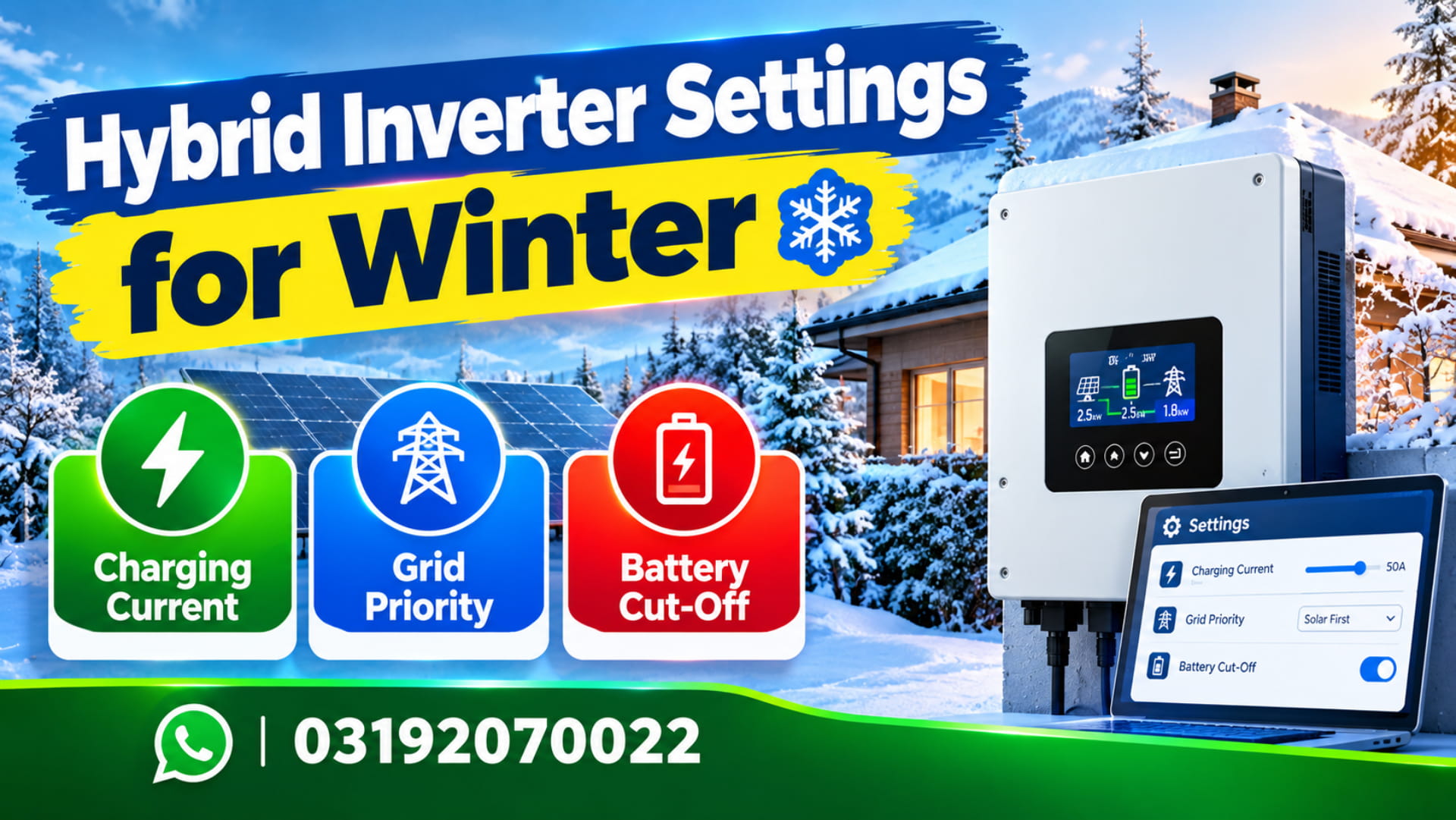
Every winter, the same complaint shows up in inverter dealer WhatsApp groups and Facebook solar forums across Pakistan: “my system worked fine all summer, now the battery is dead by 9 PM.” In almost every one of these cases, the hardware hasn’t failed. The inverter is still doing exactly what it was told to do back in June, except the sun it was told to rely on isn’t showing up the way it used to.
Winter in most of Pakistan — from the fog belt around Lahore, Faisalabad and Gujranwala to the shorter daylight hours everywhere else — can cut solar generation by 40-60% compared to peak summer months. A system that was comfortably charging a battery bank by noon in July might now struggle to reach even 70% state of charge by 4 PM, right before the sun drops and load shedding or evening peak demand kicks in. If your hybrid inverter’s charge priority, grid-charge behaviour and low-battery cut-off are still set the way they were in summer, you are effectively running a winter system on summer logic, and that mismatch is what drains batteries early, trips low-voltage alarms, and leaves households without backup exactly when they need it most.
This guide walks through the three setting categories that matter most once the weak-sun season arrives: output source priority, battery charging current, and low-battery cut-off / state-of-charge thresholds. We’ll also be upfront about something most generic guides gloss over — exact menu names, numbered codes and parameter ranges differ from brand to brand and even firmware version to firmware version. What we can give you with confidence are the underlying principles that apply across nearly every hybrid inverter sold in Pakistan today, so that whatever screen you’re looking at, you know what you’re trying to achieve and can find the matching option.
Buy Inverter Shop premium inverters in Pakistan. High-performance home and industrial inverters with ISO certification, nationwide delivery. If you’re shopping for a unit that can actually handle Pakistan’s winter solar dip without constant fiddling, WhatsApp us now for the latest price of the battery at 03192070022 and we’ll walk you through which models pair best with your existing or planned battery bank.
Why Winter Breaks “Default” Inverter Settings
Most hybrid inverters ship from the factory, or get configured by the installer on install day, with settings tuned for whatever the weather happened to be that week. If your system went live in April or May, chances are good nobody touched the charge priority or cut-off voltage again — because for five or six months, generous sunshine covered up any inefficiency in the settings. The battery would hit full charge by late morning regardless of how the priority mode was configured, so it simply didn’t matter.
Winter removes that cushion. Three things change at once:
Daylight hours shrink, so there are fewer total hours of usable sun. Fog, especially in central and northern Punjab, can suppress panel output for entire mornings at a time — a topic we cover in more depth in our piece on why solar output drops in winter fog. Panel angle relative to the lower winter sun also reduces the effective irradiance hitting a roof that was optimized (or left flat) for summer sun paths. The combined effect is that the battery may only get a partial charge on cloudy or foggy days, sometimes for several days in a row.
When a battery starts the next day at 60% instead of 100%, and the settings still assume a full charge is coming, the system runs on a shrinking margin every single day until something gives — usually a low-voltage shutdown in the evening, right when the family wants backup power the most.
Setting Category 1: Output Source Priority (Solar, Battery, Grid Order)
Almost every hybrid inverter — whatever the brand — has a setting that decides which power source feeds your home’s loads first. Depending on the brand, you’ll see this labeled as output priority, source priority, or work mode, and the options are usually some version of these three ideas:
Solar-first, battery-second, grid-last (often shown as SBU on many inverter menus). The inverter uses solar to run the house and charge the battery during the day. Once solar isn’t available, it draws from the battery. Only when the battery hits its low cut-off point does it fall back to grid power. This mode maximizes battery use and minimizes grid draw, which is great in summer when the battery refills easily the next day — but in winter, this can mean the battery gets drained every single night and never gets a real chance to recover, because the next day’s weak solar charge barely replaces what was used.
Solar-first, grid-second, battery-last (often shown as SUB on many inverter menus). Solar powers the house during the day, but once solar drops off, the inverter pulls from the grid rather than the battery, keeping the battery in reserve mainly for outages. This is usually the safer winter posture if your area doesn’t have heavy load shedding, because it protects the battery from being cycled every day during a season when it can’t easily recharge.
Grid-first / utility priority. The grid runs the house and the battery/solar combination acts purely as backup. This suits areas with reliable grid supply and is sometimes used deliberately through winter to let the battery sit at a healthy charge, ready for when load shedding actually happens, instead of cycling nightly for no real benefit.
If your area gets meaningful daily load shedding, don’t just flip blindly to grid-priority mode — you’ll lose the backup exactly when you need it. The better winter approach for most Pakistani households with moderate load shedding is a middle path: solar-first for daytime loads (so you’re not wasting free solar power), but with a grid-assist or utility-second behaviour once the sun is gone, so the battery isn’t needlessly drained on nights with no outage. Exactly how you configure this hybrid behaviour — and what it’s called — varies by model, so check your inverter’s manual or ask your installer which of its listed modes maps onto “use solar when available, prefer grid over battery at night, save battery for outages.”
Setting Category 2: Battery Charging Current
Charging current (sometimes called max charge current, charger current, or bulk charge amps) controls how fast the inverter is allowed to push current into the battery from either solar or grid. This is a different setting from source priority — priority decides which source gets used, charging current decides how aggressively the battery gets topped up once a source is charging it.
In winter, there are two competing pressures on this setting. On one hand, with less total solar-hours available each day, you might be tempted to crank charging current up to the battery’s or inverter’s maximum rated limit, so that whatever sun you do get gets converted into stored energy as fast as possible. On the other hand, charging current that’s set too high for your specific battery chemistry and bank size can shorten battery life, generate excess heat, and — for lead-acid batteries particularly — cause premature gassing and water loss in flooded types.
The safer approach is to set charging current according to your battery manufacturer’s recommended charge rate (commonly expressed as a fraction of battery capacity, such as C/10 or C/5, depending on chemistry), not simply maxed out because winter feels urgent. Lithium batteries generally tolerate higher charge currents than lead-acid and recover faster from partial-charge cycles, which is one of several reasons lithium performs more forgivingly through a Pakistani winter — we go into the tradeoffs in detail in our comparison of lithium vs lead-acid batteries for inverters. If you’re running lead-acid through winter, be conservative with charge current and prioritize getting the battery to a genuinely full charge over multiple days rather than a fast, shallow top-up every evening.
If grid-charging is enabled (see the next section), many inverters let you set a separate, often lower, charging current for grid-sourced charging versus solar-sourced charging. This exists because grid charging usually happens during limited windows and at a steadier voltage, so a moderate, battery-friendly rate is usually the right call rather than pushing it to the maximum the inverter allows.
For specifics on what to watch for if your battery stubbornly refuses to reach full charge regardless of settings, see our troubleshooting piece on an inverter that isn’t charging the battery properly, which covers wiring, sensor and fault-code causes separate from settings misconfiguration.
For sizing questions — how big your battery bank should be relative to your inverter and expected winter backup hours — WhatsApp us now for the latest price of the battery at 03192070022 and our team can recommend a bank size that actually holds up through foggy, low-sun weeks instead of just summer averages.
Setting Category 3: Grid-Charge Scheduling
Grid-charge (sometimes labeled AC charge, utility charge, or grid charge enable) lets the inverter top up the battery from grid power rather than relying purely on solar. Many installers leave this disabled by default, on the logic that a solar system shouldn’t need grid electricity to charge its own battery. That logic holds up fine in summer. In winter, when several consecutive foggy or heavily overcast days can leave a battery sitting at 40-50% state of charge with no real recovery in sight, grid-charge scheduling becomes one of the most useful tools you have.
The general principle, consistent with how most inverter manufacturers document this feature: you set a time window (commonly overnight or during a specific block of hours) during which the inverter is permitted to draw from the grid to charge the battery, generally up to a target state of charge you define, rather than charging indefinitely. This prevents the battery from ever bottoming out completely while also not needlessly pulling grid power once a reasonable buffer charge is reached.
One important caveat specific to Pakistan: unlike some markets where grid-charge scheduling is paired with cheap off-peak electricity tariffs, most residential consumers here are on flat or slab-based tariffs without a meaningfully cheaper overnight rate, and net-metering/net-billing arrangements don’t typically offer a reason to prefer charging at one time of day over another from a tariff-savings perspective. So in Pakistan, grid-charge scheduling in winter is primarily a reliability tool — insurance against a dead battery after several weak-sun days — rather than a cost-optimization tool the way it might be marketed elsewhere. If your goal is purely to avoid a system that can’t hold backup through a stretch of foggy days, enabling a modest grid-charge window (enough to bring the battery to roughly 80-90% state of charge, not necessarily 100%) during winter months is a reasonable, commonly recommended approach, though exact target percentages should be checked against your specific battery’s and inverter’s documentation since figures do vary by brand and battery chemistry.
If your home also deals with scheduled load shedding on top of winter’s weak solar, our guide on calculating winter load-shedding battery backup hours walks through the math of how battery capacity, inverter settings and shedding duration interact — useful context before you decide how aggressive your grid-charge window needs to be.
Setting Category 4: Low-Battery Cut-Off and State-of-Charge Protection
This is the setting most directly responsible for the “my battery died early” complaint. Low-battery cut-off (also called low voltage disconnect, LVD, or under-voltage protection, depending on the brand) determines the point at which the inverter stops drawing from the battery to protect it from over-discharge, switching to grid power (if available) instead.
In summer, a relatively low cut-off threshold works fine, because the battery reliably gets back to full charge the next sunny day regardless of how deep it was discharged the night before. In winter, repeatedly discharging close to that same low cut-off point — when the next day might only deliver a partial recharge — compounds over several days into chronic undercharging. This is harder on battery health generally, and for lead-acid in particular, repeated deep discharge without full recovery accelerates sulfation and capacity loss.
The commonly recommended winter adjustment, consistent across manufacturer guidance for both lead-acid and lithium systems, is to raise the low-battery cut-off threshold somewhat higher during winter months than you’d use in summer — giving yourself a smaller usable capacity window, but protecting the battery from the deep, poorly-recovered discharges that weak winter sun makes more likely. Some newer hybrid inverters include separate “winter mode” or seasonal profiles that automate exactly this kind of adjustment; others require you to manually change the percentage or voltage figure and then change it back when spring generation improves.
We’re not going to hand you a universal cut-off percentage or voltage figure to punch in, because the right number genuinely depends on your specific battery’s chemistry, age and manufacturer specification — a figure that’s safe and sensible for one lithium battery can be overly conservative or insufficiently protective for another. Check your battery datasheet or ask your dealer for the recommended winter discharge floor for your exact battery model before changing this setting. If you’re unsure which battery fits your inverter and backup goals in the first place, WhatsApp us now for the latest price of the battery at 03192070022 and we can match a battery and cut-off recommendation to your actual load profile.
Putting It Together: A Winter Settings Checklist
Rather than treating these as four separate, unrelated dials, think of them as one coordinated winter profile. A sensible starting point many Pakistani households land on, subject to your installer’s confirmation for your specific hardware: keep solar-first priority for daytime loads so you’re not wasting free generation, shift to grid-assist rather than battery-first once the sun sets if load shedding in your area is light to moderate, set charging current to your battery manufacturer’s recommended rate rather than the inverter’s absolute maximum, enable a modest grid-charge window if you’ve had several consecutive weak-sun days and the battery isn’t recovering, and raise your low-battery cut-off threshold slightly compared to your summer setting so the battery isn’t discharged as deeply each night.
None of this requires buying new hardware — it’s purely a configuration exercise on the system you already have. That said, if you’re finding that even with careful settings your current inverter-battery combination simply can’t carry you through a Pakistani winter evening, it may genuinely be undersized for your household’s load, not just misconfigured. Our roundup of the best hybrid inverters in Pakistan for 2026 is a good next stop if you’re weighing whether to upgrade capacity ahead of next winter rather than fight the same seasonal battle again.
It’s also worth testing your settings before you actually need them. Don’t wait for the first serious foggy spell of the season to discover your cut-off threshold is still on its summer setting — walk through the menu in October or November, confirm what’s currently configured, and adjust deliberately rather than reactively once the complaints start rolling in from the rest of the household.
Common Mistakes That Make Winter Worse
A few patterns show up repeatedly in the field and are worth calling out directly. Leaving charging current maxed out year-round regardless of battery chemistry is one of the most common, often done with good intentions (“more charging is better”) but counterproductive for battery longevity, especially with lead-acid banks. Never adjusting cut-off thresholds seasonally is another — many installers configure a system once at installation and never revisit it, leaving a summer-tuned cut-off running through the harshest months of the year. Disabling grid-charge entirely as a point of pride (“I have solar, I shouldn’t need grid to charge my battery”) is understandable but can leave a household with zero backup through a genuinely bad stretch of foggy days, when a modest, scheduled grid-assist charge would have kept the battery in a safer range. And relying purely on a battery percentage shown on an app or display without understanding how that percentage is calculated can be misleading in winter — some battery monitoring systems lose calibration accuracy after extended periods of partial charging, which is part of why manufacturer guidance for several systems recommends periodic full-charge cycles specifically to recalibrate state-of-charge readings.
Most households set a winter profile once conditions turn (shorter days, more fog) and revert closer to original settings in spring; some newer inverters automate this with seasonal or adaptive profiles, but many models on the market in Pakistan still require a manual switch each way.
Yes, slightly — you’re reserving a bit more capacity as a protective buffer, which trades a small amount of nightly backup runtime for better battery health and more reliable recovery across consecutive weak-sun days.
No, not when it’s used deliberately and with a defined target state of charge rather than left running unrestricted; in Pakistani winters it functions mainly as reliability insurance against multi-day low-generation stretches, not a cost-saving feature.
Menu labels vary significantly by brand and firmware version, so match the underlying concept (which source is prioritized, how fast the battery charges, at what point discharge stops) to whatever labels your specific unit’s manual uses, and when in doubt, WhatsApp us now for the latest price of the battery at 03192070022 and we can help identify the matching settings for your model.
Both are possible — chronic deep discharge without full recovery accelerates degradation in lead-acid batteries especially, while consistently maxed-out charging current can generate excess heat and stress cells over time, so getting these settings right protects both your backup reliability and your battery’s working lifespan.
Winter doesn’t have to mean choosing between a drained battery every evening and an electricity bill that climbs from constant grid reliance. The inverter you already own almost certainly has the settings needed to strike a reasonable balance — they just need to be found, understood, and adjusted deliberately for the season you’re actually in, rather than left on whatever configuration happened to work when the sun was doing most of the work for you. Buy Inverter Shop premium inverters in Pakistan. High-performance home and industrial inverters with ISO certification, nationwide delivery. For help matching a battery and settings profile to your household’s winter backup needs, WhatsApp us now for the latest price of the battery at 03192070022.
Prices, specifications and settings guidance mentioned in this post are indicative as of October 2026 and can change; always confirm exact figures, menu paths and charge parameters against your specific inverter and battery manufacturer documentation before making adjustments.