
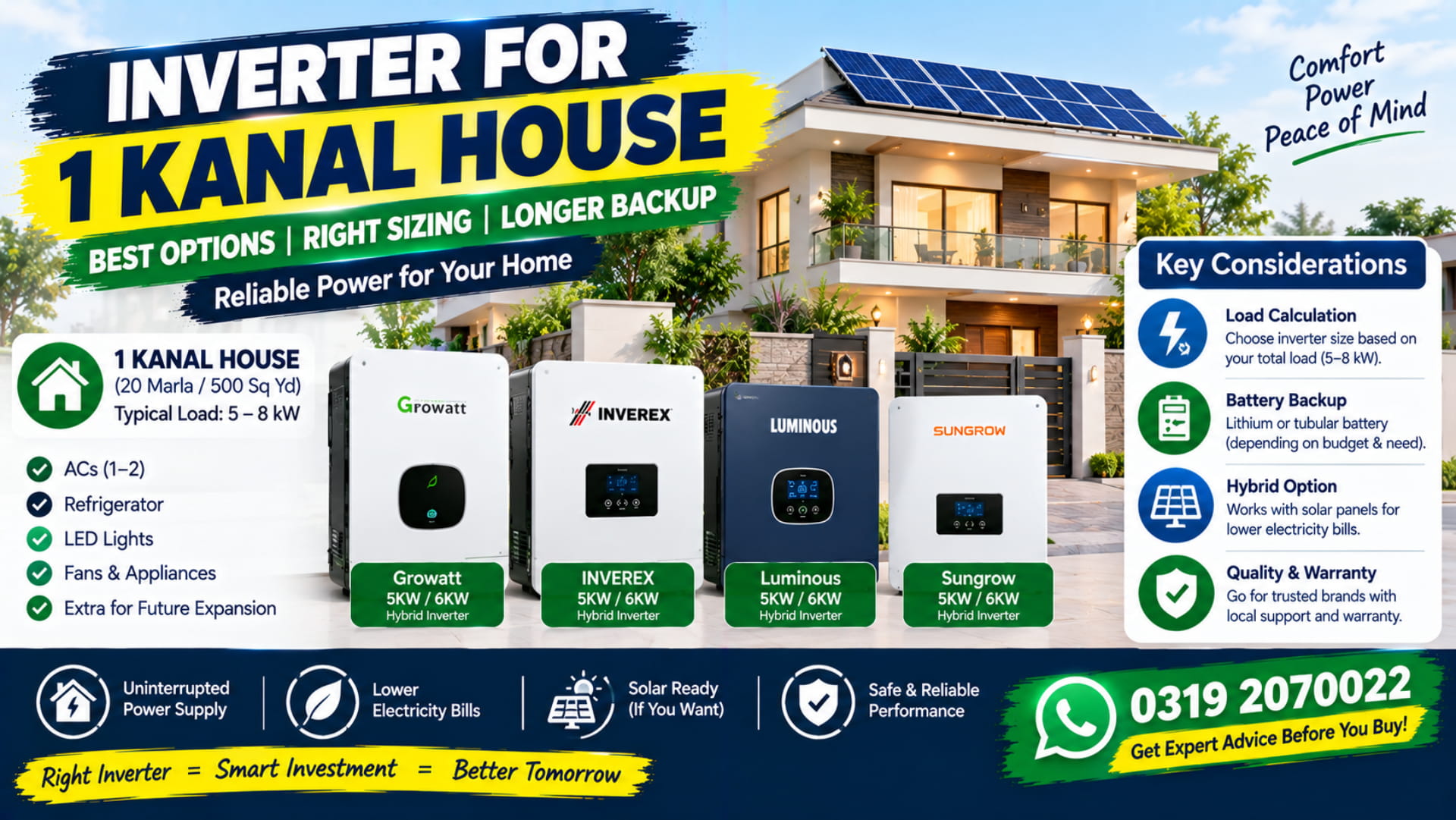
A 1 kanal house is where the “just buy a 5kW” advice that works for a smaller home starts failing badly. Twenty marla of covered and open area usually means four to six bedrooms, two or three air conditioners that can genuinely run at the same time, a lawn or garden pump, and often a basement or servant quarter with its own small load. Sizing by habit instead of by calculation is how a 1 kanal household ends up with an inverter that trips every July evening, or one that cost far more than the house actually needed.
The plot size itself tells you almost nothing. What decides the right capacity is how many compressors can start close together, whether the geyser is electric, and how much of the house you actually want to keep running during an outage rather than just lit.
This guide gives you realistic load numbers for a 1 kanal home, the correct capacity at each stage from essentials-only to a fully backed-up house, indicative price ranges, and the point at which the conversation shifts from a household inverter to a small commercial one. For a recommendation matched to your actual load, WhatsApp 03192070022.
The Short Answer
For most 1 kanal houses in Pakistan running two air conditioners that could operate together, a 6kW to 8kW hybrid inverter is the correct range.
Move up to 10kW if three air conditioners could run simultaneously, if the house has a basement or annexe with its own meaningful load, or if you want the whole property, lawn pump included, backed up through long outages.
Drop to 5kW only if your 1 kanal house is lightly occupied, with modest cooling needs, or if you are deliberately backing up essentials and a single bedroom rather than the entire property.
Beyond roughly 10kW to 12kW, the conversation usually shifts from a standard single-phase household inverter to a three-phase, semi-commercial setup, covered further down.
What a 1 Kanal House Actually Draws
A 1 kanal plot is about 4,500 square feet, and houses on this size vary enormously, from a modest single-storey layout to a double-storey house with a basement and a servant quarter. Here is a realistic load profile using running wattage rather than nameplate figures.
| Load | Quantity | Running Watts |
|---|---|---|
| 1.5 ton inverter AC | 2–3 | 1,800–4,800 |
| Ceiling fans | 8–12 | 480–960 |
| LED lighting throughout, inside and outside | — | 200–400 |
| Refrigerator | 1 | 100–200 |
| Deep freezer (if present) | 1 | 150–300 |
| Television, router, security cameras | — | 150–300 |
| Lawn or garden water pump (1HP) | 1 | 750–900 |
| Washing machine (intermittent) | 1 | 500–1,200 |
| Basement or servant quarter load | — | 300–800 |
As with any size of house, the number that matters is what runs at the same time during an outage, not the sum of everything you own.
Essential load only across a 1 kanal house, fans, lighting, refrigerator, security cameras and router, typically lands around 1,200W to 2,000W, simply because there is more house to light and more fans to run than in a smaller property.
Two ACs plus essentials lands around 3,200W to 5,000W. This is the most common real-world scenario and the one the 6kW to 8kW range is built around.
Three ACs plus essentials plus a pump or basement load lands around 4,800W to 7,500W, pushing toward the 8kW to 10kW range.
If you want to build this number precisely for your own house rather than using a bracket, our room-by-room load calculation guide walks through it appliance by appliance, and the same logic that applies to a 10 marla home simply gets repeated across more rooms.
Surge Matters More at This Scale, Not Less
A 1 kanal house usually has more than one motor-driven appliance that could start at the same moment. Two or three air conditioner compressors, a lawn pump, sometimes a washing machine, all cycling on and off independently through a summer evening.
This is the scenario where surge rating genuinely separates a good inverter from a frustrating one. Two units both labelled 8kW can differ by 30% or more in their surge capability, and that difference is invisible unless you specifically ask for it. For a 1 kanal house running two ACs, look for a surge rating of at least 10,000VA. With three ACs or a pump in the mix, 12,000VA and above gives real headroom rather than a unit that copes most of the time and trips on the hottest afternoons.
Four Scenarios, Four Recommendations
Scenario 1: Essentials and lighting only, no AC backup
Fans, lighting throughout the house, refrigerator, router and security cameras, with the ACs left on grid power only.
Recommended: 5kW hybrid inverter. Indicative price range roughly Rs. 103,000 to Rs. 235,000.
This suits a 1 kanal household where the main concern is losing light and ventilation during an outage, with a modest bill and no plan to carry cooling load on backup.
Scenario 2: One bedroom cooled, plus the rest of the house
One AC running during an outage, alongside full essential load across a larger property.
Recommended: 6kW hybrid inverter. Indicative price range roughly Rs. 116,000 to Rs. 285,000. Our 3.6kW vs 5kW vs 6kW comparison goes deeper on exactly where this line sits for a smaller load, which is useful context even though a 1 kanal house usually needs more than this stage.
Scenario 3: Two ACs that could run together, plus the house
The most common real scenario for an occupied 1 kanal home: two bedrooms cooled simultaneously on a hot night, plus everything else.
Recommended: 8kW hybrid inverter. Indicative price range roughly Rs. 260,000 to Rs. 360,000.
Scenario 4: Three ACs, a lawn pump, and a basement or annexe
A fully occupied, heavily used 1 kanal property wanting comprehensive backup.
Recommended: 10kW hybrid inverter. Indicative price range roughly Rs. 300,000 to Rs. 420,000.
At this stage it is worth reading our honest take on why a 12kW inverter is overkill for most homes before jumping a size further than you need. A genuinely heavy-use 1 kanal house can justify 10kW. Very few need the full 12kW step beyond it, and the full-system cost gap between the two is larger than the headline inverter price suggests once panels and battery capacity scale with it.
All figures above are indicative and move with exchange rates and stock. WhatsApp 03192070022 for today’s rate on a specific model and capacity.
When the Conversation Becomes Three-Phase
Most 1 kanal houses run comfortably on single-phase supply up to around 10kW to 12kW. Beyond that, particularly if the property has heavy simultaneous motor load, central air conditioning plant, or a tube well on the same connection, three-phase architecture starts making more electrical sense, balancing load across phases rather than straining one.
If your property sits in this territory, treat it as a different conversation from standard household sizing. Our 12kW hybrid inverter price in Pakistan guide covers that capacity class specifically, including the single-phase versus three-phase decision and the point at which it becomes worth the added installation complexity. Confirm your property actually has three-phase supply, or budget separately for arranging it, before sizing around a three-phase unit.
Specifications Worth Insisting On at This Scale
Surge rating of at least 10,000VA to 12,000VA, covered above and the most overlooked figure on any spec sheet.
Dual MPPT with 18A or higher per tracker, and ideally more than two trackers at 8kW and above. A large roof on a 1 kanal house often has several distinct faces and shading patterns, and more independent trackers means less of the array dragged down by one shaded section.
Dual output or load prioritisation with multiple circuits, not just a single essential-versus-non-essential split. A 1 kanal house benefits from being able to prioritise specific rooms or zones rather than an all-or-nothing switch.
Lithium BMS communication. At this capacity the battery investment is larger, and buying an inverter that properly communicates with a lithium pack protects that investment rather than forcing a replacement later.
A protection rating matched to the mounting position, the same rule that applies at any house size. A larger property often has a genuine outdoor mounting option, a boundary wall, a covered veranda, where a sealed unit earns its premium.
Generous PV oversizing headroom. An 8kW to 10kW hybrid pairing with a correspondingly larger panel array needs the inverter to accept well above its rated DC input to keep winter generation usable.
Our how many batteries for a 6kW inverter guide works through the battery math at the 6kW tier in detail; the same principles scale upward, with the battery bank growing roughly in proportion to the inverter capacity and the backup duration you want.
Panels and Batteries to Match
As with any inverter purchase, the unit itself is typically 15% to 20% of a complete system at this scale, sometimes less, because panels and battery capacity grow faster than the inverter cost does.
Panels. An 8kW to 10kW hybrid commonly pairs with sixteen to twenty-four modules of 550W to 620W, depending on how much PV oversizing headroom the unit supports and how much roof area a 1 kanal property actually has clear of water tanks, stairwells and shading.
Battery bank. This is where a 1 kanal household’s backup ambitions are decided. Running two or three ACs through a multi-hour outage draws down a battery bank considerably faster than essential loads alone, and the gap between a bank sized for comfort and one sized for genuine disappointment is large. Battery pricing moves too often to print reliably here, so WhatsApp us now for the latest price of the battery at 03192070022 for a configuration matched to your chosen inverter and backup duration.
Balance of system. Mounting structure, correct-gauge cabling for the higher currents involved at this capacity, breakers, surge protection and proper earthing all scale up in cost and in importance. Grid spikes and poor earthing damage more inverters in Pakistan than manufacturing faults do, and the damage bill is larger on an 8kW to 10kW unit than on a 3kW one.
Mistakes We See in 1 Kanal Installations
Sizing by habit rather than by load. “Everyone on this street bought 6kW” is not a calculation, and a 1 kanal house with three ACs and a basement needs considerably more than a 10 marla house with one.
Underestimating how many appliances actually run together. A larger house often has more people in it at once, which means more simultaneous use than the owner first assumes.
Treating the lawn pump as negligible. A 1HP pump’s surge draw is easy to forget until it starts at the same moment as an AC compressor and the inverter trips.
Buying the biggest number available instead of the right one. Jumping straight to 12kW when 8kW genuinely covers the load means paying for panels and battery capacity to match a size the house does not use.
Skipping surge and earthing budget at this scale. The protection components cost proportionally less at 8kW to 10kW than the inverter itself, and skipping them risks a far more expensive unit than at smaller capacities.
Forgetting the basement or servant quarter in the load calculation. These areas are easy to overlook on a walkthrough and easy to regret once the system is running.
A Buying Checklist for a 1 Kanal Home
- Count every air conditioner that could realistically run at the same time, including any in a basement or annexe.
- Decide whether lawn or garden pumps, washing machines and a basement load are part of the backup plan.
- Ask for the surge rating in VA, not just the continuous kilowatt figure, and confirm it covers your heaviest simultaneous start.
- Confirm whether your property’s electrical supply is single-phase or three-phase, and at what capacity that matters.
- Match the protection rating to the actual mounting position you have available.
- Confirm dual MPPT, tracker count and lithium compatibility suit a larger panel array.
- Get the warranty term and nearest service centre in writing before paying.
- Confirm your electricity distribution company accepts the model if net metering is part of the plan.
Most 1 kanal homes running two ACs that could operate together need 6kW to 8kW. Three ACs plus a pump or basement load pushes that to around 10kW.
Only for essentials and a single room, not for a fully backed-up property. Most occupied 1 kanal homes outgrow 5kW quickly once more than one AC runs at once.
Generally beyond 10kW to 12kW of real simultaneous load, or where heavy motor equipment benefits from balanced phase loading. Confirm your property has three-phase supply before sizing around it.
Indicatively around Rs. 260,000 to Rs. 360,000 depending on brand, protection rating and specification, excluding panels and battery.
Typically sixteen to twenty-four modules of 550W to 620W for an 8kW to 10kW system, depending on roof area and how much PV oversizing headroom the inverter supports.
Get a Quotation for Your 1 Kanal House
Send us how many air conditioners you run and whether they could operate together, whether a lawn pump or basement load needs backing up, and your average monthly electricity units. That is enough for us to recommend the right capacity, a specific model and a battery configuration without guesswork.
WhatsApp 03192070022 for today’s rates and a straight recommendation.
Prices reflect indicative market ranges in Pakistan as of October 2026 and vary with exchange rates, brand, protection rating and stock. Confirm current pricing before ordering.