
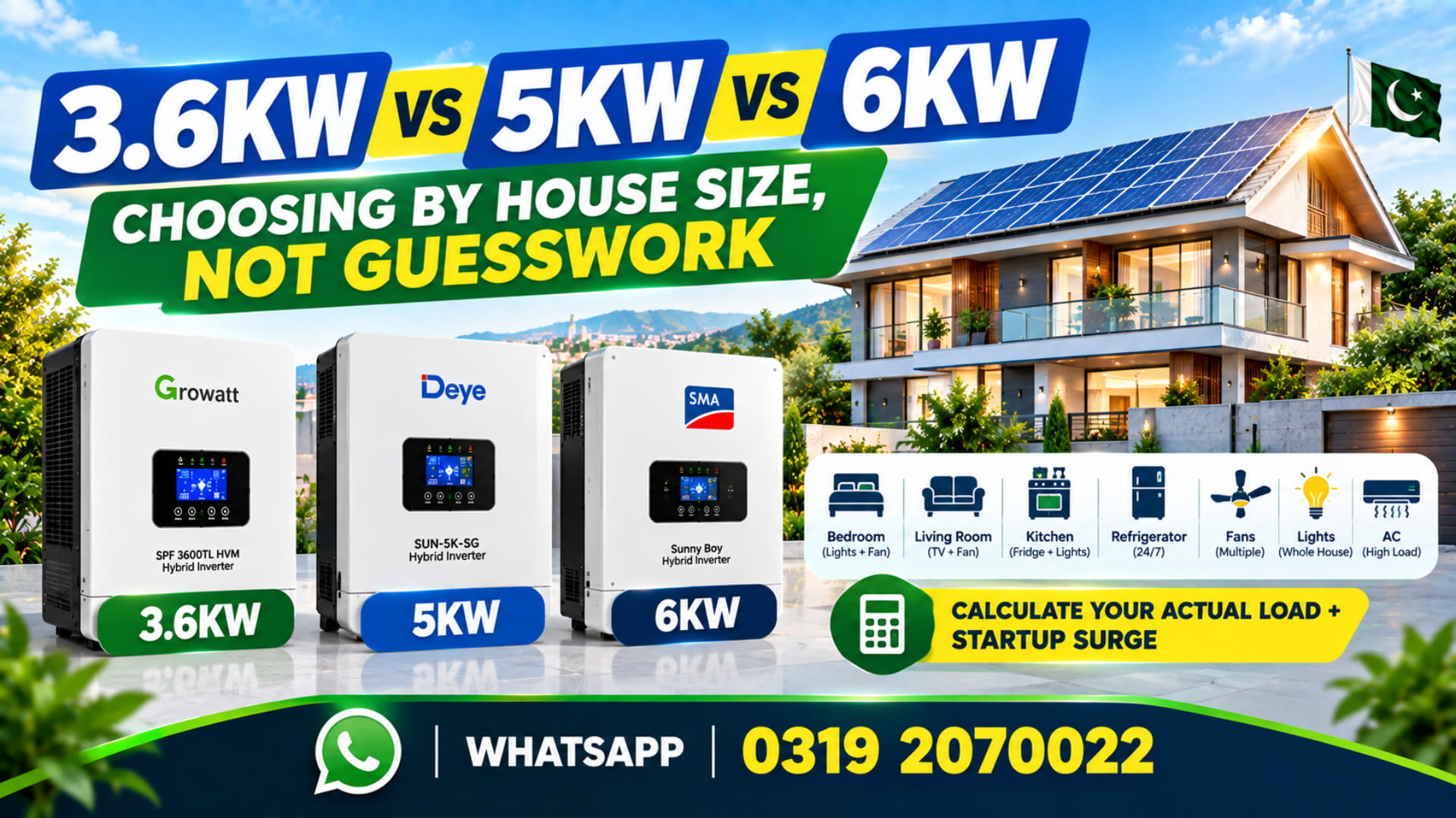
Three capacities cover the overwhelming majority of Pakistani homes, and buyers routinely pick between them by asking a dealer “which one is popular” rather than working out which one actually fits their house. That approach gets you a working inverter most of the time and an expensive mismatch a meaningful amount of the time, either paying for headroom you will never use or discovering within a year that you undersized.
This compares 3.6kW, 5kW and 6kW directly, by house size, appliance load and realistic upgrade paths, so the choice comes from your actual situation instead of whichever number a dealer suggested first. For a recommendation matched to your specific home, WhatsApp 03192070022.
The Three Capacities at a Glance
| Capacity | Typical Price Range (PKR, inverter only) | Realistic Household Fit |
|---|---|---|
| 3.6kW | 90,000 – 175,000 | 5-marla home, no AC or one AC used lightly |
| 5kW | 103,000 – 235,000 | 8 to 10-marla home, one AC running regularly |
| 6kW | 116,000 – 285,000 | 10-marla to 1-kanal home, two ACs or heavier load |
These ranges vary by IP rating, MPPT count and brand, the same way every capacity class does. What matters more than the price spread is matching the capacity to what your house actually draws, which the rest of this guide walks through properly.
3.6kW: Who This Actually Fits
A 3.6kW inverter comfortably runs a small to mid-size home with no air conditioning load, or one AC used sparingly rather than continuously through the night. Realistic running totals in this bracket sit between 2,000W and 3,000W: fans across three to four rooms, LED lighting, a refrigerator, a television, router, and occasional use of a washing machine or iron.
The honest limitation is headroom. A 3.6kW unit gives you little room to add a second AC or expand the house later without hitting the ceiling. If your household is genuinely fixed in size and load for the foreseeable future, that is not a problem. If you expect to add cooling load within two to three years, the smaller savings today often cost more than the price difference to the next tier up would have.
Best fit: a 5-marla home, a small flat, a household running fans and basic appliances without AC, or a budget-constrained buyer who will size up later rather than now.
5kW: The Middle Ground Most Households Land On
A 5kW inverter is the single most commonly purchased capacity in the Pakistani residential market, and for a specific reason: it is the smallest capacity that comfortably handles one 1.5-ton AC running for extended periods alongside full normal household load, with some margin left over.
Running totals in this bracket typically sit between 2,800W and 3,800W depending on whether the AC is inverter-technology or fixed-speed, plus fans, lighting, refrigerator, television and occasional heavier loads like an iron or blender. For the specific surge numbers that matter when sizing around an AC, our inverter for 1.5-ton AC guide and its companion piece on real AC startup load numbers break down exactly what a compressor demands at the moment it starts.
5kW leaves modest headroom for occasional second-AC use, a water pump running alongside the AC, or a home office setup, without regularly running at the inverter’s absolute ceiling. It does not comfortably support two ACs running simultaneously through a full summer night, which is where households outgrow this tier.
Best fit: an 8 to 10-marla home with one AC used regularly, a household that wants genuine backup during outages rather than just lights and fans, and a buyer who wants the best-value capacity in the entire market, since 5kW pricing tends to sit at the sharpest point on the price-per-watt curve.
6kW: When the Extra Capacity Actually Earns Its Cost
A 6kW inverter is the right call once your household’s realistic simultaneous load crosses roughly 3,800W to 4,000W, which in practice usually means two ACs that could run together, a larger home with more rooms drawing load at once, or a household running a water pump, washing machine and AC within the same window regularly rather than occasionally.
Running totals here often reach 4,000W to 5,500W: two 1.5-ton ACs, five to six ceiling fans, full lighting, refrigerator, television, router, and periodic heavier appliances. The jump from 5kW to 6kW typically costs 15,000 to 40,000 additional rupees depending on brand and IP rating, a modest premium against the frustration of an inverter that trips every time both ACs start within the same minute.
6kW is also the capacity where PV oversizing headroom starts mattering more, since most hybrid units in this class support panel arrays up to 200% of inverter rating, useful for keeping generation usable through Punjab’s foggy winter months. Our 5kW vs 6kW solar system comparison goes deeper on the full system cost difference, panels and battery bank included, not just the inverter alone.
Best fit: a 10-marla to 1-kanal home running two ACs, a larger family home with heavier simultaneous load, or any household that specifically wants to avoid revisiting this decision again within a few years.
Worked Comparison by House Size
| House Size | Typical Load Profile | Recommended Capacity |
|---|---|---|
| 5 marla, no AC | Fans, lights, fridge, TV | 3.6kW |
| 5 marla, one AC used lightly | Above plus occasional AC | 3.6kW to 5kW |
| 8 to 10 marla, one AC regular use | Above plus AC running nightly | 5kW |
| 10 marla, two bedrooms with AC | Two ACs, possible simultaneous use | 6kW |
| 1 kanal, family home | Two to three ACs, water pump, larger lighting load | 6kW, sometimes higher |
These are starting points rather than fixed rules. A 5-marla home with three ACs running constantly needs more than 3.6kW despite its small footprint, and a 1-kanal home occupied by a couple with minimal cooling needs can sit comfortably on 5kW. House size is a reasonable proxy for load, but the actual appliance count and simultaneous-use pattern is what decides the number. Our room-by-room load calculation guide walks through building that number from your own home rather than a size bracket.
The Cost of Guessing Wrong in Either Direction
Undersizing shows up as an inverter that trips whenever two motor-driven appliances start close together, an AC that will not run through a full outage without draining the battery bank faster than expected, or a system that simply cannot support the second AC you add next summer. The fix is usually a full inverter replacement, since the original unit has no path to more capacity.
Oversizing rarely causes a functional problem, an inverter does not become less efficient at idle in any meaningful way, but it does mean paying 20,000 to 60,000 rupees more upfront for capacity that sits unused indefinitely. That money is generally better spent on panel capacity, battery storage, or simply kept, unless you have a concrete plan to grow into the extra headroom within a reasonable window.
The practical rule: size for your realistic load within the next two to three years, not today’s load exactly and not an aspirational future you have no concrete plan toward.
Talk to your own household about this before you buy, not just your dealer. The person who decides whether the second bedroom gets an AC next year, or whether the family is adding a floor, usually is not the one standing at the shop counter, and that conversation changes the right answer more than any spec sheet does.
Battery Bank Size Grows With Inverter Capacity Too
The inverter is only half the sizing decision. A larger capacity inverter paired with an undersized battery bank still leaves you without backup within an hour or two, regardless of how well the inverter itself was chosen. As a rough pattern, a 3.6kW system running light loads gets meaningful backup time from a modest lead-acid bank, a 5kW system supporting one AC through several hours of outage needs a noticeably larger bank or a switch to lithium for the same physical footprint, and a 6kW system running two ACs draws down even a generous battery bank quickly unless the backup plan is deliberately built around essential loads only during longer outages.
This is where households sizing purely by inverter capacity get an unpleasant surprise: the inverter handles the load correctly, but the batteries run out well before the grid comes back. Our how many batteries for a 6kW inverter guide works through the actual math, series and parallel configuration, and the real difference lithium’s higher usable depth of discharge makes against lead-acid at each of these capacities.
What Stays the Same Across All Three Capacities
Regardless of which of these three you land on, the same buying checklist applies. Confirm the surge rating, not just the continuous kW figure, particularly if AC load is part of your calculation. Confirm dual MPPT and an 18A or higher per-tracker input current if you are pairing with modern high-wattage panels. Confirm lithium BMS communication if battery chemistry is part of your future plans, since retrofitting means replacing the inverter rather than upgrading it. And confirm the IP rating matches where the unit will actually be mounted, indoor units cost less but have no business on an exterior wall.
On battery sizing specifically, capacity and chemistry pricing shift often enough that nothing printed here would stay accurate. WhatsApp us now for the latest price of the battery at 03192070022 for a current figure matched to whichever inverter capacity you land on.
Yes, for one 1.5-ton AC running regularly alongside normal household load, 5kW is the standard, well-matched choice for most 8 to 10-marla homes.
When your household runs, or is likely to soon run, two ACs that could operate simultaneously, or when your combined running load regularly approaches 4,000W or more.
Not for its intended fit. It suits homes with no AC or very light AC use. It becomes limiting the moment you add a second significant cooling or motor load.
No. An oversized inverter’s ongoing running cost is essentially the same as a correctly sized one; the extra cost is entirely in the upfront purchase price.
Not by upgrading the same unit. Moving up a capacity class means replacing the inverter outright, which is why sizing with two to three years of realistic headroom in mind is cheaper than sizing exactly for today.
The surge rating and MPPT specification at your chosen capacity vary between brands and models even within the same kW class, so compare the full spec sheet, not just the headline number.
Get the Right Capacity for Your House
Tell us your house size, how many ACs you run and whether they operate together, and we will recommend the exact capacity rather than defaulting to whichever size is most popular this year.
WhatsApp 03192070022 for today’s rates and a sizing recommendation.
Prices and load figures reflect typical market ranges in Pakistan as of September 2026 and vary by brand, IP rating and specific appliance mix. Confirm current pricing before ordering.