
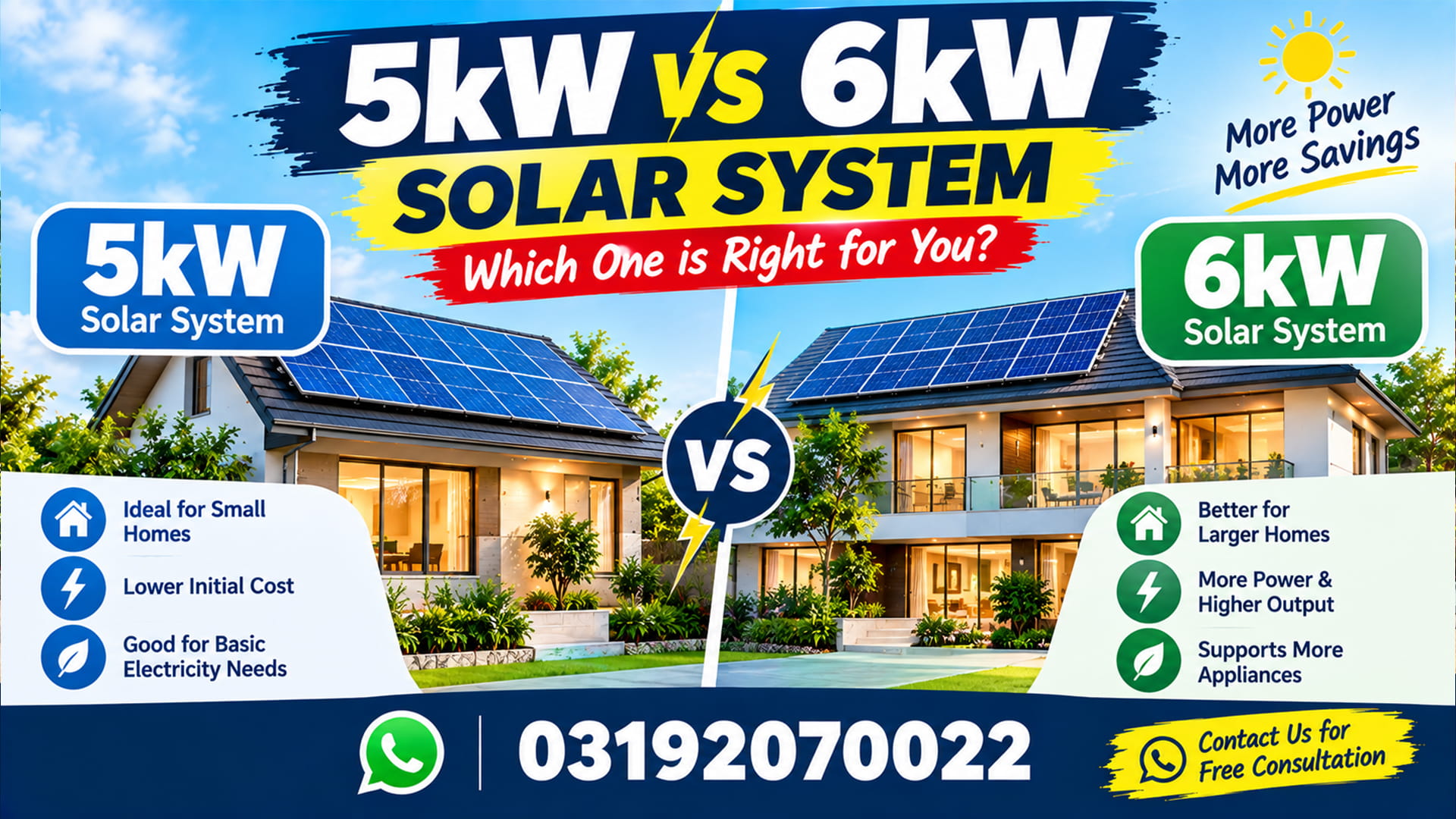
The gap between a 5kW and a 6kW solar system looks small on paper. One kilowatt. Two or three extra panels. A few thousand rupees on the inverter.
In practice it is the difference between a system that runs one air conditioner comfortably and one that runs two, and that single fact is usually what should decide the purchase, not the price tag or what your neighbour bought.
This comparison walks through the real differences: cost, generation, roof space, and most importantly, what each size actually supports in a Pakistani household. By the end you should know which one is yours without needing a dealer to tell you.
For a sizing recommendation specific to your house, WhatsApp 03192070022.
The Quick Comparison
| Factor | 5kW System | 6kW System |
|---|---|---|
| Inverter price | Rs. 98,000 – 235,000 | Rs. 116,000 – 285,000 |
| Panels needed (550–620W) | 9 – 11 | 12 – 14 |
| Roof space required | 300 – 380 sq ft | 400 – 490 sq ft |
| Peak generation, clear day | 20 – 26 units | 24 – 32 units |
| Monthly average generation | 550 – 700 units | 650 – 800 units |
| Air conditioners supported | One 1.5-ton comfortably | Two 1.5-ton comfortably |
| Typical monthly bill fit | Rs. 15,000 – 25,000 | Rs. 25,000 – 40,000 |
| Full system cost (no battery) | Rs. 420,000 – 700,000 | Rs. 480,000 – 920,000 |
The pattern to notice: the inverter price gap between the two sizes is often smaller than the perceived gap, sometimes only Rs. 15,000 to Rs. 20,000 at the budget end. What actually separates them is load capacity, and that is where the real decision sits.
What Each Size Actually Runs
This is the part that matters more than any number on a spec sheet.
5kW: one air conditioner, comfortably
A 5kW system handles one 1.5-ton inverter AC at 1,200W to 1,500W, plus a fridge at 300W, plus freezer, fans, lighting and the occasional pump or washing machine start. That lands around 2,400W to 3,000W of steady load, with genuine headroom for a pump surge.
Push it to two air conditioners and the headroom disappears. Two 1.5-ton inverter ACs alone draw 2,400W to 3,000W, and adding the rest of the household pushes you to the edge of a 5kW inverter’s comfortable range, with nothing left over for a pump start.
6kW: two air conditioners, comfortably
A 6kW system runs two 1.5-ton inverter ACs at 2,400W to 3,000W combined, plus fridge, freezer, fans and lighting at roughly 1,100W to 1,400W, plus room for a pump or washing machine. Total steady load sits around 4kW to 4.5kW, leaving genuine margin.
This is why 6kW is the single most common system size in Pakistan. It matches the load profile of an average family home almost exactly: two ACs, normal appliances, occasional pump use.
The one-appliance test
If your household runs one AC and nothing else heavy, 5kW is not a compromise, it is the correct size, and spending more on 6kW buys you capacity you will not use.
If you run two ACs, or one AC plus a non-inverter appliance with a heavy startup surge, 6kW is not an upgrade, it is the minimum that actually works without tripping. Our complete inverter sizing guide walks through the full load calculation if your situation sits between these two profiles.
Cost Difference in Detail
Inverter only
| Type | 5kW | 6kW |
|---|---|---|
| Budget indoor IP21 | Rs. 98,000 – 150,000 | Rs. 116,000 – 185,000 |
| Sealed outdoor IP65/66 | Rs. 197,000 – 235,000 | Rs. 215,000 – 285,000 |
At the budget end, the gap between a 5kW and 6kW inverter can be as small as Rs. 15,000 to Rs. 20,000. At the premium sealed end, it widens to Rs. 20,000 to Rs. 50,000. Either way, the inverter itself is rarely the deciding cost factor between the two sizes.
Our Crown Yorker 5KW price guide and 6kW solar inverter price in Pakistan guide cover the model-by-model detail for each size.
Full system
| Component | 5kW System | 6kW System |
|---|---|---|
| Inverter | 98,000 – 235,000 | 116,000 – 285,000 |
| Panels (9–14 units, 550–620W) | 210,000 – 340,000 | 280,000 – 420,000 |
| Mounting structure | 25,000 – 65,000 | 30,000 – 80,000 |
| Cabling, breakers, SPD | 15,000 – 35,000 | 20,000 – 45,000 |
| Earthing | 8,000 – 18,000 | 8,000 – 20,000 |
| Installation labour | 10,000 – 20,000 | 12,000 – 25,000 |
| Net metering application | 15,000 – 40,000 | 15,000 – 45,000 |
| Total, no battery | 381,000 – 753,000 | 481,000 – 920,000 |
The real gap, once panels and installation are included rather than just the inverter, typically lands between Rs. 100,000 and Rs. 170,000. That is a meaningful number, and it is worth asking honestly whether your household needs the extra capacity or whether that money is better spent on battery storage instead.
Battery cost sits on top of both figures and varies too much with lithium pricing to publish reliably here. WhatsApp us now for the latest price of the battery at 03192070022.
Panels and Roof Space
A 5kW system typically needs 9 to 11 panels of 550W to 620W, using 300 to 380 square feet of roof. A 6kW system needs 12 to 14 panels, using 400 to 490 square feet.
That is a real difference on a small urban plot. A 5 marla house often has 350 to 450 square feet of usable roof after accounting for water tanks, stairwells and shading obstacles, which can make 5kW the practical ceiling regardless of what your bill suggests you need.
If your roof genuinely cannot fit a 6kW array, do not force it. A correctly installed 5kW system on the available space outperforms a poorly laid out 6kW system fighting shading and tight clearances.
Generation and Bill Offset
5kW generation
Roughly 20 to 26 units on a clear summer day, dropping to 10 to 15 in December fog, averaging 550 to 700 units monthly across the year. That covers a household consuming 600 to 750 units monthly, which typically corresponds to a bill of Rs. 15,000 to Rs. 25,000.
6kW generation
Roughly 24 to 32 units on a clear day, dropping to 12 to 18 in winter, averaging 650 to 800 units monthly. That covers 700 to 900 units of consumption, corresponding to a Rs. 25,000 to Rs. 40,000 bill.
Where this actually matters
If your bill sits at Rs. 20,000, a 5kW system likely offsets it close to fully. Buying 6kW in that situation means generating surplus you either export at a lower net-metering buyback rate or simply do not use, which weakens the payback math rather than improving it.
If your bill sits at Rs. 35,000, a 5kW system leaves a meaningful shortfall every month, and the extra cost of 6kW pays for itself faster than the raw price difference suggests, because it is closing a gap that would otherwise be paid at full grid rate.
Match the system to the bill, not the other way round.
Payback Comparison
Both sizes typically pay back the solar-only portion, excluding batteries, in three to five years, but the mechanics differ slightly.
A 5kW system matched correctly to a Rs. 20,000 bill tends to pay back faster in relative terms because nearly all its generation is used, either directly or through net metering, at close to full value.
A 6kW system matched to a Rs. 35,000-plus bill also pays back well, and additionally benefits from moving the household out of higher tariff slabs, which often saves more per unit than the raw generation figures suggest.
Where payback suffers is mismatch in either direction. An undersized 5kW system on a Rs. 45,000 bill leaves too much unmet demand. An oversized 6kW system on a Rs. 15,000 bill generates surplus that is worth less than the capital spent to produce it.
When 5kW Is the Right Answer
Household runs one air conditioner and no other heavy appliance. Monthly bill sits between Rs. 15,000 and Rs. 25,000. Roof space is limited, under roughly 400 square feet usable. Budget is a genuine constraint and the household is unlikely to add major load within a few years. No non-inverter AC or heavy pump in regular use.
When 6kW Is the Right Answer
Household runs two air conditioners, even if both are inverter models. Monthly bill sits between Rs. 25,000 and Rs. 40,000. There is a water pump, washing machine or other appliance likely to run alongside the ACs. Roof space comfortably accommodates 12 to 14 panels. There is a reasonable chance of adding load within the next two to three years, such as a third bedroom’s AC or a home office.
Our guide to choosing the best inverter for a home in Pakistan covers specific model recommendations once you have settled on a size, and if your situation involves running one 1.5-ton AC specifically, the inverter for 1.5-ton AC guide covers that case in more depth.
The Middle Ground Nobody Mentions
If you are genuinely torn between the two, there is a third option worth knowing about: buy a 6kW inverter now and install only 5kW worth of panels, adding the remainder later.
Most hybrid inverters support meaningful PV oversizing, often 130% to 200% of rated capacity, and installing fewer panels than the inverter supports is simply the lower end of that range rather than a limitation. This gets you the load-handling headroom of a 6kW inverter immediately, at close to 5kW panel cost, with a clear upgrade path when budget allows or when a second AC arrives.
The one thing this does not solve is roof space. If your roof genuinely tops out around 400 square feet, this approach still requires finding room for panels 3 and 4 eventually.
A Note on Getting This Decision Wrong
Undersizing is more common and more expensive to fix than oversizing. A household that buys 5kW, adds a second AC eighteen months later, and finds the inverter tripping every afternoon usually ends up buying a second system rather than reselling the first, because used solar inverters have a thin resale market in Pakistan.
Oversizing is cheaper to live with. A 6kW system running one AC simply runs with headroom to spare, generates a bit more than is used, and is ready the day a second AC or an EV charger arrives.
If your household is anywhere near the boundary between the two profiles described above, the safer economic choice is usually 6kW.
Not universally. It is better if you run two air conditioners or expect to add load. If you run one AC and have a fixed budget or limited roof space, 5kW is the correct size, not a lesser one.
The inverter gap is often Rs. 15,000 to Rs. 50,000 depending on model. Including panels and installation, the full system gap typically runs Rs. 100,000 to Rs. 170,000.
Two 1.5-ton inverter ACs plus household load pushes a 5kW system to its limit with no margin for a pump start or a non-inverter appliance. It is possible in light-use scenarios but not comfortable as a standard setup.
Roughly 12 to 14 panels for 6kW versus 9 to 11 for 5kW, at 550W to 620W each. The difference in roof space is typically 100 to 120 square feet.
Whichever one is correctly matched to your electricity bill. A system sized to your actual consumption pays back faster than either an undersized or oversized alternative.
Battery rates change too frequently to publish accurately, and the pack cost is similar for both inverter sizes since it depends on backup hours rather than inverter capacity. WhatsApp us now for the latest price of the battery at 03192070022.
Get a Recommendation for Your House
Tell us your monthly bill, how many air conditioners you run and whether they are inverter or non-inverter models, and your approximate roof space. We will tell you honestly whether 5kW or 6kW fits, and we will not push the more expensive option if your household does not need it.
WhatsApp 03192070022 for today’s rates on either size.
Prices and generation figures reflect typical Pakistani conditions as of September 2026 and vary with panel efficiency, shading, and location. Confirm current pricing before ordering.