
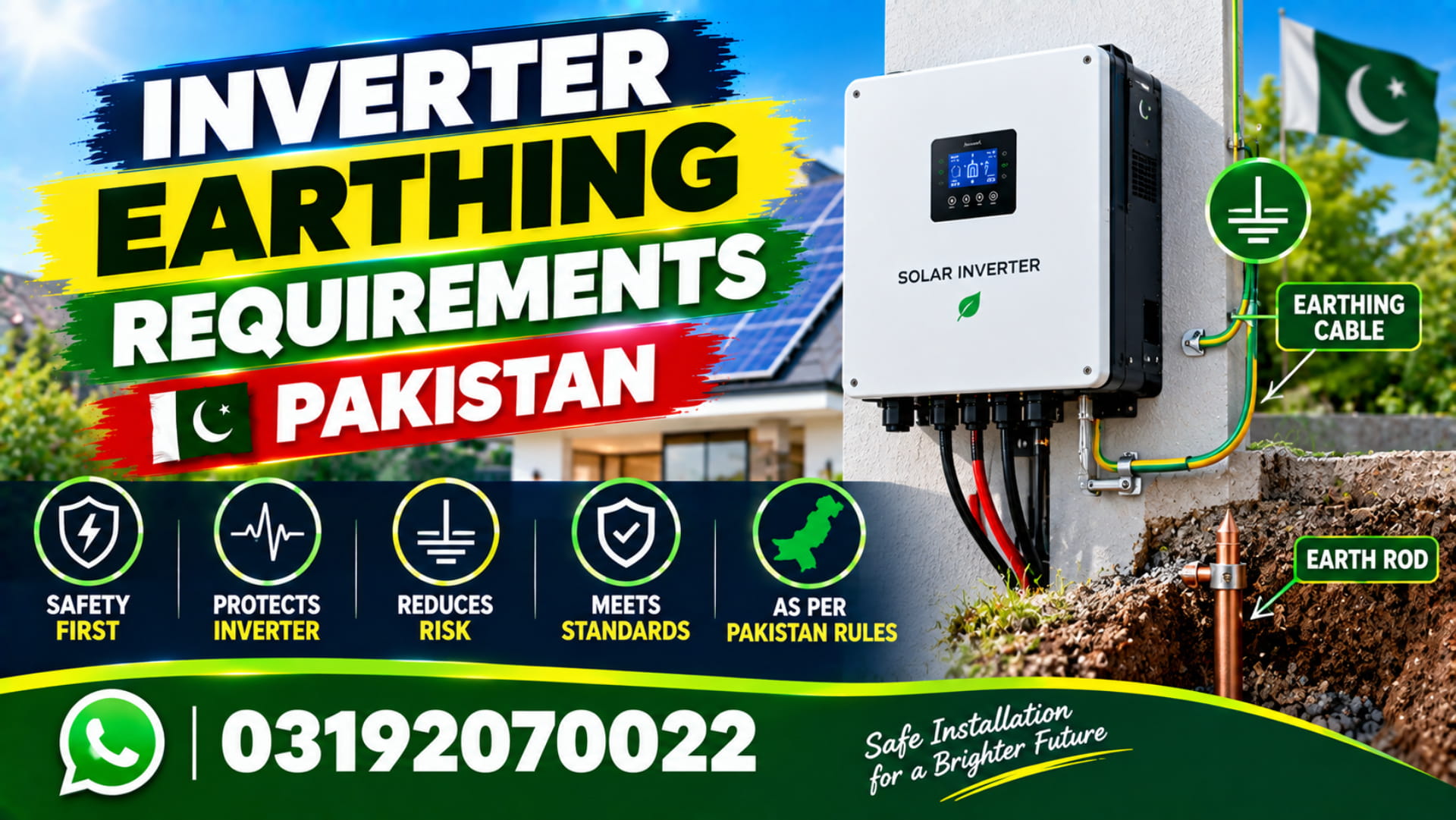
Ask most people what protects their household from an electrical fault and they will describe the breaker box. The breaker matters, but it is only half the safety system. The other half is earthing, and it is the part almost nobody thinks about until either a technician flags it during a net metering inspection or, worse, until a fault happens and there was no safe path for the current to go.
This is not a DIY topic, and this guide is not written to turn you into your own electrician. It exists so you know what proper earthing is supposed to accomplish, what to ask the person installing your system, and what a lazy or missing earth actually costs you in risk and in warranty terms. Every earth rod, cable and bonding connection described here should be installed and tested by a licensed electrician.
For help arranging a qualified installer or reviewing an existing setup, WhatsApp 03192070022.
What Earthing Actually Does
It gives fault current somewhere safe to go. If an insulation fault develops anywhere in the system and the inverter’s metal casing, or a panel frame, becomes accidentally energised, a properly earthed system gives that current a low-resistance path to ground instead of through the nearest person who touches it.
It lets your circuit breakers and RCDs actually work. A residual current device trips by detecting current leaking to earth. Without a genuine, low-resistance earth path, that leakage current may not register properly, and the protection you are relying on to trip in a fault condition simply does not function as intended.
It protects equipment from surges. Grid spikes and induced lightning currents need somewhere to discharge. A solid earth connection, paired with surge protection devices, is what actually lets an SPD do its job. Without it, the SPD has nowhere to send the surge it is trying to divert, and it becomes far less effective regardless of how good a unit it is. Surge damage is one of the leading causes of inverter failure in Pakistan, and it is also something no manufacturer warranty covers, which our inverter overload error and fault codes guide touches on from the fault-diagnosis side.
It enables DC ground fault detection. Many modern transformerless inverters continuously monitor insulation resistance between the PV array and ground before and during operation, and refuse to energise if that resistance falls below a safe threshold. This detection only works correctly with a properly earthed reference point.
The Different Earths in One System, and Why They Should Be Bonded, Not Separate
A solar and inverter installation typically involves several things that need earthing: the inverter’s own metal chassis, the mounting structure and frames holding the panels, any surge protection devices on the DC and AC sides, and sometimes a dedicated lightning protection system on larger installations.
A common misconception, and one repeated by installers who should know better, is that solar electronics need their own separate, isolated “clean” earth, kept apart from the building’s main electrical earth to avoid noise or interference. This is generally the wrong approach. Standard practice, aligned with IEC principles that Pakistani electrical work generally follows, favours a single, common earthing system with everything properly bonded together at one reference point, rather than multiple separate earths.
The reason matters and is worth understanding rather than just accepting. Two separate, unbonded earth points can sit at different electrical potentials during a fault, even if both are individually “grounded.” That potential difference is itself a shock hazard, precisely the thing earthing exists to prevent. A single, well-designed, properly bonded earthing system avoids this entirely.
What a Proper Earth Actually Looks Like
A dedicated earth electrode, typically a copper-bonded rod rather than a plain galvanised iron pipe, since copper resists corrosion far better over the system’s working life and maintains lower resistance for longer. The rod is driven to a depth sufficient to reach consistently moist soil, since resistance rises sharply in dry, sandy conditions common across much of Punjab, Sindh and Balochistan.
Earthing compound or backfill treatment around the electrode in dry or rocky soil, which reduces soil resistivity and helps the earth connection stay effective through the driest months of the year rather than only performing well right after installation or after rain.
Short, direct earth conductors connecting the inverter chassis, the panel mounting structure, and any surge protection devices back to the electrode, since unnecessarily long or looped earth cable runs add resistance and reduce the earth’s effectiveness during a fast transient like a lightning-induced surge.
A measured, tested resistance value, not an assumption. Widely followed engineering practice targets an earth resistance of 5 ohms or lower for a solar and inverter installation, with some installers working to a stricter 1 ohm target where soil conditions and budget allow. This should be measured with a proper earth resistance tester after installation, not estimated by how deep the rod looks like it went in.
None of this is something to attempt yourself with a length of wire and a garden stake. Get it installed and tested by someone qualified, and ask to see the resistance reading rather than simply being told it is “fine.”
Earthing and Net Metering Approval
If you are applying for net metering, proper earthing and protection arrangements are part of what your DISCO reviews before approving the connection. NEPRA’s distributed generation framework requires the technical interconnection, including protection and earthing, to follow the applicable standards, and DISCO engineers commonly check for surge protection devices on both the DC and AC sides during commissioning as part of this review.
Exactly what a given DISCO’s inspecting engineer checks in practice can vary somewhat by region and by inspector, so the safest approach is to confirm the current requirement with your installer or your specific DISCO before the inspection date, rather than assuming a generic checklist covers everything a particular office wants to see. An installation that fails this stage over an earthing deficiency is a delay you can avoid by getting it right the first time.
What Happens When Earthing Is Missing or Poor
Increased shock risk. The most direct consequence, and the reason earthing exists in the first place. An insulation fault on an unearthed or poorly earthed system can leave the inverter casing or panel frames live without tripping any protection, since there is no clear path for the fault current to register.
Surge damage that keeps recurring. A system without effective earthing loses much of the benefit of its surge protection devices, since the SPD has no low-resistance path to actually divert the surge into. Inverters on poorly earthed systems tend to suffer repeat surge-related failures that a properly earthed, SPD-protected system would have avoided.
Nuisance faults or failed protection. RCDs and ELCBs that do not trip reliably, or that trip unpredictably, are frequently traced back to an inadequate earth reference rather than a fault with the protective device itself.
Net metering delays or rejection. Covered above, and one of the more common reasons an otherwise correctly installed system gets sent back for rework before a DISCO will approve the connection.
Voided warranty claims. Several manufacturers explicitly exclude coverage for damage traced to inadequate earthing or missing surge protection, on the reasonable basis that the installation, not the product, caused the failure.
Common Mistakes
No dedicated earth at all, with the installer relying solely on whatever earth exists at the main utility connection, which may be inadequate on its own or may not extend a proper bonded path to the inverter and panel structure specifically.
Using a water pipe as the earth electrode. A long-standing bad habit in some installations, and unreliable for several reasons: modern plumbing increasingly uses non-conductive plastic sections that break electrical continuity, and even an all-metal system was never designed or tested as a proper earthing electrode.
Multiple isolated earths for different parts of the system, covered above, which can create a potential difference hazard rather than the safety benefit intended.
An earth rod driven into dry, untreated soil with no backfill compound, resulting in a resistance reading that may have passed on installation day but climbs well above a safe threshold during the dry season.
Never testing the resistance at all, treating “we installed an earth rod” as equivalent to “we have a functioning earth,” when only a measured resistance value actually confirms the second claim.
Undersized or excessively long earth conductors, reducing the earth’s effectiveness against fast transient events even when the electrode itself is adequate.
Maintenance and Retesting
Earth resistance is not a permanent, set-and-forget number. Soil conditions change with the seasons, connections corrode over time, particularly in humid or coastal areas, and mechanical connections can work loose from vibration or thermal cycling.
Periodic retesting, ideally before the summer season when both electrical load and storm activity increase, catches degradation before it becomes a functional problem rather than after. This is a straightforward check for a qualified electrician to carry out as part of routine system maintenance, similar in spirit to the panel cleaning and terminal inspection covered in our complete inverter sizing guide, which touches on the broader installation quality issues that affect long-term system performance.
What to Ask Your Installer
Before installation, ask specifically whether the earthing will be a single bonded system covering the inverter, panel structure and surge protection, or whether separate earths are planned, and if so, why, since the answer should generally favour the bonded approach discussed above.
Ask what electrode material will be used, and whether the soil at your specific site will need treatment to achieve an adequate resistance reading. Ask to see the measured resistance value after installation, in writing, rather than a verbal assurance. And if net metering is part of your plan, confirm the earthing and surge protection arrangement meets what your specific DISCO will check during commissioning, ideally before the inspection date rather than after a rejection.
Our hybrid inverter price in Pakistan guide and IP66 rating explainer cover related installation decisions, protection rating and enclosure choice, that go alongside proper earthing as part of a genuinely well-installed system rather than one that merely looks complete.
When to Call a Professional
Always, for the earthing work itself. This is not a caveat added out of caution; working with earth electrodes, bonding conductors and the inverter’s protective earth connection involves genuine electrical risk, and a poorly executed earth can be worse than none at all if it creates a false sense of protection without actually functioning correctly.
Beyond the initial installation, call a professional if you notice an RCD or ELCB tripping unpredictably, if you have had repeat surge-related equipment failures, if your net metering application was returned over a protection or earthing concern, or if your system has never had its earth resistance tested since installation.
Current stock and specifications for inverters that pair well with a properly earthed, surge-protected installation are on our products page.
Proper protection and earthing arrangements are part of the technical requirements reviewed for net metering approval, and are standard good practice for any electrical installation regardless of whether net metering is involved. Confirm the specific requirement with your installer or DISCO.
Widely followed engineering practice targets 5 ohms or lower for a solar and inverter installation, with some installers working to a stricter 1 ohm target depending on soil conditions and system size. This should be measured, not assumed.
Generally yes, provided it is a genuine, tested electrode rather than an informal connection to plumbing, and provided the inverter, panel structure and surge protection are all properly bonded into that same system rather than left on a separate, unconnected earth.
Two unbonded earth points can develop a potential difference between them during a fault, which is itself a shock hazard. Standard practice favours one properly bonded earthing system rather than multiple isolated ones.
Yes, in many cases. Manufacturers commonly exclude coverage for damage traced to inadequate earthing or missing surge protection, since the installation rather than the product is considered the cause.
This is not recommended. Earthing work involves genuine electrical risk and needs to be tested with proper equipment to confirm it actually functions, not just that a rod was placed in the ground.
Get Your Earthing Checked
Whether you are planning a new installation or want an existing system reviewed, tell us your situation and we can help you find a qualified installer or point you toward what to ask about your current setup.
WhatsApp 03192070022 for guidance.
This guide provides general information on earthing principles for solar and inverter installations in Pakistan. It is not a substitute for a qualified electrician’s assessment, and all earthing work should be installed and tested by a licensed professional in line with applicable standards and your DISCO’s requirements.