
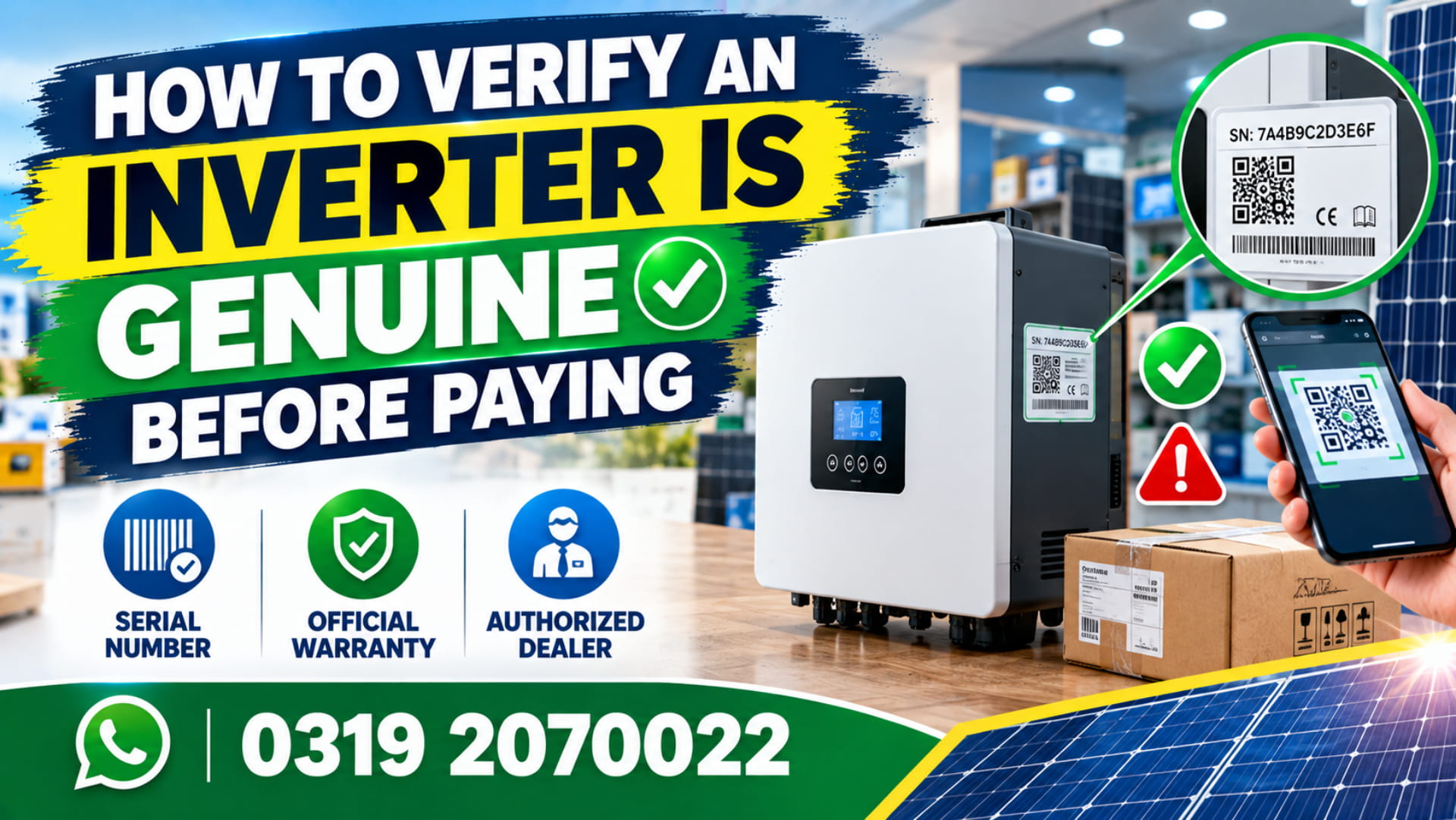
An inverter is one of the larger single purchases in a solar or backup system, and one of the easiest to get wrong without realising. A counterfeit or rebadged unit usually looks fine on the shop floor. The trouble appears months later: it overheats, trips for no reason, loses its warranty, or fails in a way nobody will repair.
The good news is that most problems can be caught before you hand over any money. This guide gives you a practical checklist you can run in a shop, over WhatsApp or on delivery day, without any technical equipment. None of it requires you to be an engineer. It only requires you to ask the right questions and notice when the answers do not hold together.
For a genuine unit with a warranty that someone local will honour, WhatsApp 03192070022.
What “Not Genuine” Actually Covers
People use the word “fake” for several different things, and the risks differ.
Counterfeit. A unit made to look like a known brand and model, with a copied label and housing but different, usually cheaper, internals.
Rebadged. A lesser unit with a more desirable brand’s sticker, or a unit passed off as a higher-capacity or higher-protection model than it really is.
Altered or refurbished. A used or repaired unit sold as new, sometimes with a new box and reprinted label.
Grey stock. Genuine product that did not come through the brand’s authorised channel. The unit may be real, but the warranty and support are not guaranteed. Our guide to local warranty vs imported grey stock covers this case in detail.
A good verification routine catches all four, because they leave similar clues.
Step 1: Start With the Seller, Not the Box
The most reliable early check is the seller, because a trustworthy seller makes most other checks easy.
- Is there a physical address you can visit, and has the business traded for some time?
- Can they tell you which brand distributor they buy from, and will they say so in writing?
- Do they answer technical questions directly, or change the subject?
- Are they comfortable with you checking the unit before paying in full?
A seller who resists simple questions is giving you information. It costs you nothing to walk away and ask the next one.
Step 2: Match the Model Code to the Manufacturer’s Listing
Every genuine model has a specific code. Write down the code printed on the unit’s label, the code on the box and the code on the quotation, then compare all three with the brand’s own published product information.
Things to look for:
- The three codes should match exactly. Small differences matter.
- The published specifications for that code should match what the seller told you: rated output, battery voltage, protection rating and number of MPPT inputs.
- If the seller quotes a capacity that does not exist for that model line, something is wrong.
This single check exposes many rebadged units, because the label often claims more than the model actually offers.
Step 3: Ask for the Datasheet and Check the Numbers
A genuine manufacturer publishes a full datasheet. Ask for it and compare the claims on the quotation with the document.
Check these figures in particular:
- Continuous output and surge rating. A unit sold as one size but with a mismatched surge figure is suspect.
- Battery voltage and compatible battery types. Make sure the unit supports the chemistry you plan to use.
- PV input limits. Maximum voltage, current per tracker and number of trackers.
- Protection rating. An indoor-rated unit sold as outdoor-ready will not survive.
- Operating temperature and efficiency.
If the numbers the seller recites change between conversations, or cannot be matched to a document, treat that as a warning.
Step 4: Inspect the Label, Packaging and Build
You do not need expertise to notice inconsistency. Look closely at:
The rating label. Printing should be crisp and even, with no smudging, misspellings or crooked alignment. Compare it with photographs of labels from the manufacturer or an authorised dealer if you can.
The serial number. It should be present, legible and unique. Photograph it. Be wary of a serial that looks hand-written, stickered over, or identical to one on another unit in the same shop.
The packaging. Original boxes are usually clean, with consistent printing. Signs of opening and resealing, mismatched tape or a box that does not fit the unit deserve questions.
Build quality. Compare the weight and finish with what you would expect from the capacity. Very light units for a large rated output are suspicious, because transformers, heat sinks and components have real mass.
Included accessories and manual. Missing manuals, photocopied papers or accessories that look generic can indicate a repackaged unit.
None of these alone proves a problem. Several together should make you stop and ask.
Step 5: Verify the Warranty, Not Just the Promise
A warranty only has value if someone is obliged and able to honour it.
- Ask who issues the warranty: the brand’s authorised distributor in Pakistan, or the shop alone.
- Ask for the terms in writing, including duration, what is excluded and how a claim is made.
- Ask where the nearest authorised service point is, by name and city.
- Ask whether the serial number will be registered at the point of sale.
If you can, contact the distributor or service centre directly and ask whether they recognise the seller as an authorised source. A short call can save a long dispute later.
Step 6: Compare the Price Honestly
Price is evidence, though not proof. Retail prices vary legitimately between sellers, and our inverter price in Pakistan today guide shows how wide that range can be for ordinary reasons. But a price far below every other seller usually has a cause: grey stock, an older revision, a refurbished unit or a counterfeit.
If you want to see how a specific popular model is normally priced and specified, a model-level guide such as our Crown inverter price in Pakistan breakdown gives you a reference range to compare against.
Step 7: Check the Brand’s Place in the Market
Some brands are copied more often than others simply because they sell more. That is a reason for extra care, not a reason to avoid them. Our best inverter brand in Pakistan 2026 ranking explains how the main names differ, which helps you recognise whether a claim made about a unit is plausible for that brand.
Where a seller claims a premium feature at a budget price, ask how that is possible. A brand known for good value can be genuinely cheap. A brand known for premium engineering rarely is.
Step 8: Test on Delivery Before Paying the Balance
If possible, avoid paying everything upfront. A sensible arrangement is a modest deposit, with the balance paid once the unit has been checked on delivery.
On delivery:
- Compare the box, label and serial with what you recorded earlier.
- Check that the unit matches the model on the quotation and the invoice.
- Look for visible damage, loose parts or signs of previous use.
- Have a qualified installer power it up and confirm the display shows sensible information and the settings match what you ordered.
- Photograph everything before the installer leaves.
If something does not match, say so immediately and in writing, before installation is complete.
Step 9: Keep the Paper Trail
Keep every document: the quotation, invoice, warranty card, serial number photographs, delivery receipt and any messages with the seller. If a dispute arises, this is your evidence. Make sure the invoice names the model, serial number and date, and carries the seller’s details.
Never accept a handwritten note with no model information as proof of purchase. It will not help you in a warranty claim.
Buying Online or Over WhatsApp
Many purchases now start with a photograph and a price in a message. That is convenient, and it raises the stakes on verification, because you cannot hold the unit before deciding.
Ask for a short video of the actual unit showing the label and serial number, not a stock photo. Ask the seller to hold up a handwritten note with today’s date next to it if you have any doubt. Confirm the business has a real address and a number you can call, and check how long the page or account has existed. Prefer payment methods that leave a record, and avoid sending the full amount to a personal account for a seller you cannot trace.
If delivery is by courier, record yourself opening the package so any mismatch between what you ordered and what arrived is documented from the first moment.
Red Flags at a Glance
| Warning sign | Why it matters |
|---|---|
| Price far below every other seller | Often grey stock, refurbished or counterfeit |
| Seller will not put warranty terms in writing | The promise may not be real |
| Model code on label, box and quote do not match | Possible rebadging |
| No datasheet, or numbers keep changing | Specifications may be invented |
| Box looks opened or resealed | Unit may be used or swapped |
| Pressure to pay in full immediately | Removes your chance to check |
| Seller cannot name the supplier or service centre | No clear route for claims |
| Unit feels unusually light for its rating | Smaller components than claimed |
What Genuine Does Not Guarantee
A genuine unit can still fail if it is installed badly. Undersized cable, missing surge protection, poor earthing and a sealed storeroom with no airflow cause many failures that have nothing to do with authenticity. Choose an installer you trust and insist on correct earthing, protection and ventilation. Our guide on whether Chinese-made inverters are reliable explains why brand tier and installation matter more than country of manufacture.
The same care applies to batteries, where genuine product and warranty backing matter just as much. Pricing moves too often to publish, so WhatsApp us now for the latest price of the battery at 03192070022.
Match the model code on the label, box and quote to the manufacturer’s listing, check the datasheet and ask who issues the warranty.
Not always, but a price far below every other seller usually has a cause such as grey stock, refurbishment or counterfeit.
Photograph it and ask the brand’s authorised distributor whether they recognise it and the seller.
No. Pay a modest deposit and the balance after you have checked the unit on delivery.
No. Poor installation, missing protection and bad ventilation still cause failures.
Buy With Confidence
Tell us the capacity you need and where the unit will be installed, and we will quote a genuine model with a named warranty, a visible serial number and a service point you can contact.
WhatsApp 03192070022 for today’s rates.
This guide offers general buying advice as of October 2026. Verification options vary by brand, so confirm the specific steps with the brand’s authorised distributor before purchase.