
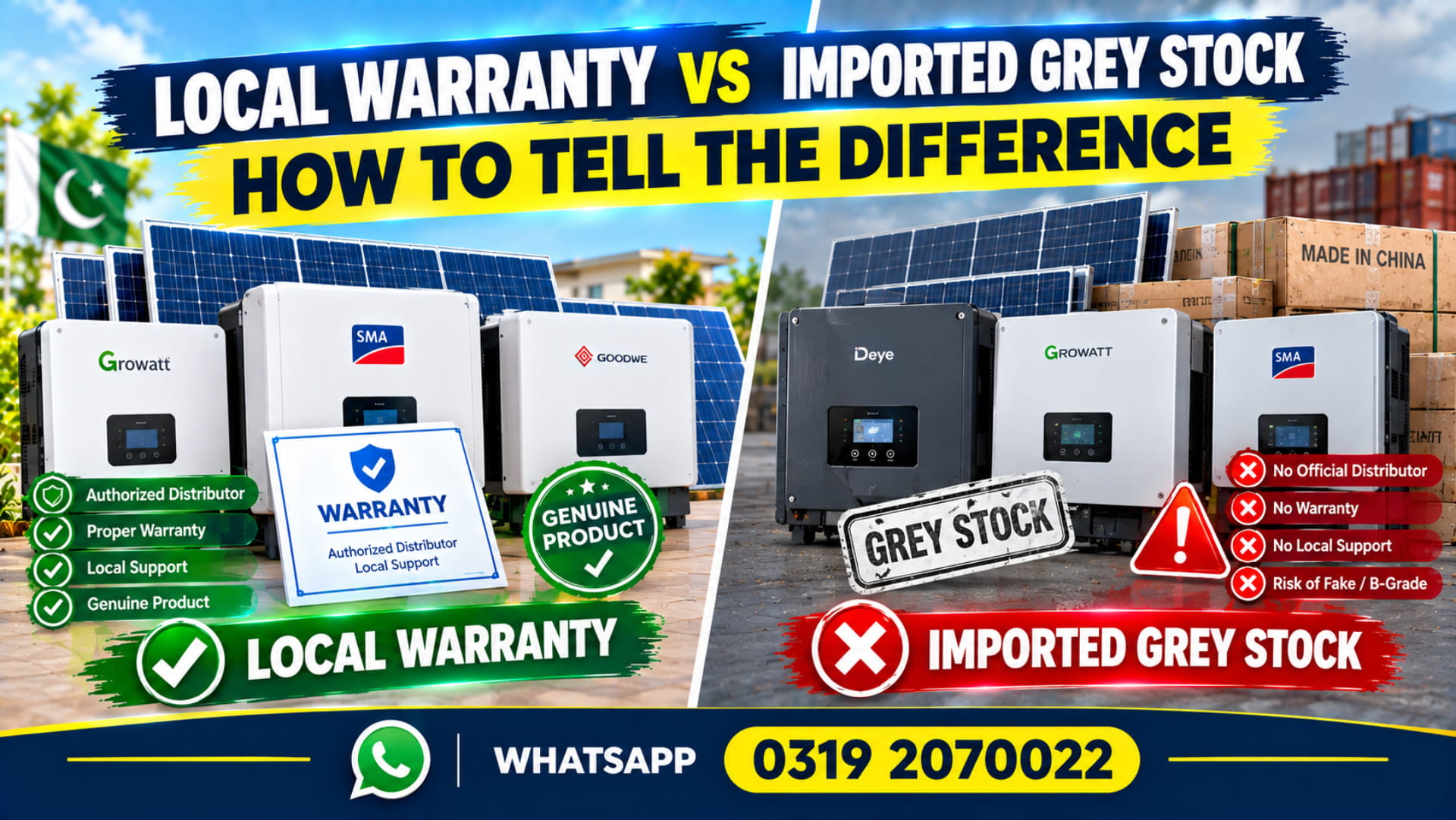
Two inverters can sit side by side on a shop counter, carry the same brand name, show the same model number, and still be completely different purchases. One arrives through the brand’s official channel in Pakistan with a warranty that someone local is obliged to honour. The other arrives through a side door, often cheaper, with a warranty that exists on paper and nowhere else.
That second kind is what the trade calls grey stock. It is not always counterfeit and it is not always faulty, which is exactly why it catches so many buyers out. This guide explains what grey stock actually is, why it is priced lower, what you give up when you buy it, and the specific checks that tell the two apart before you pay.
For a genuine unit with a warranty we will stand behind, WhatsApp 03192070022.
What “Grey Stock” Actually Means
Grey stock is genuine product that reaches the Pakistani market outside the brand’s authorised distribution. A trader imports a batch directly, or buys surplus intended for another market, and sells it without the manufacturer’s local distributor being involved.
The unit itself is often real. The difference lies in what surrounds it:
- No official local distributor is responsible for it.
- The warranty may be issued by the seller rather than the brand, or tied to a different country.
- The firmware, labelling or packaging may be intended for another market.
- Service centres and parts supply are not obliged to support it.
“Local warranty stock,” by contrast, comes through the authorised channel. The brand’s Pakistani representative registers it, stands behind the warranty, and supports it with technicians and spare parts.
Neither label guarantees quality on its own. What they decide is who you call, and whether anyone answers, when something goes wrong.
Why Grey Stock Is Cheaper
The price gap is real, and it has understandable causes.
No distributor margin to cover. Authorised channels carry the cost of service centres, trained technicians, spare parts inventory and warranty claims. Grey sellers carry none of that, so they can price lower.
Bulk or surplus purchasing. Stock bought in volume from another market or from clearance lots can be genuinely cheaper at source.
Cost cutting on everything after the sale. The saving is frequently funded by the support you will never receive.
None of this makes the lower price dishonest. It makes it a trade: you accept the risk of a warranty that may not work in return for paying less upfront. The problem arises when buyers do not realise they have made that trade.
What You Actually Give Up With Grey Stock
A warranty someone will honour in Pakistan
This is the central difference. A warranty is only as good as the party obliged to fulfil it. If the brand’s local distributor has no record of your unit, they can decline the claim, and your only recourse is the seller who may no longer be reachable.
Predictable repair times
Authorised service centres hold parts and follow a defined process. For an unsupported unit, a repair can mean shipping it to a workshop that has never seen that model, or waiting for a part that has no local supplier.
Market-correct configuration
Units made for other grids can ship with settings suited to a different voltage or frequency standard, or with a display language and manual that do not match. A unit configured for the wrong grid behaviour can misbehave on Pakistan’s supply.
Net metering eligibility
If net metering is part of your plan, approved equipment lists and documentation matter. Our solar inverter price in Pakistan overview explains why you should confirm that your DISCO accepts the exact model before buying, and grey stock is where that confirmation is hardest to obtain.
Resale confidence
A unit with registered local warranty is easier to sell on, because the next buyer can verify it. Grey stock tends to trade at a discount for the same reason it was bought at one.
How to Tell the Difference Before You Pay
No single check is conclusive. Together they separate the two kinds reliably.
1. Ask who issues the warranty, in writing
For local warranty stock, the warranty is issued or registered by the brand’s authorised Pakistani distributor. For grey stock, it is usually the shop’s own promise. Ask directly: “Is this warranty backed by the brand’s official distributor in Pakistan?” Then ask for it written on the invoice or warranty card with the distributor’s name.
2. Ask where the nearest authorised service point is
A seller selling official stock can name the service centre in your region and describe how a claim is handled. Vague answers such as “we will sort it out” are a warning sign.
3. Check the packaging and label
Genuine local stock generally carries consistent labelling that matches the brand’s official model listing for the Pakistani market. Mismatched language, different regulatory markings, missing distributor stickers, or a label that looks reprinted deserve questions.
4. Verify the model code against the manufacturer’s official listing
Match the model code on the box, the unit and the quote against the brand’s own published specifications. A code that does not exist, or specifications that differ from the listing, point to a rebadged or altered unit.
5. Look for a registration step
Official distributors typically register the serial number at the point of sale. If nobody asks for your details or records the serial, ask why. Unregistered units are harder to claim against.
6. Compare the price against the market, honestly
A price modestly below others can reflect a smaller margin. A price far below every other seller usually reflects either grey stock or something worse. Our inverter price in Pakistan today guide shows how wide legitimate retail variation really is, which helps you judge what counts as suspiciously low.
7. Test the seller, not just the product
A seller with a verifiable trading address, a history and reviews you can check behaves differently from one operating from a phone number. Visit, ask questions and note how they respond. Confidence about the warranty is a good sign. Defensiveness is not.
A Simple Comparison
| Factor | Local Warranty Stock | Imported Grey Stock |
|---|---|---|
| Warranty backed by | Brand’s authorised Pakistani distributor | Often the seller only |
| Service and parts | Defined process, local technicians | Unpredictable, may be unsupported |
| Configuration | Intended for the local market | May be intended for another market |
| Price | Higher | Lower |
| Net metering paperwork | Easier to confirm | Harder to confirm |
| Resale | Easier | Harder |
The table is not a verdict that grey stock is always a mistake. It is a description of the trade you are making.
When Grey Stock Might Still Make Sense
We would rather be honest than absolute. A buyer who understands the trade, can verify the unit independently, has technical skill to handle faults without the brand, and is buying a lower-stakes unit may reasonably accept the risk for a real saving. That describes a minority of buyers.
For most households, the inverter is the component that keeps the fridge, fans and router running through load shedding, and the one that cannot afford a month in a workshop. The saving rarely justifies the exposure. For businesses where downtime costs money every day, it almost never does.
If You Have Already Bought Grey Stock
It is not a disaster, but it does call for a few practical steps.
Keep every document. The invoice, the seller’s warranty card, the box, the serial number and any messages with the seller are your evidence if a claim arises. Photograph the label and serial number now, while the unit is healthy.
Get the installation right. Correct earthing, surge protection, cable gauge and ventilation remove the most common causes of failure, and they matter more when you cannot count on warranty support. A unit that is installed well is simply less likely to need a claim.
Confirm the settings. Ask a qualified installer to check that the output voltage, frequency and grid-protection settings suit Pakistan’s supply, rather than assuming the factory defaults are correct.
Identify a repair route before you need one. Find a technician who is willing to service that model, and ask what parts they can source. Knowing this in advance turns a future fault into a scheduled job instead of an emergency.
Check net metering early. If you plan to apply, ask your DISCO whether the model is acceptable before the paperwork is underway, so a rejection does not arrive after the panels are installed.
Red Flags That Suggest a Problem Beyond Grey Stock
Some situations are worse than grey stock and deserve walking away.
- A price dramatically below every other seller.
- Refusal to write the warranty terms on the invoice.
- Pressure to pay immediately or in cash only, with no receipt.
- No datasheet available, or specifications that change between conversations.
- Packaging that has clearly been opened and resealed.
- A seller who cannot say where the stock came from.
Counterfeit and rebadged units exist in the market, particularly for popular models, and they combine every risk above with an outright false product. If something feels wrong, trust that.
What We Do Differently
We stock genuine units with manufacturer warranty and ISO-certified handling, ship nationwide, and tell buyers plainly which brand’s service network reaches their city. If a brand is thin in your region, we say so, and we point you to the one that is not.
If you want a sense of which brands have the strongest support, our best inverter brand in Pakistan 2026 ranking weighs service network alongside price and build quality, and our is Crown a good inverter brand review is candid about where one popular brand’s service reach is thinner outside the major cities. For a direct comparison between two leading names on exactly this question, see Crown vs Inverex.
The same logic applies to batteries, where warranty backing matters just as much as it does for the inverter. Pricing moves too often to print here, so WhatsApp us now for the latest price of the battery at 03192070022.
Genuine product imported outside the brand’s authorised Pakistani distribution, usually without a locally honoured warranty.
No. The unit may be genuine, but its warranty, service support and configuration are not guaranteed locally.
Ask for it in writing, naming the brand’s official distributor, and confirm the serial number is registered at the point of sale.
No, but a price far below every other seller is a strong warning sign worth investigating before you pay.
Yes. Your DISCO must accept the exact model, and confirming that is harder without official documentation.
Get a Genuine Unit With Real Warranty
Tell us your budget, your city and what the inverter needs to run, and we will recommend a genuine model with a warranty that someone local will actually honour.
WhatsApp 03192070022 for today’s rates and honest advice.
This guide reflects general market practice as of October 2026. Warranty terms vary by brand and model, so confirm the exact terms in writing with your dealer before ordering.