
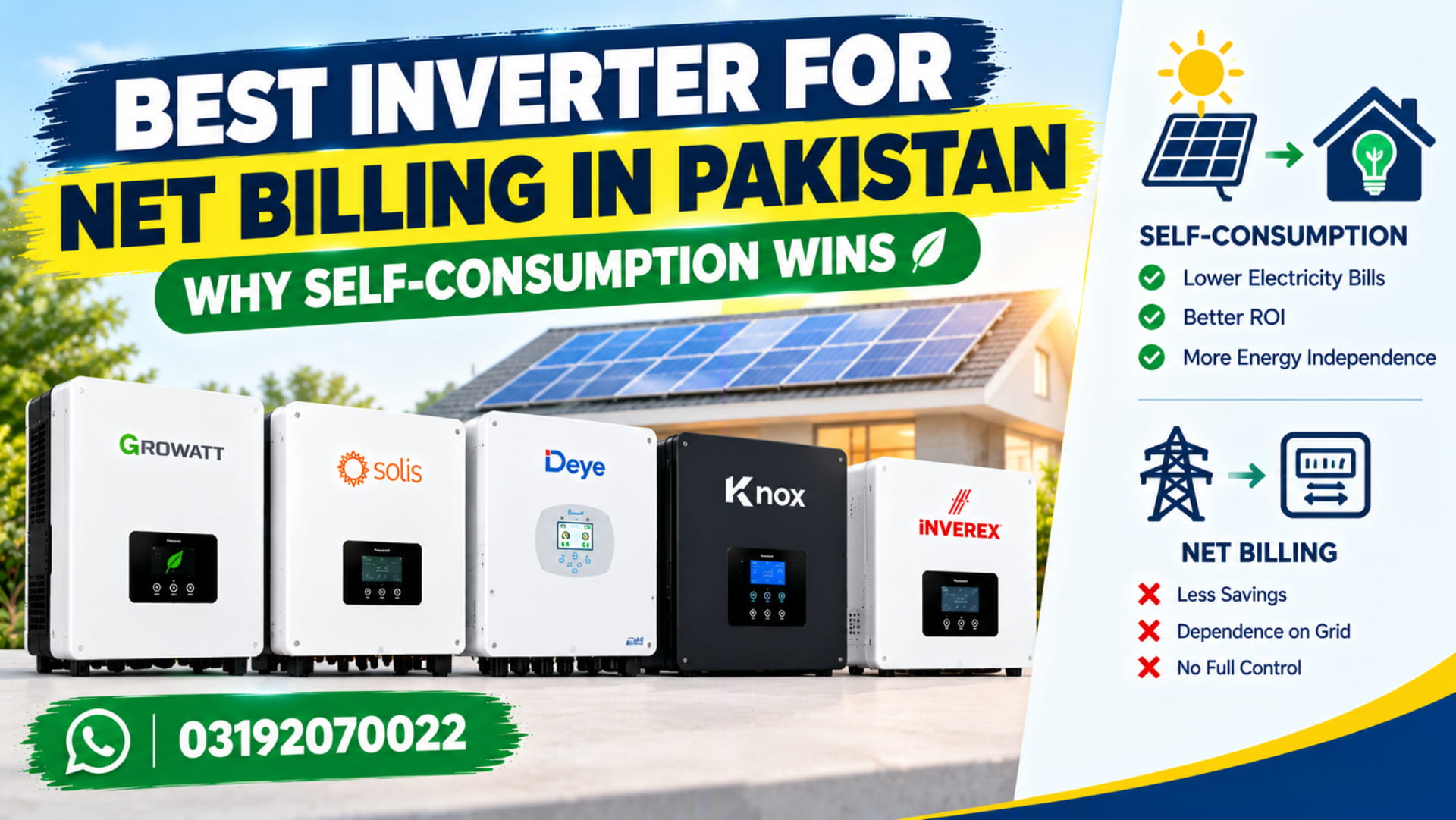
Under net billing, exported electricity is reported to be bought back at roughly Rs. 11 per unit, while the electricity you draw from the grid still costs somewhere around Rs. 40 to Rs. 50 per unit. That four-to-one gap changes what “best inverter” actually means. Under the old net metering rules, a bigger inverter that generated more than you needed was still money in your pocket, because export was worth almost what import cost. Under net billing, generating more than you can use at the moment you use it is now a mediocre outcome dressed up as a good one.
The best inverter for net billing is not the one with the highest kilowatt rating or the flashiest brochure. It is the one with the specific features that let you consume your own solar power the moment it is generated, store the surplus for later rather than exporting it cheaply, and show you clearly how well that is actually working. This guide names those features directly, so you can evaluate any quote against them rather than against a capacity number alone.
For a recommendation built around maximising your own self-consumption, not just hitting a kilowatt target, WhatsApp 03192070022.
Self-Consumption Is the Metric That Now Decides Your Bill
Self-consumption is simply the share of your solar generation that you use directly in your own home or business, as opposed to the share exported to the grid. Under net metering, this number barely affected your bill, because export and import were priced close to the same. Under net billing, it is close to the entire story.
A system that generates well but self-consumes poorly, because nobody is home during the day, because the battery is too small to absorb the midday surplus, or because the inverter has no way to manage the shift, will show a respectable generation figure on paper and a disappointing bill saving in practice. The inverter’s job, under these rules, is to maximise that self-consumption share, not simply to convert DC to AC at a high rated capacity.
Feature One: A Battery the Inverter Actually Communicates With Properly
This is the single biggest lever. A battery stores midday surplus, worth roughly Rs. 11 per unit if exported, and releases it in the evening, worth roughly Rs. 40 to Rs. 50 per unit if it replaces a grid import. That spread is the entire financial case for pairing a battery with your inverter under net billing.
What matters is not simply “does it support a battery” but whether the inverter communicates properly with the battery’s BMS, particularly for lithium. A unit that only reads battery voltage to estimate charge state manages the battery crudely and often charges or discharges less efficiently than one that receives real state-of-charge and health data directly from the BMS over a proper communication protocol. Ask specifically whether the model you are quoted supports BMS communication for the battery chemistry you plan to use, not just “yes it works with lithium” as a vague answer.
Feature Two: Export Limiting or Zero-Export Capability
Many modern hybrid inverters can be configured to cap, or entirely stop, how much power is sent to the grid, prioritising the battery and your own load first and only exporting once both are satisfied, or not exporting at all.
Under net billing’s low buyback rate, this feature has gone from a nice-to-have to one of the more financially relevant specifications on the sheet. An inverter without this capability will push surplus to the grid at the low export rate even when your battery still has room to absorb it, simply because its logic was never built to prioritise storage over export. Ask the dealer directly whether the model supports export limiting or a zero-export mode, and whether your installer actually configures it at commissioning rather than leaving the inverter on its factory default export behaviour.
Feature Three: Real Monitoring, Not Just a Blinking Light
You cannot manage what you cannot see. A monitoring app or web portal that shows generation, self-consumption, export and import as separate live figures, not just a single combined “power flow” animation, is what lets you actually tell whether your system is behaving the way net billing rewards.
This matters practically, not just for curiosity. If your monitoring shows a consistently high export share during the day, that is a concrete signal to either add battery capacity, shift a load, such as running the washing machine or ironing at midday instead of the evening, or review your export-limiting settings. Without that visibility, you are optimising blind.
Feature Four: Dual or Multi-MPPT for a Realistic Roof
Most Pakistani roofs are not a single flat, unshaded, south-facing surface. A parapet, a water tank, a neighbouring wall or a second roof face mean your panels often split across more than one orientation or experience partial shading at different times of day.
An inverter with at least dual MPPT, and ideally more on larger systems, lets each string generate independently rather than having the whole array dragged down to match its weakest section. Under net billing, that matters more than it used to, because a dragged-down array produces less usable power exactly when your daytime load, and therefore your self-consumption opportunity, is at its highest.
Feature Five: Smart Charge and Discharge Scheduling
A hybrid inverter’s settings menu decides when the battery charges from solar, when it charges from grid if ever, and when it discharges to cover load instead of drawing from the grid. Under net billing, the correct default behaviour is almost always: charge the battery from solar first, avoid charging it from the grid at full retail rate unless you specifically need to pre-charge for a planned outage, and discharge it during your highest-load evening hours rather than letting the grid cover that load by default.
Not every inverter makes this easy to configure correctly, and not every installer sets it up that way out of the box. Ask specifically how charge priority and discharge timing are configured on the model you are buying, and confirm the installer will set it to favour self-consumption rather than leaving factory defaults in place.
Feature Six: Enough Surge Headroom to Avoid Falling Back to the Grid
An inverter that trips or drops to grid-only mode when a motor load starts, an air conditioner compressor or a water pump, forces you back onto the expensive side of the net billing equation at exactly the moment you most wanted to be running on stored or generated power. Adequate surge rating is a self-consumption feature as much as it is a reliability one, because every unplanned fallback to the grid is a unit you are buying at the full retail rate instead of using your own.
For the actual numbers behind sizing this correctly, our what size inverter do I need guide walks through the load calculation, including the surge margin that motor loads require.
Feature Seven: Load Prioritisation Across Circuits
Dual output or load-prioritisation lets the inverter decide which circuits draw from the battery first and which can fall back to grid if the battery is low, rather than treating the whole house as one undifferentiated load. For a household or small business trying to maximise self-consumption without oversizing the battery, this lets a smaller, better-targeted battery cover the loads that matter most, essential lighting, refrigeration, a priority AC, while letting less critical circuits draw from the grid when the battery is genuinely low.
What This Looks Like in a Real Shortlist
When you are comparing quotes, run each one through this list rather than comparing kilowatt ratings alone: proper BMS communication for your chosen battery chemistry, export limiting or zero-export capability, a monitoring app that separates self-consumption from export rather than showing one blended number, dual or multi-MPPT, configurable charge and discharge scheduling, adequate surge rating for your actual motor loads, and load prioritisation across circuits.
Two inverters at the same headline capacity can differ meaningfully on every one of these, and the cheaper of the two is very often the one missing several of them. Our best hybrid inverter in Pakistan 2026 roundup names specific models against criteria like these, and our best inverter brand in Pakistan 2026 ranking is worth reading alongside it, because a brand’s monitoring app quality and firmware polish, not just its hardware spec sheet, is part of how well it actually delivers on self-consumption in daily use.
Don’t Oversize the Inverter Chasing This List
A common mistake is assuming a bigger inverter automatically delivers better self-consumption, since a bigger unit “has more features.” That is not how it works. Self-consumption is driven by how well your panel array, battery and inverter settings match your actual daytime and evening load shape, not by the inverter’s rated capacity. An 8kW inverter serving a 3kW household does not self-consume better than a correctly sized 5kW unit with a properly matched battery and good settings. It simply costs more to buy and runs further from its efficient operating range. Size the inverter to your real load first, using the hybrid inverter price in Pakistan guide to see what the features above cost at each realistic capacity, then insist on the feature list above at that capacity rather than jumping a tier.
Battery Capacity Still Has to Match Your Pattern
None of the inverter features above substitute for a battery sized to your actual daily surplus and evening load. An inverter with excellent export limiting and scheduling can still end up exporting a lot of cheap power simply because the battery fills by early afternoon and has nowhere left to put the rest of the day’s generation. Our how many batteries for a 6kW inverter guide works through that sizing arithmetic. Because battery pricing changes too often to print reliably, WhatsApp us now for the latest price of the battery at 03192070022 for a bank sized to your actual surplus and evening load pattern, not a generic recommendation.
Mistakes to Avoid
Choosing by kilowatt rating alone. Two inverters at the same capacity can behave completely differently under net billing, depending on the seven features above.
Leaving factory default settings in place. An inverter capable of smart charge and export-limiting behaviour does nothing for you if the installer never configures it that way.
Oversizing the inverter instead of matching the battery and panels. Capacity beyond your real load adds cost without adding self-consumption.
Ignoring the monitoring app until after you own the system. Checking app quality, update frequency and whether it actually separates self-consumption from export, before buying, saves a frustrating discovery later.
Assuming a cheaper qute has the same feature set. It frequently does not. Ask for each of the seven features explicitly rather than assuming a lower price is simply a better deal on an identical product.
Its ability to maximise self-consumption: proper battery communication, export limiting, clear monitoring, dual MPPT, smart charge scheduling, adequate surge headroom and load prioritisation, not simply its rated capacity.
No. Self-consumption depends on matching the inverter, battery and panel array to your actual load pattern, not on buying a larger unit than you need.
Yes. Under net billing’s low buyback rate, an inverter that prioritises charging your battery over exporting surplus protects more of your bill than one that exports by default.
Some, like charge-priority settings, often can be reconfigured. Others, like BMS communication protocol or MPPT count, are built into the hardware and cannot be added after purchase.
Both work together, but a well-specified inverter with a modest, correctly sized battery usually outperforms an oversized inverter with a battery too small to use its own capabilities.
Get a Recommendation Built Around Self-Consumption
Tell us your daytime occupancy pattern, your evening load, and your budget, and we will recommend a specific inverter and battery combination chosen for how well it keeps your own power at home under net billing, not just for its kilowatt rating.
WhatsApp 03192070022 for today’s rates and a straight recommendation.
Figures and policy details referenced here reflect the net billing framework as publicly reported as of October 2026. Confirm current rates and your own tariff details with your DISCO, and current equipment pricing before ordering.