
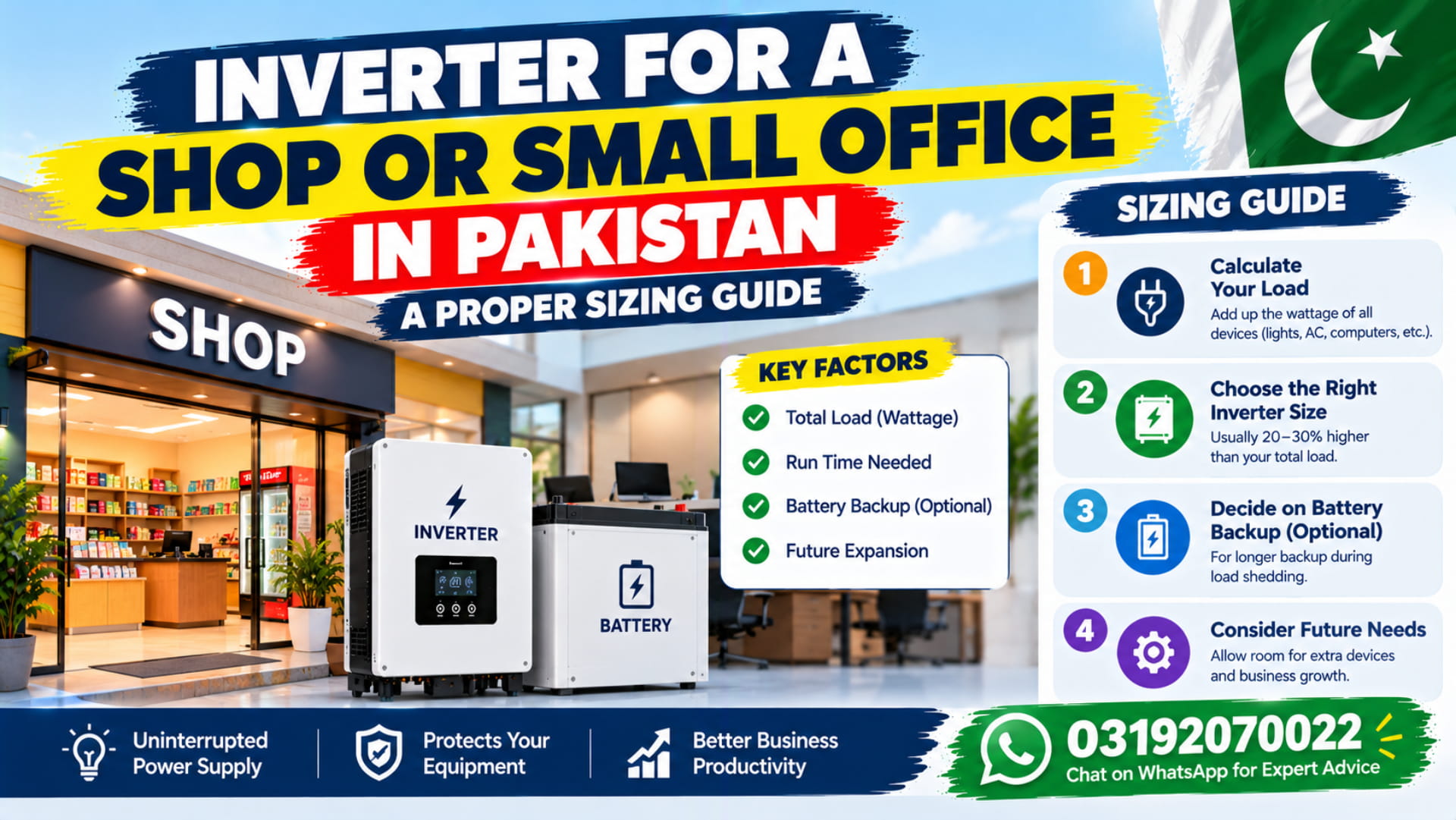
Most inverter sizing advice in Pakistan is written for houses, and shop owners end up adapting it as best they can. That usually means either buying too small, because a shop “looks” smaller than a house, or buying too big, because the dealer defaults to the same number he sells to everyone on the street. Neither is right, because a shop’s load behaves nothing like a house’s load.
A home draws its heaviest load for a few hours in the evening, when the family is in and the ACs are on. A shop draws a steady load for ten to twelve hours straight, seven days a week, with the AC, lighting, a fridge or freezer, and counter equipment all running through the exact hours the sun is also out. That difference changes not just the capacity you need, but what the system is actually for.
This guide works through a realistic shop and small office load, the capacity that fits it, and where shop sizing genuinely diverges from the house-sizing advice you may already have read. For a recommendation based on your actual shop, WhatsApp 03192070022.
The Short Answer
For a small to medium shop or office in Pakistan, essentially any single retail unit, a boutique, a mobile or electronics shop, a pharmacy, or a small office with a handful of desks, a 3kW to 5kW hybrid inverter covers the load correctly in most cases.
Move up to 6kW if the shop runs one 1.5 to 2 ton AC continuously through business hours alongside display lighting, a fridge or freezer, and several counters or workstations.
A larger shop, a small supermarket, or a unit with two ACs and heavy display lighting moves into the same 6kW to 8kW territory covered for larger homes, and the same surge and oversizing principles apply, just driven by different appliances.
The rest of this guide shows the working, because “shop” covers everything from a single-counter mobile accessories stall to a small supermarket, and the right number depends on what is actually plugged in.
Why a Shop’s Load Profile Is Different From a House
Three things separate a shop from a house, and all three change the sizing decision.
The load runs all day, not for a few evening hours. A house’s heaviest draw is a short evening window. A shop’s AC, lighting, fridge and counter equipment run for the entire business day, which means the system spends far more hours near its typical load than a house inverter ever does.
Daytime solar self-consumption matters more than night backup. A house mostly wants backup for the evening and night, when solar generation has stopped. A shop is open during daylight hours, so solar panels can directly offset the bill in real time rather than simply charging a battery for later. This changes what you are actually buying the system to do.
An outage during business hours costs money immediately, not just comfort. A house losing power for an hour is an inconvenience. A shop losing power for an hour can mean a card machine that cannot process a sale, a freezer warming up on stock that cannot be re-frozen, or customers walking out because the shop looks closed. The cost of downtime is real and immediate in a way it usually is not for a home.
Keep these three differences in mind, because they explain several sizing choices below that would look odd if you were sizing a house instead.
A Realistic Shop Load Profile
Here is a load table for a typical small to medium retail shop, using running wattage.
| Load | Quantity | Running Watts |
|---|---|---|
| 1.5 ton inverter AC | 1 | 900–1,600 |
| LED display and track lighting | — | 150–400 |
| General ceiling/wall fans | 2–4 | 120–320 |
| Refrigerator or display chiller | 1 | 150–350 |
| Deep freezer (pharmacy, bakery, general store) | 1 | 200–400 |
| POS machine, card reader, barcode scanner | — | 50–100 |
| Signage or lightbox (if illuminated) | 1 | 60–150 |
| Computer or laptop, small office setup | 1–3 | 150–450 |
| Printer or small office equipment | — | 100–200 |
For a small office rather than retail, swap the fridge and display lighting for more computers, printers and perhaps a water dispenser, and the totals land in a similar range.
Essentials-only load (lighting, fans, fridge, counter electronics, no AC) typically runs 700W to 1,400W, comfortably inside a 2kW to 3kW inverter.
With one AC running through business hours, the simultaneous load climbs to roughly 1,800W to 2,800W, which is where a 3.6kW to 5kW hybrid becomes the sensible choice.
With two ACs, or a larger display and refrigeration load, expect 3,000W to 4,800W, pushing into the 5kW to 6kW range covered in more depth in our 3.6kW vs 5kW vs 6kW comparison.
If you want to build this number precisely for your own shop rather than using a bracket, the method in our room-by-room load calculation guide applies just as well to a shop floor as it does to a house, counter by counter instead of room by room.
Surge Still Matters, Even Without a Water Pump
A shop usually has fewer motor loads than a house, often just the AC compressor and perhaps a refrigeration compressor, but those two can still start close together, particularly on a hot afternoon when the AC cycles on right as the fridge compressor also kicks in.
For a shop running one AC and one refrigeration unit, a surge rating of at least 6,000VA to 7,000VA gives comfortable margin. If the shop runs two ACs, size the surge rating the same way you would for a two-AC house, and check our 1.5 ton AC startup load guide for the actual numbers behind that compressor surge.
Battery Sizing for a Shop Is a Different Question Than for a House
This is where shop sizing genuinely parts ways with house sizing, and it is worth being deliberate about rather than copying a house formula.
A house typically wants enough battery to cover an evening and overnight outage comfortably. A shop open roughly ten to twelve hours a day, closed overnight, has a fundamentally different need: the battery mostly exists to cover a daytime outage without interrupting business, not to run the shop through the night when it is closed anyway.
That means two sensible approaches exist, and which one fits depends on how often your area loses power during business hours specifically. If daytime outages are frequent, size the battery bank to cover your heaviest typical daytime load, AC included, for the length of your longest common outage. If daytime outages are rare and most of your load shedding happens overnight when the shop is shut, a smaller battery focused on keeping the fridge, freezer, security system and essential lighting alive overnight is the better spend, since the AC and most other load simply is not needed while the shop is closed.
Our how many batteries for a 6kW inverter guide works through the underlying arithmetic for both chemistries. Because battery pricing changes too often to print reliably, WhatsApp us now for the latest price of the battery at 03192070022 for a configuration matched to whichever of the two patterns above fits your shop.
Maximising Daytime Solar Self-Consumption
Because a shop is open during daylight hours, the panels can offset load in real time rather than simply charging a battery for later use. A few practical points follow from that.
Size the panel array around your daytime running load, not just the inverter’s rated output. A shop that runs 2,000W to 3,000W steadily through the afternoon benefits from a panel array that can comfortably supply that in real time, which argues for a reasonably generous array even on a modest-capacity inverter.
A dual-MPPT inverter helps if your shopfront has limited or awkward roof space. Many commercial units share a roof, face a single direction, or have a shaded section from a neighbouring building, and splitting panels across two MPPT trackers makes better use of whatever space is actually usable.
Don’t oversize the battery at the expense of the panel array. For a shop leaning on daytime self-consumption, a bigger panel array earns its cost faster than a bigger battery does, because every watt a panel supplies directly during business hours is a watt the shop never has to buy from the grid or draw from a battery at all.
What Specifications Actually Matter for a Shop
Dual output or load prioritisation, so refrigeration and security systems stay protected even if the AC gets dropped during a battery-only stretch.
A protection rating suited to the mounting position, which in many shops means a utility area, storeroom or a wall behind the counter rather than a purpose-built utility room. The same clearance and ventilation principles that apply to a house apply here, perhaps more so, since a cramped storeroom behind a shop counter is a common and poor mounting choice.
Reasonable PV oversizing headroom, for the same reason it matters in a house: a shop that depends on solar through the working day benefits from an array sized above the inverter’s bare rating, so cloudy days and winter still contribute something useful.
A reliable brand with accessible local service. Downtime during business hours has a direct cost, which makes service-centre proximity worth more to a shop owner than it typically is to a homeowner. Our hybrid inverter price in Pakistan guide breaks down what separates budget and premium options at each capacity.
Commercial Electricity Tariffs Change the Payback Maths
Commercial electricity tariffs in Pakistan are generally structured differently from domestic ones, and in many cases commercial rates run higher per unit than the equivalent domestic slab. That tends to make solar payback faster for a shop than for a house of similar consumption, because every unit of grid electricity it avoids buying is worth more. Exact commercial tariff rates and slabs vary by distribution company and change periodically, so confirm your specific commercial tariff with your DISCO or your latest bill rather than assuming a figure, and use that real number when working out your own payback period.
Mistakes Shop Owners Make When Sizing
Copying a house-sizing bracket without accounting for daytime load. A shop open all day has a fundamentally different usage pattern than a house, and sizing purely from square footage or “what my neighbour’s shop has” misses it.
Underestimating refrigeration load. A fridge or chiller running continuously, cycling on and off through the day, adds up to more cumulative draw than its running wattage alone suggests, especially in summer.
Treating battery sizing the same as a house’s overnight backup. As covered above, a shop’s real battery need is usually about daytime outages, not keeping a closed shop running overnight.
Skipping surge and earthing budget on a smaller system. The assumption that a smaller shop system needs less protection is wrong. Grid spikes damage a 3kW shop inverter just as readily as a 6kW house inverter.
Ignoring the commercial tariff when judging payback. Using a domestic tariff figure to estimate savings understates how quickly a shop’s system actually pays for itself.
A Buying Checklist for a Shop or Small Office
- List every appliance that runs during business hours, with the AC and any refrigeration as the two to measure most carefully.
- Decide whether your real backup need is a daytime outage, an overnight one, or both, and size the battery around whichever actually happens where you are.
- Ask for the surge rating in VA, not just the continuous kilowatt figure.
- Confirm the mounting position has genuine ventilation, not just available wall space behind the counter.
- Ask about dual output or load prioritisation so refrigeration and security stay protected during a battery-only stretch.
- Confirm your commercial electricity tariff with your DISCO before estimating payback.
- Get the warranty term and nearest service centre in writing, since downtime during business hours has a real cost.
Most small to medium shops with one AC need 3.6kW to 5kW. Essentials-only shops without AC backup can often use 2kW to 3kW.
Yes. A shop runs its heaviest load during the day rather than the evening, which changes both the battery strategy and how much weight daytime solar self-consumption carries.
Not necessarily, and often less. Many shops are closed overnight, so the real battery need is covering a daytime outage, not an overnight one.
Broadly similar to the equivalent house capacity, since the inverter itself does not know whether it is in a shop or a home. Expect the same ranges as a 3.6kW to 6kW hybrid for a house.
Yes, often more noticeably than for a house, because commercial tariffs tend to be higher per unit and a shop’s daytime hours line up directly with peak solar generation.
Get a Quotation for Your Shop or Office
Tell us your business hours, what runs during the day, and whether your area’s outages are more common during the day or at night. That is enough for us to recommend the right capacity, panel array and battery strategy for how your shop actually operates, not how a house operates.
WhatsApp 03192070022 for today’s rates and a straight recommendation.
Prices and tariff structures referenced here are indicative as of October 2026 and vary by brand, specification and distribution company. Confirm current commercial tariff rates with your DISCO and current equipment pricing before ordering.