
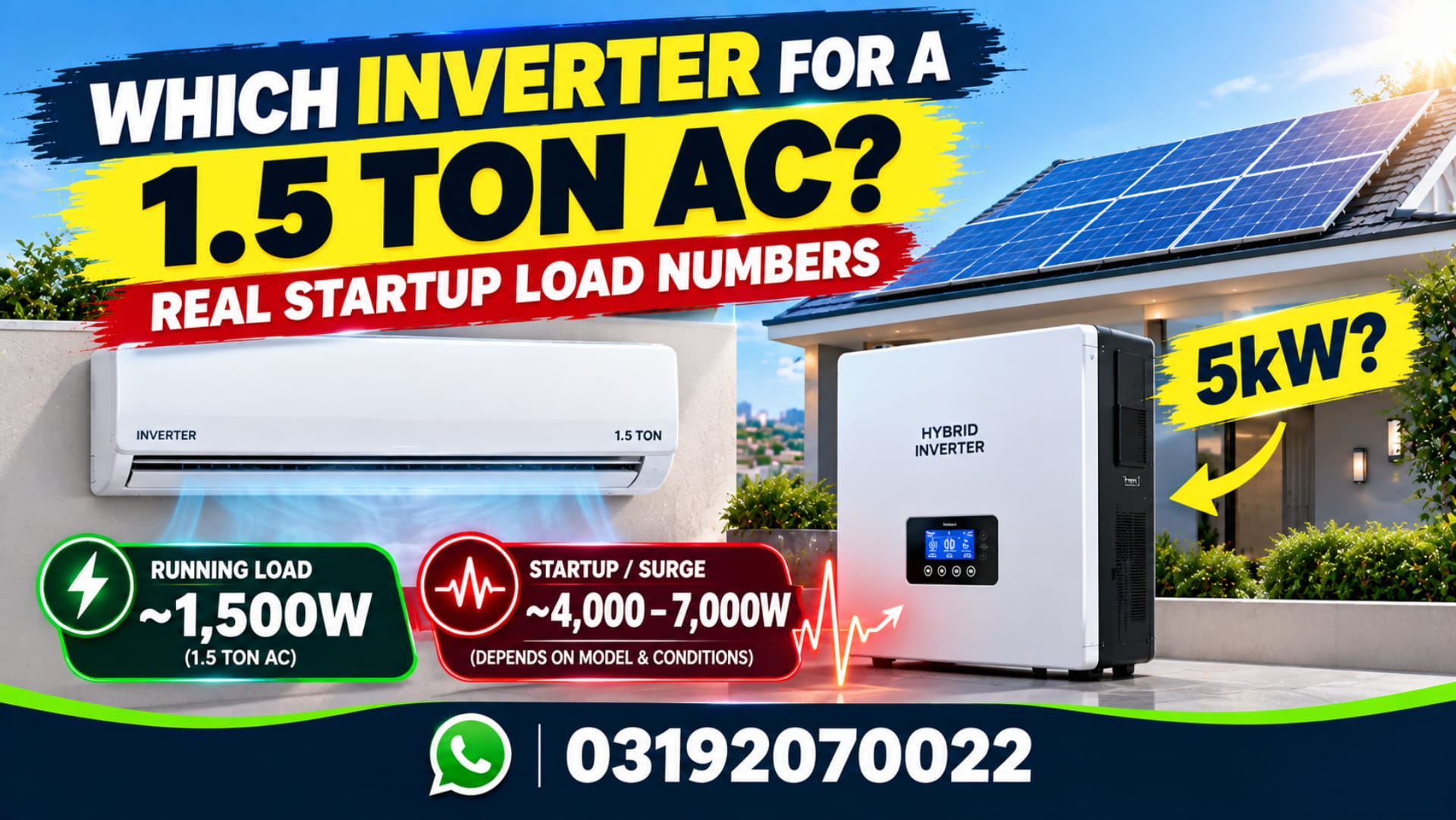
Ask five dealers what inverter a 1.5 ton AC needs and you will get five different answers, most of them a round number pulled from habit rather than the actual startup current your specific AC draws. The honest answer depends on one number almost nobody quotes correctly: the compressor’s locked-rotor surge, not its running wattage.
This breaks down what a 1.5 ton AC actually pulls at the moment it starts, why that number decides your inverter choice far more than the running wattage does, and what capacity actually copes with it. For a recommendation matched to your specific AC model, WhatsApp 03192070022.
Running Watts vs Starting Watts: Where the Confusion Comes From
Every AC compressor has two very different power figures, and dealers routinely quote only the smaller one.
Running watts is the steady draw once the compressor is up to speed, typically what shows on the AC’s energy label. For a 1.5 ton unit this sits roughly between 1,200W and 1,800W depending on whether it is an inverter-technology or fixed-speed compressor.
Starting watts (locked-rotor surge) is the burst the compressor motor pulls in the fraction of a second it takes to overcome the resistance of a stationary rotor and get spinning. This can run two to three times the running figure, briefly. It lasts well under a second, but an inverter that cannot supply it will trip, shut down, or in cheaper units, audibly strain and sometimes stall the compressor entirely.
Sizing an inverter against running watts alone is the single most common mistake we see in AC-related support queries, and it is almost always the reason an inverter that “should” handle the AC on paper keeps cutting out the moment the compressor kicks in.
Real Numbers: What a 1.5 Ton AC Actually Draws
| AC Type | Running Watts | Typical Starting Surge |
|---|---|---|
| 1.5 ton non-inverter (fixed speed) | 1,500–1,800 | 3,800–4,800 |
| 1.5 ton inverter-technology AC | 900–1,600 (varies with load) | 2,000–3,200 |
| 1.5 ton DC inverter AC (soft-start) | 800–1,400 | 1,800–2,800 |
These are ranges rather than a single figure because compressor design, refrigerant, ambient temperature and how hard the unit is working all move the number. A compressor starting cold on a mild morning surges less than the same unit restarting on a 45°C afternoon after the thermostat cycles it off and back on within minutes, which is a pattern worth remembering: a hot re-start is often the highest-stress moment for your inverter, not the very first startup of the day.
Inverter-technology ACs are the more forgiving load. Most use a variable-frequency drive that ramps the compressor up gradually rather than slamming it to full speed instantly, which is why their starting surge sits meaningfully below a fixed-speed unit’s. If you are choosing between AC types specifically to make inverter sizing easier, inverter-technology wins clearly.
Fixed-speed (non-inverter) ACs hit hardest at startup. The compressor goes from stationary to full speed almost instantly, and the surge reflects that. An older 1.5 ton fixed-speed unit is the toughest single load most households ask a home inverter to handle.
What Inverter Capacity Actually Copes With This
The running wattage of a single 1.5 ton AC fits comfortably inside almost any inverter sold in Pakistan today, 3kW and above. The surge rating is what actually separates a unit that handles it cleanly from one that trips.
For one inverter-technology 1.5 ton AC alongside normal household load (fans, lights, fridge, router), a 3kW to 4kW inverter with a surge rating of at least 6,000VA to 7,000VA is comfortable. Most mid-tier hybrid inverters in this capacity class meet that bar.
For one fixed-speed 1.5 ton AC, look for a surge rating closer to 7,000VA to 8,000VA given the harsher startup curve, even though the running load is similar to the inverter-technology equivalent.
For two 1.5 ton ACs that might start within seconds of each other (both thermostats cycling around the same time on a hot afternoon), you need the inverter’s surge rating to clear the sum of one AC’s surge plus the other’s running load at minimum, and ideally both surges close together. This is where households running multiple bedrooms with AC most often undersize. A 5kW to 6kW inverter with a strong surge rating is the realistic starting point here rather than the 3kW to 4kW that comfortably handles a single AC.
For the full room-by-room method that gets you to an exact total rather than a single-appliance estimate, see our room-by-room load calculation guide.
Why “Rated Capacity” on the Box Is Not the Whole Story
Manufacturers quote an inverter’s continuous VA rating prominently and its surge rating in smaller print, sometimes not at all on the retail packaging. Two inverters both labelled “5kW” can differ by 30% or more in surge capability depending on the internal design, and that difference is invisible unless you specifically ask for the surge figure or check the datasheet.
Ask your dealer for the surge rating in VA before buying, not just the continuous kW figure. If they cannot answer, that is a sign to ask a different dealer, not to guess.
Sizing Mistakes We See Most Often With AC Loads
Buying based on running watts alone. The AC’s energy label shows running consumption, not startup surge, and dealers who size purely off that label are setting buyers up for exactly the trip-and-shutdown complaint that brings most people to this question in the first place.
Assuming inverter-technology AC needs no special sizing consideration. It surges less than a fixed-speed unit, but it still surges, and pairing it with an undersized inverter’s low surge rating still causes trips, just less dramatically.
Ignoring what else is running when the AC starts. An inverter that handles the AC’s surge in isolation can still trip if the fridge compressor or a water pump happens to kick in within the same second. Total surge headroom, not just the AC’s number alone, is what protects against this.
Not accounting for a second AC added later. A single-AC household that adds a second unit the following summer frequently discovers their existing inverter, sized correctly for one AC, cannot comfortably handle both starting close together. Building in headroom at the first purchase avoids a second inverter purchase eighteen months later.
Choosing the inverter before choosing the AC. If you are buying both together, an inverter-technology AC is the easier partner for any given inverter capacity, since its gentler startup curve gives you more margin than a fixed-speed unit at the same price point.
Wiring and Circuit Considerations
A correctly sized inverter can still underperform if the wiring between it and the AC is undersized. Voltage drop across a long or thin cable run reduces the actual voltage reaching the compressor at the exact moment it needs full power to start, which can produce the same tripping or stalling symptoms as an undersized inverter even when the inverter itself is rated correctly. Use the cable gauge your installer specifies for the AC’s rated current, keep the run as short and direct as practical, and confirm the circuit breaker feeding the AC is rated correctly rather than borrowed from a general household circuit. This is a common, cheap-to-fix cause of AC-related inverter complaints that gets blamed on the inverter when the actual fault sits in the wiring between the two.
For the complete picture on running one 1.5 ton AC specifically, including load prioritisation settings and which inverter tiers handle it comfortably, our dedicated inverter for 1.5-ton AC guide covers the full buying decision beyond just the startup numbers here.
Battery Sizing for AC Backup
Running an AC through an outage draws down a battery bank considerably faster than fans and lighting alone. A 1.5 ton AC running continuously for two to three hours can require a meaningfully larger battery bank than a household backing up only essential loads, and lithium’s higher usable depth of discharge makes a real practical difference here over lead-acid at the same physical bank size. Battery pricing moves too often to print reliably, so WhatsApp us now for the latest price of the battery at 03192070022 rather than trusting a number on any page.
If you are sizing the battery bank specifically around AC backup rather than just essential loads, our how many batteries for a 6kW inverter guide works through the math for both lead-acid and lithium configurations at the capacity most two-AC households land on.
Which Inverters We Recommend for AC-Heavy Homes
Across the brands we stock, hybrid units with dual MPPT, an 18A or higher per-tracker input current, and a surge rating clearly stated at 7,000VA or above are the ones that handle 1.5 ton AC loads without drama. Our best inverter for home in Pakistan guide covers specific models at each capacity, and our 6kW solar inverter price in Pakistan breakdown is the right starting point once your calculation lands in that class, which it usually does for two-AC households.
It is worth saying plainly that the cheapest inverter at a given kW rating is rarely the one with the strongest surge rating. Manufacturers cut costs on the components that handle brief high-current events, since they do not show up in everyday running specifications, which is exactly why two inverters carrying the same headline capacity can behave very differently the moment a compressor kicks in. If AC backup is the main reason you are buying an inverter at all, treat the surge figure as the deciding spec rather than an afterthought to the price tag.
A 3kW to 4kW inverter with a surge rating of at least 6,000VA to 7,000VA comfortably handles one inverter-technology 1.5 ton AC alongside normal household load. A fixed-speed AC needs closer to 7,000VA to 8,000VA of surge headroom.
Generally yes. Inverter-technology ACs ramp the compressor up gradually and surge less at startup, which gives you more margin at the same inverter capacity compared with a fixed-speed unit.
Startup surge varies with ambient temperature and how recently the compressor last ran. A hot restart minutes after the thermostat cycles off often surges harder than the very first startup of the day, which is why tripping can seem random.
Yes, with a properly sized unit, typically 5kW to 6kW with a strong surge rating, sized around both compressors potentially starting close together rather than just their combined running wattage.
Not on its own. The surge rating in VA, not the continuous kW figure, is what actually determines whether a compressor’s startup surge trips the unit. Ask for both figures before buying.
Get the Right Inverter for Your AC Setup
Tell us your AC’s tonnage, whether it is inverter-technology or fixed-speed, and how many units you are running, and we will recommend the exact capacity and surge rating that handles it without guesswork.
WhatsApp 03192070022 for today’s rates and a sizing recommendation.
Wattage and surge figures reflect typical ranges for 1.5 ton AC units sold in Pakistan as of September 2026 and vary by brand, model and compressor design. Check your specific AC’s nameplate and datasheet where possible.