
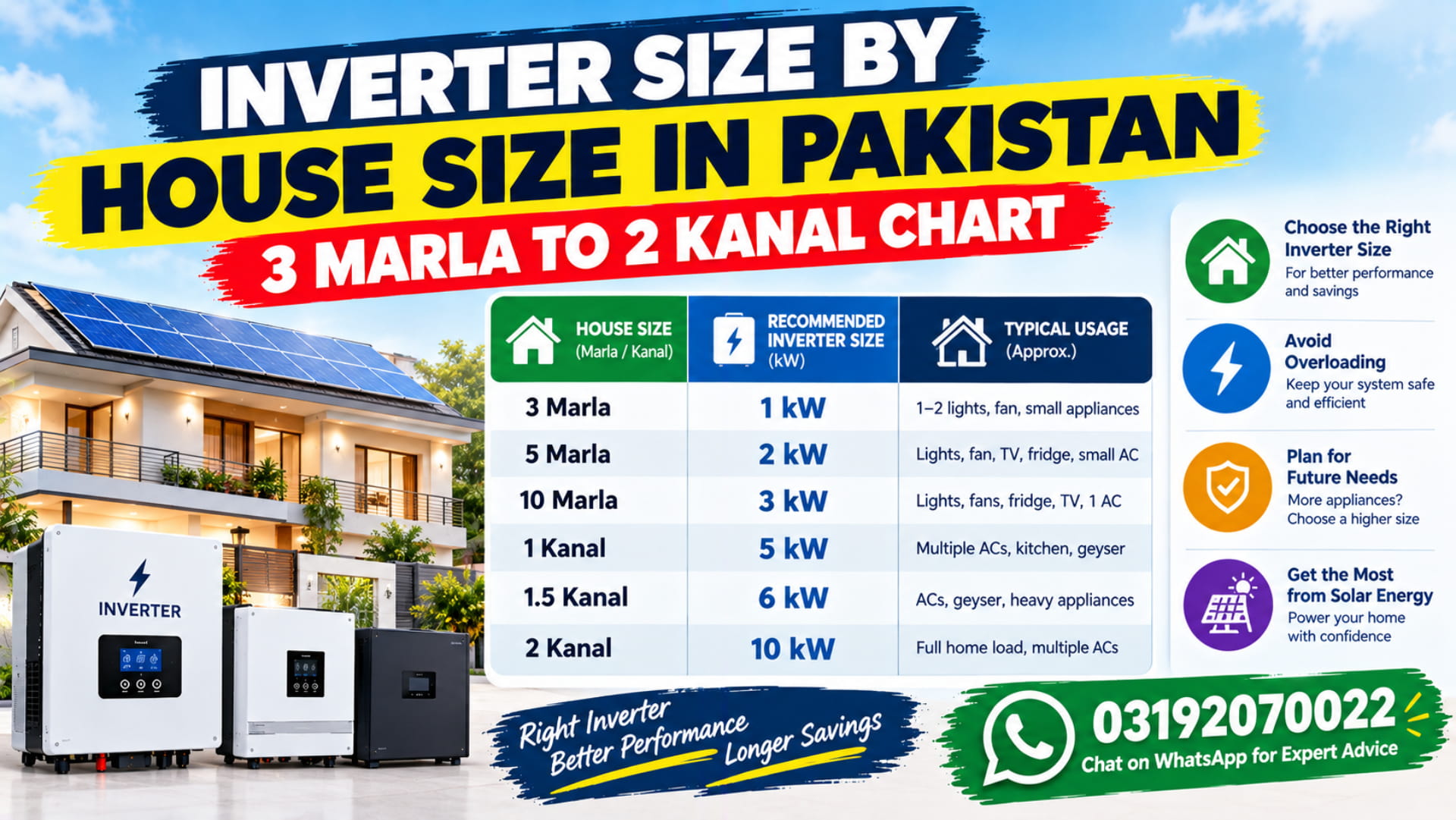
If you have ever typed “what size inverter do I need for a 10 marla house” into Google late at night with a loadshedding schedule staring you in the face, you already know the problem. Every dealer gives you a different number, every WhatsApp group has a different opinion, and the YouTube comments are split roughly three ways. Plot size is the first thing most buyers mention when they call a shop, because it is the one number everyone already knows off the top of their head — but plot size by itself is only a rough starting point, not a final answer.
This post exists to give you that starting point in one place: a single chart that runs from a 3 marla flat all the way up to a 2 kanal house, with a realistic range of AC counts and inverter capacities for each. It is a hub page, not a deep dive — for each plot size we link out to a dedicated, fully worked guide on this site that walks through the actual appliance math for that house. Think of this page as the index card you pin to the fridge, and the linked posts as the chapters.
Before the chart, two honest caveats. First, “marla” and “kanal” measure land area, not electricity consumption. A 10 marla house with four window ACs, a geyser, and a deep freezer draws a lot more power than a 10 marla house with two split ACs and careful usage. Second, these numbers are general guidance based on typical construction patterns across Punjab and the rest of Pakistan — covered area, room count, and appliance habits vary enough from house to house that your real number could sit a size bracket above or below what the chart shows. Use it to narrow the field, then confirm with the room-by-room method or a quick call.
As always, for the latest price on any battery to go with your system, WhatsApp us now for the latest price of the battery at 03192070022 — we will not quote a battery price here because battery rates move with the rupee almost weekly, and we would rather give you today’s number than yesterday’s.
A Quick Refresher: How Big Is a Marla, Really?
Since the whole chart below is organized by plot size, it helps to be precise about what a marla and a kanal actually are. In Pakistan, the commonly used (British-era) definition is 1 marla equals 272.25 square feet, or roughly 30.25 square yards, and 1 kanal equals 20 marla — so a kanal works out to roughly 5,445 square feet. Some older land records, especially outside Punjab, use slightly different regional definitions, and registry documents occasionally round these figures differently, so if you are buying or selling land the exact figure on your registry/fard matters more than the general rule quoted here. For the purpose of sizing an inverter, though, the standard conversion above is close enough for every house size discussed in this post.
What matters more than the raw square footage is covered area — a 10 marla plot with a double-story house and a basement has a very different appliance load than a 10 marla plot with a single-story bungalow and a lawn. Keep that in mind as you read the chart.
The Chart: Inverter Size by Plot Size (3 Marla to 2 Kanal)
Here is the summary. Each row assumes a typical Pakistani household: standard lighting and fans throughout, a refrigerator, a TV and router, a washing machine, and the AC count shown — with backup expected to cover most of the house during loadshedding, not necessarily every single AC running at once off-grid.
| Plot Size | Typical Covered Area | Common AC Count | Recommended Inverter Capacity | Notes |
|---|---|---|---|---|
| 3 Marla | ~700–900 sq ft | 0–1 (often a single bedroom unit) | 1kW – 3.6kW | Small household load; many 3 marla homes skip a dedicated hybrid system and use a basic UPS-style inverter |
| 5 Marla | ~1,000–1,300 sq ft | 1 | 3.6kW – 5kW | The most common starter-home bracket in Pakistan; see the dedicated breakdown below |
| 7 Marla | ~1,400–1,700 sq ft | 1–2 | 5kW | Transitional size; treat as the low end of the 10 marla range if you run two ACs |
| 10 Marla | ~2,200–2,700 sq ft | 2–3 | 5kW – 6kW | The single most-searched house size for inverter sizing in Pakistan; full guide linked below |
| 1 Kanal | ~4,500–5,500 sq ft | 3–5 | 6kW – 12kW | Wide range because 1 kanal households vary enormously in AC count and lifestyle load |
| 2 Kanal | ~9,000–11,000 sq ft | 5–8+ | 12kW, or two parallel units | Often needs either a single large hybrid unit or two inverters working together — not always a bigger single box |
A few things to notice in that table. The jump from 5 marla to 10 marla roughly doubles covered area but usually does not double the inverter size one-for-one, because fixed loads like lighting, fans, the fridge, and the router do not scale linearly with house size — it is almost entirely the AC count that drives the jump in inverter capacity. The same logic explains why 1 kanal has such a wide range: a 1 kanal house with three ACs behaves electrically a lot like the top end of the 10 marla bracket, while a 1 kanal house with five ACs and a home theater setup can easily need the same 12kW capacity as a 2 kanal house.
Why Your House Might Not Fit Its Own Row
If you read that chart and thought “but my 10 marla house only has one AC” or “my 5 marla house has two ACs because we added a room,” you are exactly the reader this section is for. The chart gives you the median case for each plot size, but real households spread across a wide range around that median, for reasons like these:
Number and tonnage of ACs matters more than anything else. One 1.5 ton split AC pulls meaningfully less startup and running current than a 2 ton unit, and a house with three 1 ton window ACs can sometimes need less inverter capacity than a house with a single large ducted system. If AC count and tonnage are the deciding factor in your case — which they usually are — the most reliable way to size correctly is to add up the actual appliances in your home rather than relying on plot size alone.
Backup hours expected during loadshedding change the picture too, mostly on the battery side rather than the inverter capacity itself — a house that wants eight hours of night backup needs a much larger battery bank than one that wants two hours, even if the inverter size stays the same.
Future plans matter. If you are building a 5 marla house today but plan to add a second floor or a second AC within a couple of years, sizing slightly above today’s chart row is usually cheaper than buying twice.
Whether the house also has solar panels or is backup-only changes the calculation again, because a hybrid inverter running under net metering or net billing is sized partly around how much solar you can physically fit on the roof, not only around your appliance load.
For the most accurate number for your specific case, the room-by-room method beats any plot-size chart, including this one — our guide on how to calculate your exact inverter size room by room walks through listing every appliance in your house with its wattage and adding up the real total, which is the only way to get a number you can be fully confident in.
3 to 5 Marla: The Starter-Home Bracket
Most 3 to 5 marla homes in Pakistan are single-story, with one to two bedrooms, a drawing room, and a kitchen. The electrical load here is usually modest: lights and fans throughout, a fridge, a TV, a washing machine, and in most cases a single AC in the main bedroom. This is the bracket where a 3.6kW inverter is genuinely enough for a large share of households, and where going straight to a 6kW unit is often unnecessary spending unless you specifically plan to add a second AC or run a home-based business with extra equipment.
Because 5 marla is such a common plot size for new construction across Lahore, Faisalabad, Multan, and similar cities, we have a full cost and sizing breakdown specifically for this bracket — see our 5 marla solar system sizing and cost guide for the complete walkthrough, including how panel count and battery bank size change depending on whether you want a backup-only setup or a full solar system with net billing.
If you are deciding between 3.6kW, 5kW, and 6kW for a small-to-mid house and want the tonnage math laid out side by side rather than folded into a single plot-size post, we also have a dedicated comparison of those three capacities elsewhere on this site that goes deeper into the tonnage math behind that specific decision.
7 to 10 Marla: The Most-Searched Bracket
Ten marla is, by search volume alone, the single most common house size people ask us about — it is the standard “family home” size for a huge share of middle-class construction in Pakistani cities, typically with two to three bedrooms, two to three ACs, and a slightly heavier appliance load than the 5 marla bracket (a deep freezer or a larger water pump are both common additions at this size). Most 10 marla homes land comfortably in the 5kW to 6kW inverter range, with the exact number depending heavily on AC count and tonnage, exactly as described above.
We have a dedicated, fully worked guide for this exact plot size — see our complete 10 marla house inverter sizing guide for the appliance-by-appliance math, typical battery bank sizes for different backup durations, and guidance on when a 10 marla home genuinely needs to jump up to 6kW rather than staying at 5kW.
A 7 marla house sits between the 5 marla and 10 marla brackets and does not usually get its own dedicated post on most sites, including this one, simply because it behaves like whichever neighbor it is closer to in AC count — if you have one AC, read the 5 marla content above; if you have two, read the 10 marla guide instead and treat your inverter number as the lower end of that range.
1 Kanal: Where the Range Gets Wide
A 1 kanal house is where plot size alone stops telling you much on its own, because 1 kanal construction in Pakistan varies hugely — some 1 kanal homes are modest single-story bungalows with three ACs, while others are large double-story houses with a basement, a servant quarter, and five or six ACs plus a home theater and a swimming pool pump. That range is exactly why the chart above shows 6kW to 12kW rather than a single number for this bracket.
Because the spread is so wide, this is the plot size where we most strongly recommend reading the full appliance breakdown rather than picking a number off a chart. Our dedicated 1 kanal house inverter guide covers both ends of that range — the lighter-load 6kW case and the heavier-load 12kW case — so you can see which description matches your actual household before you buy. WhatsApp us now for the latest price of the battery at 03192070022 if you want to talk through your specific 1 kanal appliance list before deciding.
2 Kanal and Above: One Big Unit, or Two Working Together
Once you cross into 2 kanal territory, you are usually looking at a house large enough that a single inverter — even a large one — is not automatically the right answer. Many 2 kanal homes with five or more ACs, multiple water pumps, and heavier lighting loads either need a single 12kW hybrid unit running close to its limit, or two inverters working in parallel so that each one carries a share of the load with some headroom to spare. Running a single unit flat-out at its rated capacity for hours at a time, every single day, is harder on the equipment and leaves you with no margin if you add even one more appliance later.
Before assuming you need the biggest unit available, it is worth checking whether your actual load justifies it — our post on who actually needs a 12kW inverter (and who is overpaying for one) is written specifically for large-house buyers trying to tell the difference between genuine need and oversized spending, and it is just as relevant to a 2 kanal buyer deciding between one big unit and two smaller ones in parallel.
Matching the Battery Bank to Your Plot-Size Bracket
Inverter capacity and battery capacity are two separate decisions, and this chart only addresses the first one. Inverter size is about how much load you can run at once; battery size is about how long you can run it without grid power. A 5 marla house and a 1 kanal house could both be paired with the same battery bank if the smaller house wants long backup hours and the larger house only wants to get through short loadshedding windows — plot size pushes inverter capacity up, but it does not automatically push battery size up by the same ratio.
Because battery pricing changes frequently with the exchange rate and import costs, we never quote a fixed number for this in writing — WhatsApp us now for the latest price of the battery at 03192070022 and we will walk you through the right battery size for your specific plot size, AC count, and desired backup hours, with today’s actual numbers rather than a figure that might already be out of date by the time you read it.
How to Use This Chart Without Overspending or Undersizing
Start with your plot size and find your row in the chart above — that gives you a reasonable capacity range to aim for. Then count your actual ACs and their tonnage, since that single factor moves you up or down within your row’s range more than anything else. If you are near the boundary between two rows, lean toward the larger size if you plan to add an AC or a room within the next two to three years, since resizing later always costs more than sizing correctly the first time. Finally, read the dedicated post linked for your plot size above, because it will walk through the appliance math specifically, rather than relying on the general pattern in this summary chart.
If after all that you are still unsure which bracket your house actually falls into, that is exactly the kind of question worth a two-minute WhatsApp conversation rather than another hour of searching — WhatsApp us now for the latest price of the battery at 03192070022, and we can also confirm the right inverter capacity for your plot size and appliance list while we’re at it.
Buy Inverter Shop premium inverters in Pakistan. High-performance home and industrial inverters with ISO certification, nationwide delivery — whichever bracket your house falls into on the chart above, we carry options across the 1kW to 12kW range and can help you land on the right one rather than the biggest one.
Not automatically — a large house with few ACs can need less inverter capacity than a smaller house with several ACs, since appliance load (especially AC count and tonnage) matters more than raw square footage.
Most 10 marla homes with two ACs comfortably fit the 5kW bracket, though a third AC or a heavier appliance load can push that up to 6kW — see our full 10 marla guide linked above for the exact math.
No — 1 kanal houses range widely from 6kW to 12kW depending on AC count and overall load, which is why this plot size has the widest range in the chart above.
It depends on total load — many 2 kanal homes are better served by two inverters working in parallel than by pushing one large unit to its limit every day, especially with five or more ACs.
The room-by-room appliance calculation gives the most accurate figure for your specific house, and our team is also available on WhatsApp at 03192070022 to walk through your appliance list and confirm the right size and battery capacity together.