
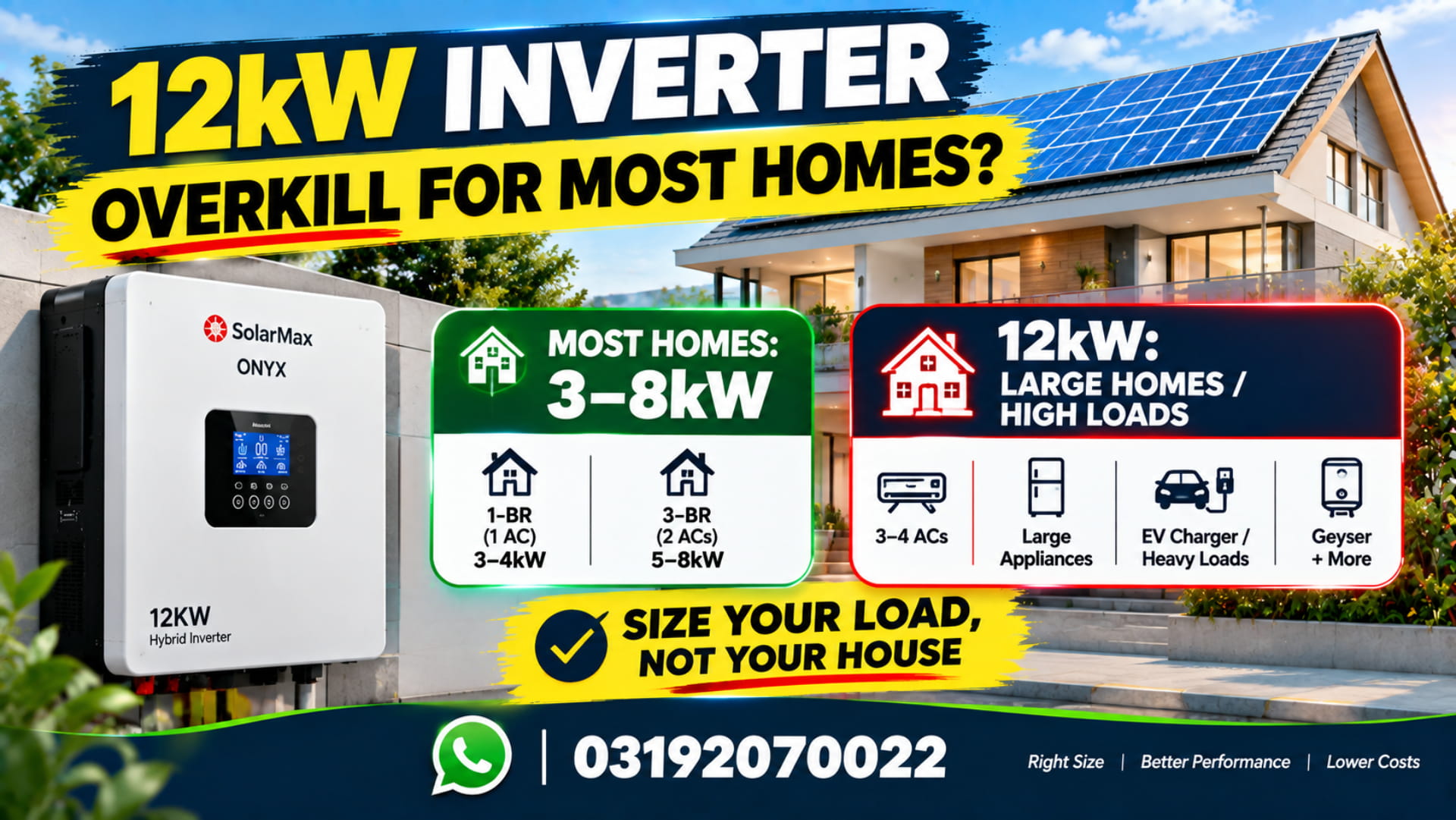
Every month we get buyers walking in asking for a 12kW inverter because a neighbour has one, or because “bigger means safer.” Most of them leave with something smaller, at a lower price, that does exactly what their house needs. A genuine minority leave with the 12kW, because their load actually calls for it.
This is the honest version of that conversation: where 12kW is clearly too much, where it is exactly right, and how to tell which side you are on before you spend the difference.
For a sizing recommendation specific to your load, WhatsApp 03192070022.
What 12kW Actually Means in Practice
A 12kW inverter is built to handle a continuous running load in the range of 9,000W to 11,000W comfortably, with surge headroom above that for motor startups. That is a genuinely large number. For context, a well-equipped 10-marla home running two air conditioners, a full kitchen, lighting throughout and a water pump typically runs 4,000W to 5,500W, less than half of a 12kW unit’s comfortable operating range.
Most residential buyers asking about 12kW are not actually approaching that load. They are either significantly overestimating their own consumption, or they are planning for a future that may never fully materialise. Neither is a reason to avoid the conversation, but both are reasons to run the numbers honestly before buying.
Why 12kW Is Overkill for Most Homes
The load simply is not there
Run the math on a typical Pakistani household, even a large one, and it is hard to reach 9,000W of simultaneous running load without deliberately trying. Three ACs running together, a full kitchen with an electric oven, a washing machine, a water pump and complete lighting still tends to land between 6,000W and 8,000W for most homes, comfortably inside 6kW to 8kW capacity rather than 12kW. For the full room-by-room method to find your own number rather than guessing, see our room-by-room load calculation guide.
You pay for capacity you will not use
The price difference between a 6kW hybrid and a 12kW unit typically runs into several hundred thousand rupees once panels and battery capacity are scaled to match, since a 12kW inverter is usually paired with a correspondingly larger PV array and battery bank to make financial sense. If your actual load sits at 5,000W, that difference buys nothing you will ever draw on.
Three-phase complexity you may not need
Most 12kW and above inverters are built for three-phase output, which is the correct architecture for balancing heavy motor loads across phases but adds genuine installation complexity most single-phase residential properties do not have the wiring to support without additional electrical work. Confirm your property even has three-phase supply available before sizing around a three-phase inverter; retrofitting it is its own separate cost.
Efficiency does not scale down cleanly
Inverters generally run most efficiently somewhere in the middle of their rated capacity, not at a small fraction of it. A 12kW unit running a 2,500W household load most of the day is operating well below its efficient zone, which is not dangerous but is simply paying for headroom that sits idle almost all the time.
The battery bank has to scale with it
A 12kW inverter paired with an undersized battery bank defeats much of the purpose of buying that capacity in the first place. Matching battery storage to a 12kW system properly means a meaningfully larger investment than matching it to a 6kW system, and that cost compounds the mismatch if the inverter was oversized to begin with.
Who Actually Needs 12kW
Large commercial and semi-commercial properties
Retail outlets with heavy refrigeration, workshops running multiple machines, clinics with imaging or lab equipment, and small manufacturing units routinely draw loads in the 8,000W to 12,000W range or beyond, where 12kW is not oversized at all but the correct, sometimes minimum, starting point. Our full 12kW hybrid inverter price in Pakistan guide covers this exact capacity class in detail, including the single-phase versus three-phase decision at this scale.
Large residential properties with genuinely heavy load
A large farmhouse or villa running four or more ACs simultaneously, a swimming pool pump, extensive lighting, a home theatre setup and a full kitchen with electric appliances can legitimately reach 12kW territory. This is a real but relatively uncommon residential profile, not the typical household asking about this capacity.
Properties planning genuine future expansion with a concrete timeline
A household actively building an additional floor, with architectural plans and a realistic one to two year timeline, may reasonably size up now rather than replacing the inverter again shortly after expansion. This is different from a vague “we might extend someday” justification, which rarely holds up as a sound financial reason to buy three to four times the capacity you currently need.
Properties combining heavy backup with net metering ambitions
A household wanting both substantial battery backup for extended outages and a large enough solar array to meaningfully offset a high electricity bill through net metering sometimes lands near 12kW once both goals are sized together, particularly in southern Punjab or interior Sindh where outages run longer and bills run higher. Our solar inverter price in Pakistan overview covers how on-grid and hybrid sizing interact with net metering goals across every capacity class.
Properties with a water-intensive agricultural load
A tube well running a large motor alongside household load, common on farms in interior Sindh and southern Punjab, can genuinely push combined running and surge requirements into this range, particularly where the motor itself draws several kilowatts on its own.
Cost Comparison: What the Jump From 6kW to 12kW Actually Costs
| Component | 6kW System (Approx.) | 12kW System (Approx.) |
|---|---|---|
| Inverter only | 116,000 – 285,000 | 300,000 – 520,000 |
| Panel array to match | 10–14 panels | 20–28 panels |
| Battery bank (moderate backup) | Smaller bank, lower cost | Roughly double the capacity, cost scales accordingly |
| Installation and wiring | Standard single-phase | Often three-phase, more labour and materials |
The inverter itself is only the most visible line item. Panels, battery bank and installation complexity all scale with it, which is why the real cost gap between 6kW and 12kW is considerably larger than the inverter price difference alone suggests. For a household whose actual load sits at 5,000W to 6,000W, that full-system gap is money spent on headroom rather than capability, and it is worth seeing the complete picture before committing to the larger number. Our best inverter for home in Pakistan guide lists specific models across the capacity range if you want to compare options once you have settled on the right size.
How to Tell Which Side You Are On
Run your actual room-by-room load, honestly, including what realistically operates at the same time rather than everything you own added together. If that total sits comfortably under 6,000W, 12kW is not serving a real purpose for you regardless of how it feels as a round, reassuring number. If it genuinely approaches or exceeds 8,000W to 9,000W, the conversation about 12kW becomes legitimate, and the right next step is sizing panels and battery storage to match rather than buying the inverter alone and hoping the rest works itself out.
For households sitting in between, typically 6,000W to 8,000W, an 8kW to 10kW unit is often the better-matched answer, avoiding both the undersizing risk of a smaller unit and the wasted capacity of jumping straight to 12kW. Our 3.6kW vs 5kW vs 6kW comparison walks through the smaller end of this decision in the same detail, if your household load turns out to sit well below the 12kW conversation entirely once you do the math.
It helps to separate two different questions that often get merged into one. “What capacity handles my load” is a straightforward calculation. “What capacity gives me peace of mind” is a different, more personal question, and it is fine to pay a premium for that peace of mind deliberately, with eyes open about the cost, rather than backing into an oversized system because a round number felt reassuring during a single conversation at a dealer’s counter.
What We Tell Buyers Who Ask for 12kW by Default
We ask three questions before recommending it. What is your actual simultaneous running load, calculated room by room rather than estimated? Does your property have three-phase supply, or would that need to be arranged separately? And is the extra cost, inverter, panels and battery bank together, funding capacity you have a concrete plan to use within a reasonable timeframe, or a number that simply sounds appropriately serious for a significant purchase?
Most households answer those three questions and land on 6kW or 8kW instead. A genuine minority answer them and confirm 12kW is correct. Both outcomes are fine. What we try to avoid is a buyer spending several hundred thousand extra rupees on a number that felt safe rather than one the math actually supports, and we would rather lose that margin on a single sale than sell capacity someone does not need and have them regret it a year later. On battery pricing specifically at whichever capacity you land on, rates shift too often to publish reliably here, so WhatsApp us now for the latest price of the battery at 03192070022.
For most Pakistani homes, yes. Typical household running loads, even in larger houses with two or three ACs, usually sit between 4,000W and 7,000W, well under a 12kW inverter’s comfortable operating range.
Large villas or farmhouses running four or more ACs simultaneously, properties combining heavy backup with large net-metering ambitions, or agricultural properties running a large tube well motor alongside household load.
Not in terms of safety or reliability. The cost is purely financial: a higher upfront price for the inverter, panels and battery bank, with capacity that goes largely unused.
Most are, since three-phase handles heavy motor loads more efficiently at this scale. Confirm your property has three-phase supply available before committing, as adding it where it does not exist is a separate cost.
Most households land on 5kW to 6kW. Larger homes with heavier simultaneous load often fit 8kW to 10kW. Run your actual room-by-room load first rather than picking a capacity by feel.