
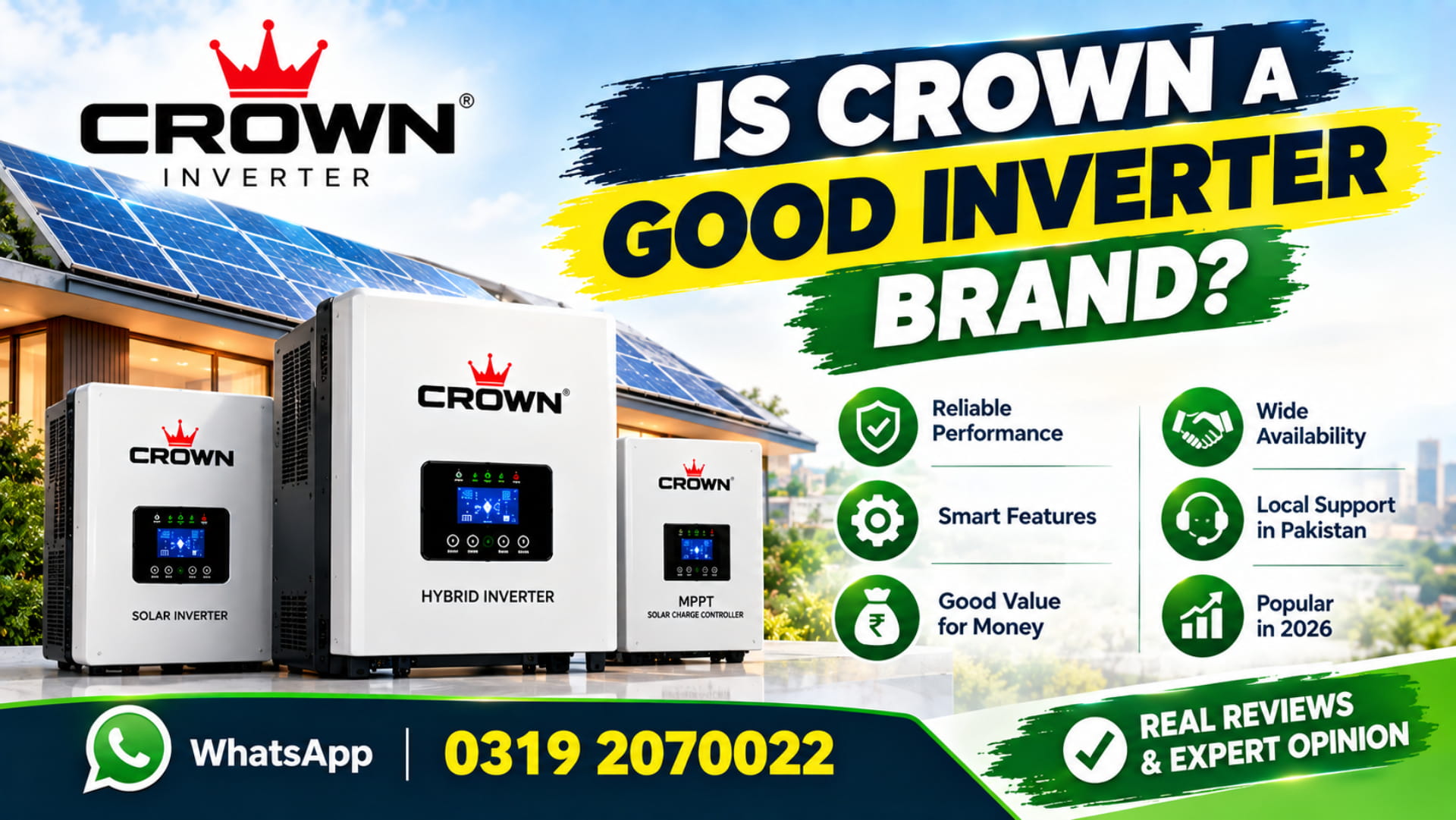
Search this question and you will mostly find two kinds of pages: dealer listings dressed up as reviews, and forum threads where one bad installation gets generalised into “Crown is junk.” Neither is a fair answer, and neither is what you actually came here for.
We stock and sell Crown inverters at Buy Inverter alongside several other brands, so this is not a page written to talk you into one name over another. It is a straight answer, including the parts of Crown’s lineup we would steer certain buyers away from.
For a recommendation matched to your actual situation rather than a general brand opinion, WhatsApp 03192070022.
The Short Answer
Yes, Crown is a good inverter brand, for most Pakistani households, with real caveats worth knowing before you buy.
Crown has become one of the highest-volume inverter brands sold in Pakistan over the last two to three years, and that growth is not purely a marketing story. The Yorker, Xavier, Elego and Nexus tiers cover budget indoor units through fully sealed IP66 outdoor hybrids, at prices that consistently undercut Inverex, Knox and the premium imported names by 15% to 30% at equivalent specification. Dual MPPT, lithium BMS communication and 200% PV oversizing, features that used to be premium-only, are now available across most of Crown’s range rather than locked to a flagship model.
The honest limitation is service network depth outside the major cities, and firmware and app polish that lags behind Inverex and the premium Chinese and European names. Neither of those is a hardware defect. Both are things you should ask about before you buy, and both matter more in some situations than others.
What Crown Actually Gets Right
Genuine dual MPPT and high input current across most of the range
Even Crown’s mid-tier units commonly ship with dual MPPT trackers rated at 18A input current, which matters more than it sounds. A single-tracker inverter forces your whole panel array to match whatever your worst-shaded string is producing. Dual MPPT lets you split east and west-facing roof sections, or a shaded area against a clear one, and track them independently. The 18A rating also matters for modern panels: older 12A-class trackers bottleneck with today’s 580W to 620W modules, so buying below 18A on a new installation is buying a limitation you did not need.
Lithium-ready BMS communication, not voltage guessing
Cheaper inverters across the market estimate battery state of charge from voltage alone, which works reasonably with lead-acid but badly with lithium, whose voltage curve stays almost flat across most of its usable range. Crown’s mainstream range communicates directly with LiFePO4 battery management systems rather than guessing, so if lithium is anywhere in your future plans, the inverter is already ready for it. On what a compatible battery actually costs today, WhatsApp us now for the latest price of the battery at 03192070022 rather than trusting a number printed on any page, ours included.
A genuine IP66 line at a price nobody else matches
The Crown Nexus is fully sealed against dust ingress and heavy water jets, at a price that undercuts the closest IP66-rated competitor from Knox and beats every IP65 unit from Inverex on protection level while often costing less. In a country where dust building up in an inverter’s heat sink is the single most common cause of premature failure, that seal is not a cosmetic feature. For an outdoor-mounted installation in Multan, interior Sindh or coastal Karachi, it is arguably the single most consequential spec on the sheet.
200% PV oversizing on most hybrid models
Crown’s hybrid range generally supports panel arrays up to double the inverter’s rated output. That headroom is what keeps a system producing usable power through Punjab’s foggy December and January rather than collapsing to a trickle for three months of the year, while the inverter simply clips the excess on a clear June afternoon.
Real price-to-feature value
This is Crown’s actual reputation in the market, and it is earned rather than assumed. At almost every capacity we sell, from 3kW residential units to 12kW hybrids, a Crown model with comparable MPPT count, input current and battery support costs meaningfully less than the equivalent Inverex, Knox or Solis unit. For a buyer whose primary constraint is budget without wanting to compromise on the core electronics, that gap is the whole reason Crown has grown the way it has.
Dual output for load prioritisation
Most of Crown’s hybrid range splits circuits into essential and non-essential loads, so during an outage the inverter can drop air conditioners and keep fans, lights, the fridge and your router running on battery. This is a feature that sounds minor on a spec sheet and changes the entire daily experience of owning a backup system.
Where Crown Falls Short
Service network depth outside major cities
This is Crown’s most consistent honest weakness. Inverex, in particular, has built a broader network of authorised service points reaching into secondary cities and smaller towns. If your installation sits well outside Lahore, Karachi, Islamabad, Faisalabad or Multan, and a warranty claim would mean a long wait for a technician or shipping the unit back to a major city, that is a real cost worth weighing against Crown’s price advantage. Our Crown vs Inverex comparison goes deeper on exactly where this trade-off bites.
Firmware and monitoring app polish
Crown’s remote monitoring and app experience is functional rather than refined. If you specifically want detailed real-time generation graphs, granular historical data and a slick interface, Huawei and to a lesser extent Solis do this better. Most buyers check the app occasionally rather than living in it, so this matters far less than the spec sheet differences above, but it is a genuine gap.
Warranty terms trail the premium names
Crown’s standard warranty typically runs one to three years depending on the specific model and dealer, shorter than the five-year terms Inverex and Knox commonly offer on their flagship lines. This is consistent with the pricing gap rather than a red flag on its own, but confirm the exact term in writing before you buy, since it varies by model.
Counterfeit and rebadged units in the market
Crown’s popularity has made it a target for counterfeiting and grey-market rebadging, more so than some less commonly sold brands. Every genuine unit carries a traceable model code that matches Crown’s official listings. Buying from an unauthorised, unusually cheap source is where this risk concentrates, not from the brand’s actual manufacturing.
Crown Against Its Two Closest Rivals
| Factor | Crown | Inverex | Knox |
|---|---|---|---|
| Typical price at equal spec | Lowest | 10–25% above Crown | Close to Crown, varies more |
| Best IP rating available | IP66 (Nexus) | IP65 (Nitrox) | IP66 (Xenon) |
| Service network breadth | Weakest of the three | Strongest | Harder to verify independently |
| Typical flagship warranty | 1–3 years | Up to 5 years | Often 5 years on Xenon line |
| Firmware and app polish | Functional | Good | Comparable to Crown |
Neither rival beats Crown outright. Inverex trades price for service reach. Knox roughly matches Crown’s protection ceiling while carrying a longer warranty on its top line, at pricing that is less predictable across retailers. Our Crown vs Knox inverter guide covers that comparison model by model, and the full best inverter brand in Pakistan 2026 ranking places all three, plus the rest of the market, side by side.
Which Crown Model Actually Fits You
Crown is not one product, and “is Crown good” really depends on which tier you are asking about.
Indoor, budget-conscious, no cooling load beyond fans and lights. The Yorker tier is Crown’s entry point and does this job well at the lowest price in the range.
Indoor, one or two air conditioners, want dual MPPT and lithium support without paying for sealing you do not need. The Xavier tier is the sweet spot for most Pakistani households and is genuinely one of the better value picks in the entire market at this capacity.
Outdoor mounting, dust, coastal humidity, or no sensible indoor location. The Nexus tier’s IP66 sealing earns its premium here and is close to unmatched at its price point.
A specific capacity question, such as 6kW. Our 6kW solar inverter price in Pakistan guide breaks down Crown against every other brand at that exact size.
Who Should Choose a Different Brand
If your installation sits far from a major city and a fast warranty response matters more to you than saving 15% to 20% upfront, Inverex’s broader service network is worth the premium. If you specifically want the longest warranty term available at a competitive price and can independently verify your local dealer’s service claims, Knox’s Xenon line is a fair alternative. If firmware polish and monitoring detail genuinely matter to you and budget is not the binding constraint, Huawei sits above all three.
None of that makes Crown a bad brand. It makes Crown the wrong fit for a specific priority, which is a different thing.
Buying Crown the Right Way
Verify the model code against Crown’s official specifications before paying, particularly on unusually cheap listings.
Ask where your nearest authorised service point actually is, by name, before you buy rather than after something fails.
Get the warranty term in writing, since it varies by model and dealer rather than being fixed brand-wide.
Confirm the IP rating matches your mounting location. An indoor Yorker or Xavier does not belong on an exterior wall, and an outdoor Nexus is overpaying if it will only ever live in a clean utility room.
Insist on correct earthing and surge protection at installation. Grid spikes, not manufacturing defects, are the leading cause of inverter failure we see reported across every brand in this market, Crown included.
The full range we currently stock, with specifications and current pricing, is available on request, and more brand and capacity comparisons are published across our other guides on this topic.
Yes, when the correct model is matched to its intended environment and installed with proper earthing. Crown’s lower price reflects a leaner service network and less firmware polish, not weaker core hardware.
Crown generally wins on price and, on its Nexus line, on IP rating. Inverex generally wins on service network breadth and warranty length. Neither is universally better; it depends on your location and priorities.
Yes, the Nexus line reaches IP66, suitable for outdoor mounting in dust and heavy rain.
Most of Crown’s mainstream range communicates with lithium battery management systems rather than estimating charge from voltage alone. Confirm the specific model supports your battery chemistry before buying.
Generally yes for indoor installations in or near a major city, where Crown’s price advantage carries little downside. Confirm local service support first if you are further afield.
Talk to Us Before You Decide
Tell us your budget, your city, and whether the inverter will sit indoors or outdoors, and we will tell you honestly whether a Crown model fits or whether a different brand serves you better. We sell both, and margin is not the basis for the recommendation.
WhatsApp 03192070022 for today’s rates and a straight recommendation for your situation.
This assessment reflects market positioning, published specifications and dealer feedback as of September 2026. Confirm current pricing and warranty terms with your dealer before ordering.